
• Link to LinkedIn
  • Link to Youtube
  • Link to Facebook
  • Link to Instagram
  • Link to X
  • Link to Telegram
  • Link to Behance
  • Link to Rss this site
  • Link to Mail
  • NEWS
  • EVENTS
  • JOBS
  • MEMBER
  • Sitemap
    • Home
      • NEWS
      • EVENTS
      • JOBS
      • MEMBERSHIP
    • ⭐ About Geodesy
    • 🏛️ IAG | International Association of Geodesy
      • About IAG
      • Structure
      • 🎓 ECS – Early Career Scientists
      • 🌈 IDEA – Inclusion, Diversity, Equity, Accessibility
    •   └─ Comissions
      • 1️⃣ Reference Frames
      • 2️⃣ Gravity Field
      • 3️⃣ Earth Rotation & Geodynamics
      • 4️⃣ Positioning & Applications
    •   └─ Inter Commission Committees
      • 📚 ICCT – Theory
      • 🌊 ICCM – Marine Research
      • 🌥️ ICCC – Climate Research
    •   └─ Project QuGe
    •   └─ Services
    • 🌍 GGOS | Global Geodetic Observing System
      • About GGOS
      • Structure
      • 🛰️ Observations
      • 📦 Products
      • ⚙️ Services
  • Shopping Cart Shopping Cart
    0Shopping Cart
geodesy.science - IAG website
  • News
    • Home
      • NEWS
      • EVENTS
      • JOBS
      • MEMBERSHIP
    • ⭐ About Geodesy
    • 🏛️ IAG | International Association of Geodesy
      • About IAG
      • Structure
      • 🎓 ECS – Early Career Scientists
      • 🌈 IDEA – Inclusion, Diversity, Equity, Accessibility
    •   └─ Comissions
      • 1️⃣ Reference Frames
      • 2️⃣ Gravity Field
      • 3️⃣ Earth Rotation & Geodynamics
      • 4️⃣ Positioning & Applications
    •   └─ Inter Commission Committees
      • 📚 ICCT – Theory
      • 🌊 ICCM – Marine Research
      • 🌥️ ICCC – Climate Research
    •   └─ Project QuGe
    •   └─ Services
    • 🌍 GGOS | Global Geodetic Observing System
      • About GGOS
      • Structure
      • 🛰️ Observations
      • 📦 Products
      • ⚙️ Services
  • News
    • ALL News
    • 📰 General News
    • 🌍 Geodesy News
    • 📅 Event Update
    • 🏛️ Organisation News
  • Mailing List
  • IAG Newsletter
  • Social Media
  • Post Your News
  • Click to open the search input field Click to open the search input field Search
You are here: Home1 / GGOS2 / Book Review – Mission Earth
© Springer - Angermann et.al.

Book Review – Mission Earth

GGOS, IAG, 📰 General News

Geodynamics and Climate Change Observed Through Satellite Geodesy
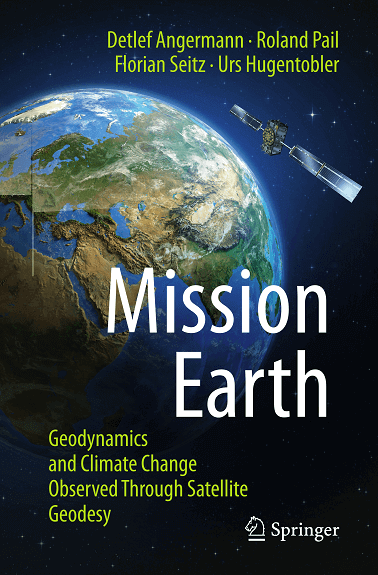


Detlef Angermann, Roland Pail, Florian Seitz and Urs Hugentobler

With interview contributions by Günter Hein, Harald Lesch and Stefan Rahmstorf

Springer-Verlag Berlin Heidelberg, 2022

ISBN 978-3-662-64105-7

ISBN 978-3-662-64106-4 (eBook)

Mission Earth


How does your cell phone know where you are right now? How is our planet changing due to geodynamic processes and ongoing climate change? How can these changes be precisely measured from space? Such questions are highly relevant for our society – and are answered by geodesy. The central mission of the author’s team led by Dr. Detlef Angermann at the Technical University of Munich is to illustrate and explain precisely this. Thus, proven experts of global geodesy have come together to present their profound knowledge accurately, factually correct and, above all, easily accessible.

To understand the explanations, one does not need a degree in geodesy and certainly not a corresponding specialization. The book is explicitly written “for the curious“. Formulas and derivations – unfortunately very often an argument against an in-depth study of the subject – are not found. Rather, our planet Earth with its complex dynamics is the focus of interest – and with it the current achievements and future possibilities of geodesy to contribute to a better understanding.

The book is divided into a total of five chapters. In a short introduction, the Earth is presented according to the modern view of systems theory as a dynamic planet, which consists of complex, interacting subsystems such as solid Earth, atmosphere, oceans or ice and which is subject to manifold changes. Climate change is already emphasized in the introduction as an example that is particularly visible to society. The chapter closes with the global view of geodesy on the Earth – illustrated by the three “basic pillars”: geometry and kinematics, orientation and rotation, gravitational field. This clarifies the focus of the book and distinguishes it from an overall view of the geodetic portfolio.

Chapter 2 deals with the historical development of geodesy with regard to questions, tasks and methods from the first surveys in antiquity to the age of satellites. This storyline continues in Chapter 3 to describe and explain the approaches, tools, and contributions of global geodesy in the 21st century comprehensively, but – following the objective and the page size – not exhaustively. In Chapter 4, the focus of the considerations is put on the Earth system with the phenomena of global change. This emphasizes that the self-understanding of geodesy is not limited to a rather technological level. Dynamic processes of the solid Earth body, sea level changes or mass displacements in connection with the global water balance due to, e.g., ice melting in the polar region, are treated in detail. Essential statements about these changes, which affect us to a large extent in our everyday lives, are based on the fundamental findings of geodesy.

Already the preceding chapters are excellently written and extremely exciting to read. Finally, this is further enhanced in Chapter 5 by three interviews with renowned experts who are also known to the broader public. The content of this chapter is based on the societal relevance of the highly precise measuring of our planet from space. Prof. G. Hein, who played a key role in shaping the European satellite navigation system Galileo, looks at the importance of navigation systems in modern society. Prof. H. Lesch, known to a wider German audience through his science broadcasts, takes a holistic look at the Earth system. Prof. S. Rahmstorf, one of the lead authors of the Intergovernmental Panel on Climate Change’s Fourth Assessment Report and an advisor to the German government, focuses on climate change and the threats it poses. The book concludes with a summarizing epilogue and a series of recommended readings to deepen and expand the presentations.

With this book, the authors have succeeded in an impressive way in presenting modern geodesy – using the example of global geodesy – in a lively and descriptive manner with regard to its possibilities and achievements and in placing it in the scientific and societal context. They have more than fulfilled their self-formulated claim, especially in times of “fake news“, to “write down what we know for sure because we have measured it directly“. Congratulations!

It is very worthwhile to read the book. Therefore, this book should be widely distributed in our professional community and its neighboring fields, in order to make the relevance and multitude of the geodetic contributions known far beyond science in the narrower sense – and thus to contribute significantly to the awareness and the positive image of geodesy, also supporting the recruitment of young people for our inspiring profession.


Hansjörg Kutterer, Karlsruhe

This book review is an authorized translation of the original German “Buchbesprechung” by Hansjörg Kutterer, published in zfv – Zeitschrift für Geodäsie, Geoinformation und Landmanagement, Heft 2/2021, 146. Jahrgang, Herausgeber: DVW e.V. – Gesellschaft für Geodäsie, Geoinformation und Landmanagement, ISSN 1618-8950. The translation was done with the help of artificial intelligence (machine translation by the service DeepL.com).


Link to the “Mission Earth” Flyer

📰 Subscribe to "IAG Updates" Mailing List

Get monthly updates on 📰 News, 📅 Events & 💼 Job offers.

No spam! Unsubscribe anytime. By signing up, you agree to our terms.

Also, explore other mailing lists or follow us on social media.

Check your inbox or spam folder to confirm your subscription.

February 18, 2022
February 18, 2022
Share this entry
  • Facebook Facebook Share on Facebook
  • X-twitter X-twitter Share on X
  • Whatsapp Whatsapp Share on WhatsApp
  • Pinterest Pinterest Share on Pinterest
  • Linkedin Linkedin Share on LinkedIn
  • Mail Mail Share by Mail
https://geodesy.science/wp-content/uploads/Mission_Earth_Cover2_small_square.png 329 330 Martin Sehnal https://geodesy.science/wp-content/uploads/IAG-logo-web.png Martin Sehnal2022-02-18 09:49:072025-10-01 12:53:50Book Review – Mission Earth
📰 NEWS

└─ 📰 General News

└─ 🌍 Geodesy News

└─ 🏛️ Organisation News

└─ 📅 Event Update

📢 Latest News

  • Honorary colloquium for Prof. Torge and Prof. Seeber at Leibniz University Hannover
  • Webinar: A Synergy between EUREF and EPOS: GNSS Data Quality Monitoring Service (DQMS)
  • Geodesy Day – International Webinar on Geodesy
  • Geodetic Data: Applying FAIR, TRUST and CARE Principles
  • Geodesy Cartoons – Free Resources for Education and Outreach

✉️ Get Updates Regularly

Mailing List Subscription

Select the list(s) you'd like updates from:

No spam! Unsubscribe anytime. By signing up, you agree to our terms.

Thank you for subscribing! Please check your inbox or spam folder to confirm.

IAG as part of the IUGG

  
The International Association of Geodesy (IAG)  is a constituent association of the International Union of Geodesy and Geophysics (IUGG).

IAG Related Organisations

IAG collaborates closely with numerous organizations within geodesy and beyond. See the list for details.

Sitemap

  • Home | geodesy.science
  • ⠀└─ 📰News
  • ⠀└─ 📅 Events
  • ⠀└─ 💼 Jobs
  • ⠀└─ 👥 Membership
  • ⭐ About Geodesy
  • 🏛️ IAG | Int. Association of Geodesy
  • ⠀└─ ➡️ Commissions:
  • ⠀⠀◻️ 1 – Reference Frames
  • ⠀⠀◻️ 2 – Gravity Field
  • ⠀⠀◻️ 3 – Earth Rotation & Geodynamics
  • ⠀⠀◻️ 4 – Positioning and Applications
  • ⠀└─ 🔀 Inter Commission Committees:
  • ⠀⠀◻️ ICCT – Theory
  • ⠀⠀◻️ ICCM – Marine Research
  • ⠀⠀◻️ ICCC – Climate Research
  • ⠀└─ ⏰ Project QuGe
  • ⠀└─ ⚙️ IAG Services
  •  🌎 GGOS | Observing System
  • ⠀└─ About GGOS
  • ⠀└─ Structure
  • ⠀└─ Observations
  • ⠀└─ Products
  • ⠀└─ Services

References

Geodesy Glossary

Media Library

IAG Cloud | Public Documents

Terms of Use / Privacy Policy

IAG Statutes

IAG By-laws

Contact Us

Contact

Follow Us

LinkedIn

BlueSky

X (Twitter)

Facebook

Instagram

YouTube

Telegram

RSS Feed

Mailing List

This website is provided by the IAG Secretariat and the GGOS Coordinating Office, which are hosted by the BEV – Federal Office of Metrology and Surveying (Bundesamt für Eich- und Vermessungswesen) in Vienna, Austria.

Website Language Translation

The primary language of this website is English – however, the integrated GTranslate tool enables automatic translation into several languages:

Please note that translations into other languages may not be accurate. For reliable information, refer to the English version of the website.

2026 © Copyright | IAG - International Association of Geodesy
  • Link to LinkedIn
  • Link to Youtube
  • Link to Facebook
  • Link to Instagram
  • Link to X
  • Link to Telegram
  • Link to Behance
  • Link to Rss this site
  • Link to Mail
Scroll to top Scroll to top Scroll to top
Accessibility Adjustments

Powered by OneTap

How long do you want to hide the toolbar?
Hide Toolbar Duration
Select your accessibility profile
Vision Impaired Mode
Enhances website's visuals
Seizure Safe Profile
Clear flashes & reduces color
ADHD Friendly Mode
Focused browsing, distraction-free
Blindness Mode
Reduces distractions, improves focus
Epilepsy Safe Mode
Dims colors and stops blinking
Content Modules
Font Size

Default

Line Height

Default

Color Modules
Orientation Modules