
• Link to LinkedIn
  • Link to Youtube
  • Link to Facebook
  • Link to Instagram
  • Link to X
  • Link to Telegram
  • Link to Behance
  • Link to Rss this site
  • Link to Mail
  • NEWS
  • EVENTS
  • JOBS
  • MEMBER
  • Sitemap
    • Home
      • NEWS
      • EVENTS
      • JOBS
      • MEMBERSHIP
    • ⭐ About Geodesy
    • 🏛️ IAG | International Association of Geodesy
      • About IAG
      • Structure
      • 🎓 ECS – Early Career Scientists
      • 🌈 IDEA – Inclusion, Diversity, Equity, Accessibility
    •   └─ Comissions
      • 1️⃣ Reference Frames
      • 2️⃣ Gravity Field
      • 3️⃣ Earth Rotation & Geodynamics
      • 4️⃣ Positioning & Applications
    •   └─ Inter Commission Committees
      • 📚 ICCT – Theory
      • 🌊 ICCM – Marine Research
      • 🌥️ ICCC – Climate Research
    •   └─ Project QuGe
    •   └─ Services
    • 🌍 GGOS | Global Geodetic Observing System
      • About GGOS
      • Structure
      • 🛰️ Observations
      • 📦 Products
      • ⚙️ Services
  • Shopping Cart Shopping Cart
    0Shopping Cart
geodesy.science - IAG website
  • IAG
    • Home
      • NEWS
      • EVENTS
      • JOBS
      • MEMBERSHIP
    • ⭐ About Geodesy
    • 🏛️ IAG | International Association of Geodesy
      • About IAG
      • Structure
      • 🎓 ECS – Early Career Scientists
      • 🌈 IDEA – Inclusion, Diversity, Equity, Accessibility
    •   └─ Comissions
      • 1️⃣ Reference Frames
      • 2️⃣ Gravity Field
      • 3️⃣ Earth Rotation & Geodynamics
      • 4️⃣ Positioning & Applications
    •   └─ Inter Commission Committees
      • 📚 ICCT – Theory
      • 🌊 ICCM – Marine Research
      • 🌥️ ICCC – Climate Research
    •   └─ Project QuGe
    •   └─ Services
    • 🌍 GGOS | Global Geodetic Observing System
      • About GGOS
      • Structure
      • 🛰️ Observations
      • 📦 Products
      • ⚙️ Services
  • About
    • About
      • What is IAG?
      • IAG Structure
      • IAG Resolutions
      • History of IAG
    • Related Organizations
      • IAG Related Organizations & Connections
    • Statutes & By-laws
      • IAG Statutes
      • IAG By-laws
    • Rules
      • Rules for IAG Scientific Meetings
  • Structure
    • 🏛️ Governance
      • IAG Council
      • IAG Executive Committee (EC)
      • IAG Bureau
    • ⚙️ Administration
      • IAG Office and Secretary General
      • IAG Communication and Outreach Branche (COB)
      • Future IAG Secretariat
    • 🧑‍🤝‍🧑 General
      • ECS – Early Career Scientists
      • IDEA – Inclusion, Diversity, Equity, Accessibility
    • 📊 Research Bodies
      • Commissions
        • 1 – Reference Frames
        • 2 – Gravity Field
        • 3 – Earth Rotation and Geodynamics
        • 4 – Positioning and Applications
      • Inter Commission Committees
        • ICCT – Theory
        • ICCM – Marine Research
        • ICCC – Climate Research
      • Projects
        • IAG Project Quantum Geodesy
    • 🌍 Observing System
      • GGOS – Global Geodetic Observing System
      • Services
        • IERS – Earth Rotation & Reference System
        • IGS – GNSS
        • ILRS – Laser Ranging
        • IVS – VLBI
        • IDS – DORIS
        • PSMSL – Mean Sea Level
        • IGFS – Gravity Field
        • ICGEM – Global Earth Models
        • IDEMS – Elevation Models
        • IGETS – Geodynamics & Earth Tides
        • ISG – Geoid
        • BGI – Gravimetry
  • Awards
    • IAG Travel Award
    • IAG Levallois Medal
    • IAG Guy Bomford Prize
    • IAG Young Author’s Award
    • IAG Best Reviewer Award
    • IAG Fellow
  • Resources
    • IAG Activity Reports
      • IAG Activity Reports – Travaux
      • IAG Meeting Reports
      • IAG Reports to IUGG
      • National Activity Reports
    • IAG General
      • Geodesist’s Handbook
      • IAG Position Paper
      • IAG Newsletter
    • IAG Scientific Publications
      • Journal of Geodesy (Springer)
      • IAG Symposia – Book Series (Springer)
    • Media Library
      • Outreach and Communication Media
      • Logos & Organisation Chart
    • IAG Cloud – All Public Documents
  • IAG Member
  • Click to open the search input field Click to open the search input field Search
You are here: Home1 / IAG2 / Structure

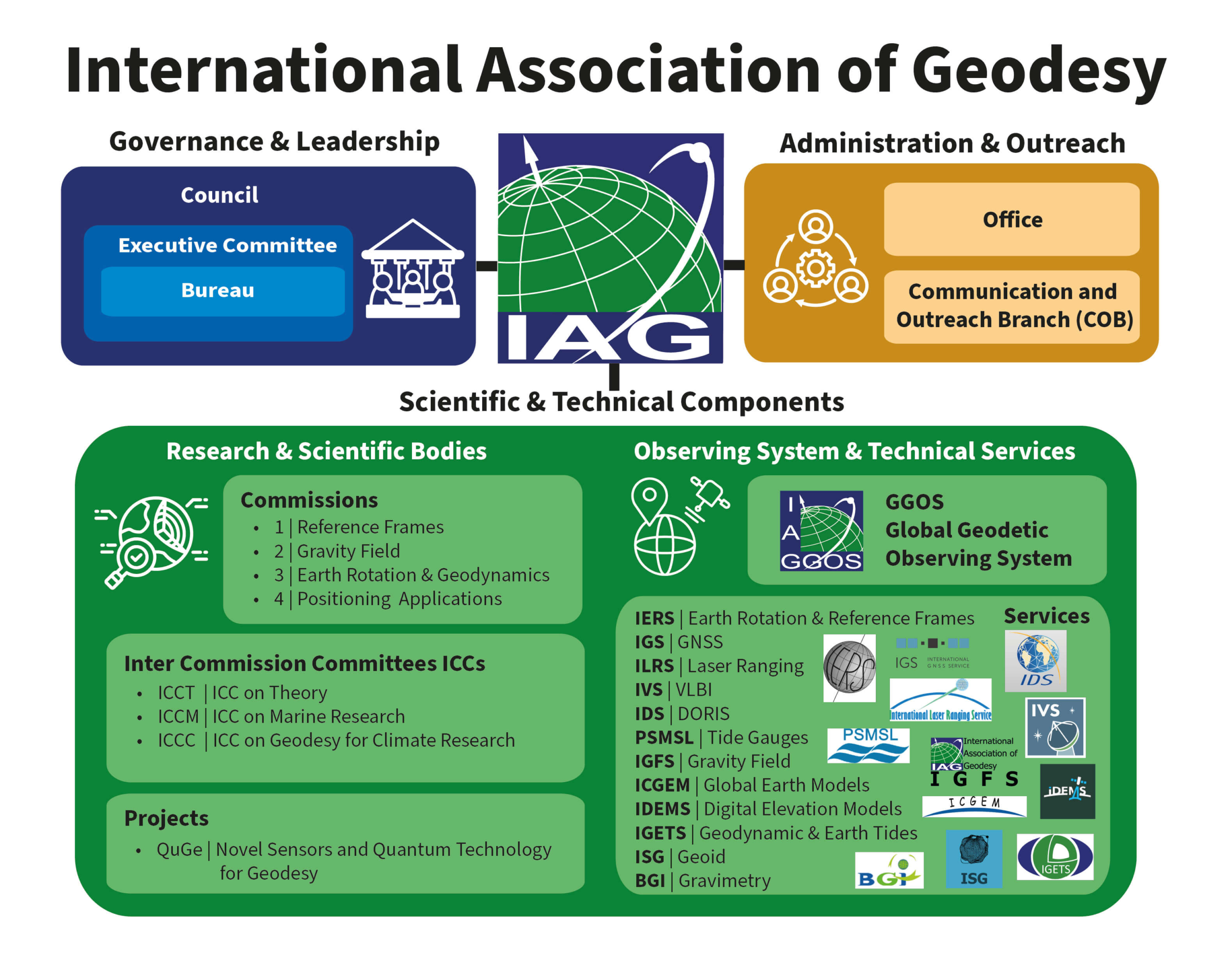
Structure of the IAG

The International Association of Geodesy (IAG) is a global scientific organization dedicated to advancing geodesy through research, collaboration, and the development of geodetic infrastructure. IAG operates through a well-defined structure consisting of several key components, each playing a vital role in fulfilling its mission.
1
2
3
4
5
6
7
8
9
10
IAG Structure Geodesy | Commissions, Inter-Commission Committees ICC, Projects, Services, GGOS, Governance, Administration

Main Components of IAG

  • Commissions – The IAG Commissions focus on fundamental geodetic research and coordinate scientific activities in their respective areas

  • Inter-Commission Committees (ICC’s) – These committees address interdisciplinary topics that require collaboration between multiple commissions.

  • Global Geodetic Observing System (GGOS) – As IAG’s flagship initiative, GGOS integrates geodetic observations from various techniques to monitor the Earth system, ensuring high-precision global geodetic reference frames and data for scientific and societal needs.

  • IAG Services – A network of international services provides essential geodetic products, such as reference frames, Earth orientation parameters, gravity field models, and GNSS solutions, supporting both scientific research and practical applications.

  • IAG Projects – These are time-limited initiatives that focus on specific geodetic challenges, fostering collaboration and innovation across the community.

This structured approach allows IAG to effectively coordinate global geodetic research and infrastructure, ensuring that the geodetic community can address scientific and practical challenges related to Earth observation, navigation, and geodynamics.

Government and Management

  • IAG Council – The IAG Council is the highest governing body of the IAG, responsible for setting the overall strategic direction and major decisions related to the association’s activities. It meets periodically to discuss and make decisions on key geodetic matters.

  • IAG Executive Committee (EC) – The IAG EC oversees the day-to-day operations of the IAG, implementing the policies and decisions of the Council. It is responsible for the overall management of IAG’s activities and represents IAG in international forums.

  • IAG Bureau – The IAG Bureau consists of key officers (IAG President, Vice-President, and Secretary-General) who lead and support the operational activities of the IAG. The Bureau ensures coordination among the IAG’s various components, making critical decisions and providing leadership to the IAG’s structure.

Administration

  • IAG Office – The IAG Office – led by the IAG Secretary General – provides essential administrative support to the organization, facilitating communication between IAG’s bodies, members, and the global geodetic community. It assists with event coordination, documentation, and logistical tasks.

  • IAG Commission on Bureau (COB) – The IAG COB promotes geodesy and IAG, manages communication and outreach, and supports the IAG Secretary General with events, the IAG website, and social media.

  • IAG Secretariat (is planned to establish in future)

These governance, management, and administrative components work together to ensure that IAG functions effectively, supporting global geodetic research, services, and infrastructure.


Page Navigation

  • IAG
  •    ★ Structure
    •       ● IAG Services
    •       ● IAG Commissions
    •       ● IAG Inter Commission...
    •       ● IAG Projects
    •    ☆ About
    •    ☆ Contact IAG
    •    ☆ Resources
    •    ☆ IAG Geodesy Awards

News

  • Honorary colloquium for Prof. Torge and Prof. Seeber at Leibniz University Hannover
  • Webinar: A Synergy between EUREF and EPOS: GNSS Data Quality Monitoring Service (DQMS)
  • Geodesy Day – International Webinar on Geodesy
  • Geodetic Data: Applying FAIR, TRUST and CARE Principles

Join Us!

Join Mailing Lists

Become IAG Member

IAG as part of the IUGG

  
The International Association of Geodesy (IAG)  is a constituent association of the International Union of Geodesy and Geophysics (IUGG).

IAG Related Organisations

IAG collaborates closely with numerous organizations within geodesy and beyond. See the list for details.

Sitemap

  • Home | geodesy.science
  • ⠀└─ 📰News
  • ⠀└─ 📅 Events
  • ⠀└─ 💼 Jobs
  • ⠀└─ 👥 Membership
  • ⭐ About Geodesy
  • 🏛️ IAG | Int. Association of Geodesy
  • ⠀└─ ➡️ Commissions:
  • ⠀⠀◻️ 1 – Reference Frames
  • ⠀⠀◻️ 2 – Gravity Field
  • ⠀⠀◻️ 3 – Earth Rotation & Geodynamics
  • ⠀⠀◻️ 4 – Positioning and Applications
  • ⠀└─ 🔀 Inter Commission Committees:
  • ⠀⠀◻️ ICCT – Theory
  • ⠀⠀◻️ ICCM – Marine Research
  • ⠀⠀◻️ ICCC – Climate Research
  • ⠀└─ ⏰ Project QuGe
  • ⠀└─ ⚙️ IAG Services
  •  🌎 GGOS | Observing System
  • ⠀└─ About GGOS
  • ⠀└─ Structure
  • ⠀└─ Observations
  • ⠀└─ Products
  • ⠀└─ Services

References

Geodesy Glossary

Media Library

IAG Cloud | Public Documents

Terms of Use / Privacy Policy

IAG Statutes

IAG By-laws

Contact Us

Contact

Follow Us

LinkedIn

BlueSky

X (Twitter)

Facebook

Instagram

YouTube

Telegram

RSS Feed

Mailing List

This website is provided by the IAG Secretariat and the GGOS Coordinating Office, which are hosted by the BEV – Federal Office of Metrology and Surveying (Bundesamt für Eich- und Vermessungswesen) in Vienna, Austria.

Website Language Translation

The primary language of this website is English – however, the integrated GTranslate tool enables automatic translation into several languages:

Please note that translations into other languages may not be accurate. For reliable information, refer to the English version of the website.

2026 © Copyright | IAG - International Association of Geodesy
  • Link to LinkedIn
  • Link to Youtube
  • Link to Facebook
  • Link to Instagram
  • Link to X
  • Link to Telegram
  • Link to Behance
  • Link to Rss this site
  • Link to Mail
Scroll to top Scroll to top Scroll to top
Accessibility Adjustments

Powered by OneTap

How long do you want to hide the toolbar?
Hide Toolbar Duration
Select your accessibility profile
Vision Impaired Mode
Enhances website's visuals
Seizure Safe Profile
Clear flashes & reduces color
ADHD Friendly Mode
Focused browsing, distraction-free
Blindness Mode
Reduces distractions, improves focus
Epilepsy Safe Mode
Dims colors and stops blinking
Content Modules
Font Size

Default

Line Height

Default

Color Modules
Orientation Modules