• Link to LinkedIn
  • Link to Youtube
  • Link to Facebook
  • Link to Instagram
  • Link to X
  • Link to Telegram
  • Link to Behance
  • Link to Rss this site
  • Link to Mail
  • NEWS
  • EVENTS
  • JOBS
  • MEMBER
  • Sitemap
    • Home
      • NEWS
      • EVENTS
      • JOBS
      • MEMBERSHIP
    • ⭐ About Geodesy
    • 🏛️ IAG | International Association of Geodesy
      • About IAG
      • Structure
      • 🎓 ECS – Early Career Scientists
      • 🌈 IDEA – Inclusion, Diversity, Equity, Accessibility
    •   └─ Comissions
      • 1️⃣ Reference Frames
      • 2️⃣ Gravity Field
      • 3️⃣ Earth Rotation & Geodynamics
      • 4️⃣ Positioning & Applications
    •   └─ Inter Commission Committees
      • 📚 ICCT – Theory
      • 🌊 ICCM – Marine Research
      • 🌥️ ICCC – Climate Research
    •   └─ Project QuGe
    •   └─ Services
    • 🌍 GGOS | Global Geodetic Observing System
      • About GGOS
      • Structure
      • 🛰️ Observations
      • 📦 Products
      • ⚙️ Services
  • Shopping Cart Shopping Cart
    0Shopping Cart
geodesy.science - IAG website
  • GGOS
    • Home
      • NEWS
      • EVENTS
      • JOBS
      • MEMBERSHIP
    • ⭐ About Geodesy
    • 🏛️ IAG | International Association of Geodesy
      • About IAG
      • Structure
      • 🎓 ECS – Early Career Scientists
      • 🌈 IDEA – Inclusion, Diversity, Equity, Accessibility
    •   └─ Comissions
      • 1️⃣ Reference Frames
      • 2️⃣ Gravity Field
      • 3️⃣ Earth Rotation & Geodynamics
      • 4️⃣ Positioning & Applications
    •   └─ Inter Commission Committees
      • 📚 ICCT – Theory
      • 🌊 ICCM – Marine Research
      • 🌥️ ICCC – Climate Research
    •   └─ Project QuGe
    •   └─ Services
    • 🌍 GGOS | Global Geodetic Observing System
      • About GGOS
      • Structure
      • 🛰️ Observations
      • 📦 Products
      • ⚙️ Services
  • About
    • About GGOS
      • What is GGOS?
      • Why GGOS?
      • Dual Roles of GGOS
      • Vision and Mission
      • GGOS History
  • Structure
    • Governance & Leadership
      • Governing Board GB
      • Executive Committee EC
    • Coordinating Office CO
    • Science Panel
    • Bureaus
      • BNO – Networks and Observations
      • BPS – Products and Standards
    • Focus Areas
      • Geohazards Monitoring
      • Geodetic Space Weather Research
      • Artificial Intelligence for Geodesy (AI4G)
    • GGOS Affiliates
      • GGOS Japan
      • GGOS D-A-CH
      • GGOS IberAtlantic
    • GGOS Committees & Working Groups
  • Observations
  • Services
  • Products
  • Resources
    • Resources Overview
    • Outreach Materials
    • Logos & Organisation Chart
    • Reports and Articles
    • Presentations and Videos
    • GGOS Meeting Reports
    • Terms of Reference and Strategy
  • Click to open the search input field Click to open the search input field Search
You are here: Home1 / IAG GGOS2 / GGOS Observations3 / IVS – International VLBI Service for Geodesy and Astrometry

IVS – International VLBI Service for Geodesy and Astrometry
IVS VLBI Service IAG
Go To IVS Service
IVS Office for Outreach and Communication

Development

The International VLBI Service for Geodesy and Astrometry (IVS) is an international collaboration of organizations that operate or support Very Long Baseline Interferometry (VLBI) components. IVS was established in 1999 and became a service of IAG that year. In 2000, IVS was recognized as a service of the International Astronomical Union (IAU). In 2002, IVS became a member of the Federation of Astronomical and Geophysical Data Analysis Services (FAGS). Following the dissolution of the FAGS federation at the end of 2008, IVS applied for membership in the newly established World Data System (WDS) and was approved in 2011. IVS interacts closely with the International Earth Rotation and Reference Systems Service (IERS), which is tasked by IAU and IUGG with maintaining the international celestial and terrestrial reference frames (ICRF and ITRF).

Mission and Objectives

The objectives of IVS are:
• To provide a service to support geodetic, geophysical, and astrometric research and operational activities.
• To promote research and development activities in all aspects of the geodetic and astrometric VLBI technique.
• To interact with the community of users of VLBI products and to integrate VLBI into a global Earth observing system.
To meet these objectives, IVS coordinates VLBI observing programs, sets performance standards for VLBI stations, establishes conventions for VLBI data formats and data products, issues recommendations for VLBI data analysis software, sets standards for VLBI analysis documentation, and institutes appropriate VLBI product delivery methods to ensure suitable product quality and timeliness. IVS closely coordinates its activities with the astronomical community because of the dual use of many VLBI facilities and technologies for both astronomy and geodesy/astrometry.
see also: https://ivscc.gsfc.nasa.gov/about/index.html

Products

VLBI data products currently available:
• Full set of Earth orientation parameters (polar motion, UT1−UTC, nutation)
• Terrestrial reference frame
• Celestial reference frame
• Tropospheric parameters
• Time series of baseline lengths
All VLBI data products are archived in IVS Data Centers and are publicly available.
see also: https://ivscc.gsfc.nasa.gov/products-data/index.html

Structure, Members, and Directing Board

IVS accomplishes its goals through Permanent Components. As of 2020 the IVS has:
• 34 Network Stations, acquiring high performance VLBI data
• 3 Operation Centers, coordinating activities of Network Stations
• 7 Correlators, processing acquired data, providing feedback to stations and providing processed data to analysts
• 5 Data Centers, distributing products to users, providing storage and archiving functions
• 31 Analysis Centers, analyzing the data and producing results and products
• 7 Technology Development Centers, developing new VLBI technology
• 1 Coordinating Center, coordinating daily and long-term activities of IVS
All together there are 88 Permanent Components, representing 41 organizations in 21 countries, and about 320 individuals who are Associate Members. The 41 organizations that support IVS components are IVS Member Organizations. There are also 6 Affiliated Organizations that cooperate with IVS on issues of common interest but do not support an IVS component.
In addition, the IVS Directing Board determines policies, standards, and goals.
see also: https://ivscc.gsfc.nasa.gov/about/org/components/index.html

Publications and Meetings

IVS publishes a Biennial Report, a thrice-annual Newsletter, and Proceedings from its bi-annual General Meeting. All publications are available from the Coordinating Center and also published on the website. IVS holds a General Meeting every two years, a Technical Operations Workshop every two years, an Analysis Workshop every year, and a VLBI School for students and novices every three years.
see also: https://ivscc.gsfc.nasa.gov/publications/index.html and https://ivscc.gsfc.nasa.gov/meetings/index.html

VGOS: The New VLBI Component of GGOS

In order to meet the very stringent science requirements established by GGOS, such as an accuracy of 1 mm in station position and 0.1 mm/year in station velocity on global scales, the four space-geodetic techniques are developing next-generation versions of their techniques. In the VLBI case, the original system was conceived and constructed in the 1960s and 1970s. Hence, aging antennas, increasing radio frequency interference (RFI) problems, obsolete electronics, and high operating costs were further drivers to upgrade the VLBI system to meet the required level of accuracy, reliability, and timeliness. The IVS contribution to GGOS is the VLBI Global Observing System (VGOS). The VGOS system is based on the so-called broadband delay, which uses four (or more) frequency bands in the range from 2.5 GHz to 14 GHz. The observations are taken by fast-slewing, 12-m class antennas at a high data rate of 8 Gbps and above. The implied higher sampling of the sky, as compared to the legacy system, will reduce the impact of error components. Together with a reduction of systematic errors, this will result in an anticipated overall accuracy of 1 mm. VGOS is planned to replace the currently employed two-band VLBI system (legacy S/X system) as its operational system for product creation over the next few years.
In the recent past, the IVS has made strides to implement the new broadband system globally. A modernized station infrastructure is being established worldwide and in 2020 a fledgling network of 8–10 VGOS stations started observing in operational IVS sessions. It is anticipated that the global network will grow to 25 stations and beyond in the coming years. As part of the modernization process, other infrastructure components of the VLBI processing chain have been further developed as well, including the VGOS correlation and post-processing capabilities as well as VGOS data analysis.

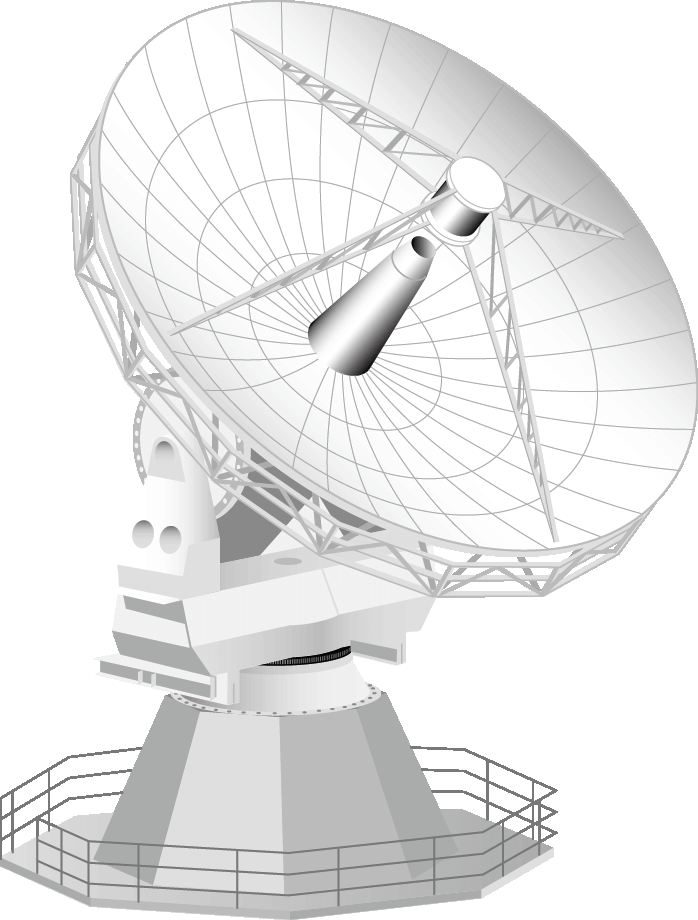
Artist’s rendition of a fast-slewing, 12-m class VGOS antenna.

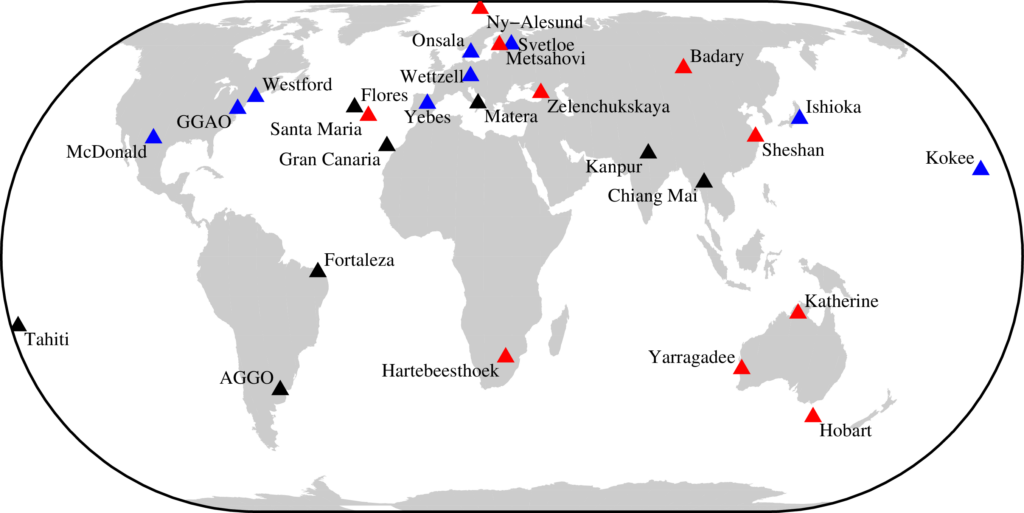
Projected VGOS network in the early 2020s.
VLBI VGOS antenna IVS
© IVS - VGOS Info Info

Artist’s rendition of a fast-slewing, 12-m class VGOS antenna.

VLBI VGOS stations map VLBI stations 2020
© IVS - VGOS Info Info

Projected VGOS network in the early 2020s (Status: Sept 2020).

IAG SERVICES

Geometric & General Services

  • IERS iag service earth rotation reference system frame© IERS
    IERS – Int. Earth Rotation and Reference Systems Service
  • IGS iag service gnss global navigation satellite system© IGS
    IGS – International GNSS Service
  • ILRS laser ranging service iag© ILRS
    ILRS – International Laser Ranging Service
  • IVS VLBI Service IAG© IVS
    IVS – International VLBI Service for Geodesy and Astrometry
  • IDS iag service DORIS© IDS
    IDS – International Doris Service
  • PSMSL Permanent Service for Mean Sea Level IAG© PSMSL
    PSMSL – Permanent Service for Mean Sea Level

Gravity Services

  • IGFS iag service gravity field© IGFS
    IGFS – International Gravity Field Service
  • ICGEM iag service© ICGEM
    ICGEM – International Centre for Global Earth Models
  • IDEMS iag service DEM digital elevation model© IDEMS
    IDEMS – International Digital Elevation Model Service
  • IGETS iag service© IGETS
    IGETS – International Geodynamics and Earth Tide Service
  • ISG service geoid IAG© ISG
    ISG – International Service for the Geoid
  • BGI gravimetric service IAG© BGI
    BGI – International Gravimetric Bureau

IAG as part of the IUGG

  
The International Association of Geodesy (IAG)  is a constituent association of the International Union of Geodesy and Geophysics (IUGG).

IAG Related Organisations

IAG collaborates closely with numerous organizations within geodesy and beyond. See the list for details.

Sitemap

  • Home | geodesy.science
  • ⠀└─ 📰News
  • ⠀└─ 📅 Events
  • ⠀└─ 💼 Jobs
  • ⠀└─ 👥 Membership
  • ⭐ About Geodesy
  • 🏛️ IAG | Int. Association of Geodesy
  • ⠀└─ ➡️ Commissions:
  • ⠀⠀◻️ 1 – Reference Frames
  • ⠀⠀◻️ 2 – Gravity Field
  • ⠀⠀◻️ 3 – Earth Rotation & Geodynamics
  • ⠀⠀◻️ 4 – Positioning and Applications
  • ⠀└─ 🔀 Inter Commission Committees:
  • ⠀⠀◻️ ICCT – Theory
  • ⠀⠀◻️ ICCM – Marine Research
  • ⠀⠀◻️ ICCC – Climate Research
  • ⠀└─ ⏰ Project QuGe
  • ⠀└─ ⚙️ IAG Services
  •  🌎 GGOS | Observing System
  • ⠀└─ About GGOS
  • ⠀└─ Structure
  • ⠀└─ Observations
  • ⠀└─ Products
  • ⠀└─ Services

References

Geodesy Glossary

Media Library

IAG Cloud | Public Documents

Terms of Use / Privacy Policy

IAG Statutes

IAG By-laws

Contact Us

Contact

Follow Us

LinkedIn

BlueSky

X (Twitter)

Facebook

Instagram

YouTube

Telegram

RSS Feed

Mailing List

This website is provided by the IAG Secretariat and the GGOS Coordinating Office, which are hosted by the BEV – Federal Office of Metrology and Surveying (Bundesamt für Eich- und Vermessungswesen) in Vienna, Austria.

Website Language Translation

The primary language of this website is English – however, the integrated GTranslate tool enables automatic translation into several languages:

Please note that translations into other languages may not be accurate. For reliable information, refer to the English version of the website.

2026 © Copyright | IAG - International Association of Geodesy
  • Link to LinkedIn
  • Link to Youtube
  • Link to Facebook
  • Link to Instagram
  • Link to X
  • Link to Telegram
  • Link to Behance
  • Link to Rss this site
  • Link to Mail
Scroll to top Scroll to top Scroll to top
Accessibility Adjustments

Powered by OneTap

How long do you want to hide the toolbar?
Hide Toolbar Duration
Select your accessibility profile
Vision Impaired Mode
Enhances website's visuals
Seizure Safe Profile
Clear flashes & reduces color
ADHD Friendly Mode
Focused browsing, distraction-free
Blindness Mode
Reduces distractions, improves focus
Epilepsy Safe Mode
Dims colors and stops blinking
Content Modules
Font Size

Default

Line Height

Default

Color Modules
Orientation Modules