
Celestial Reference Frame (CRF)
How can we link Earth and Space?
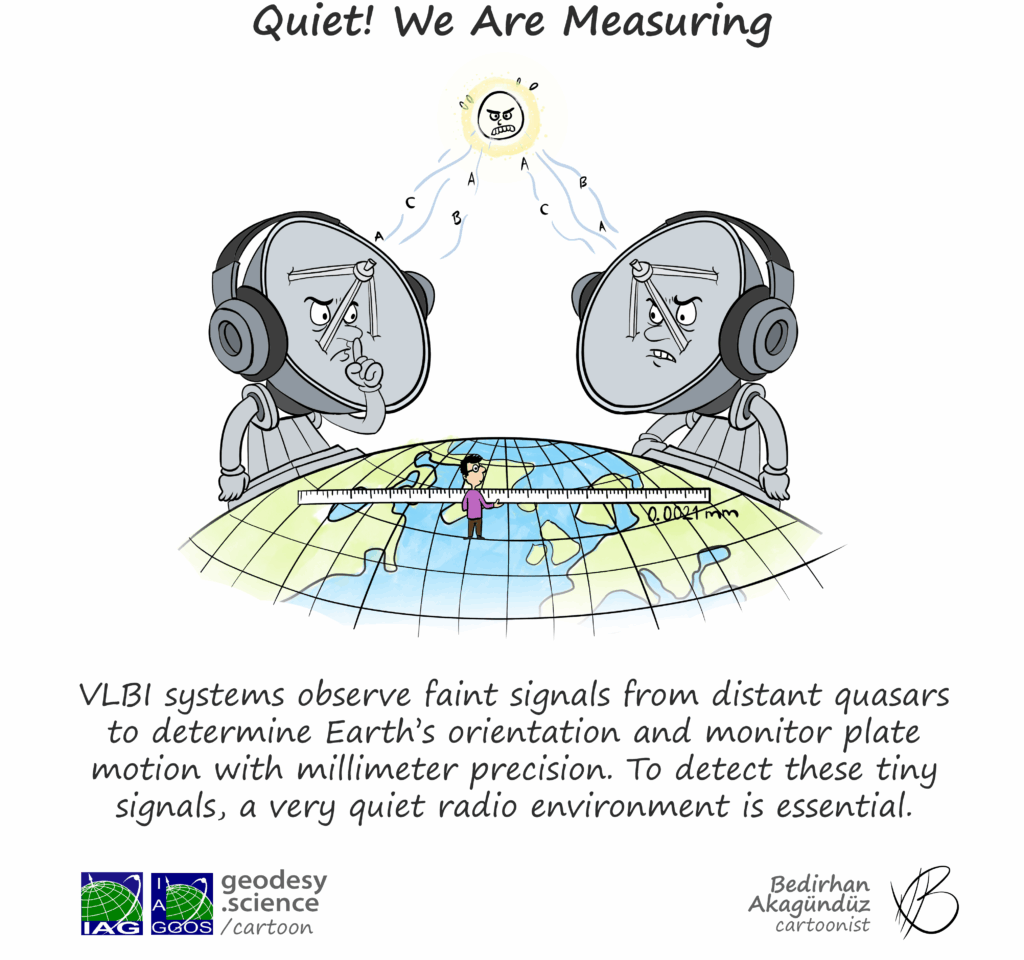
The Celestial Reference Frame is needed for the precise positioning of objects in the sky in relation to Earth. A reference frame realizes a reference system. A reference system defines how a coordinate system is established, specifying its origin, fundamental axes and the constants, models and algorithms required to transform between observable quantities and reference data that conform to the system. The refence frame implements the reference system through a set of well-defined fiducial points (or objects) with known coordinates, enabling the reference system to be applied in practice. The International Celestial Reference Frame (ICRF) is the current standard celestial reference frame adopted by the International Astronomical Union (IAU) and the International Association of Geodesy (IAG). It is the realization of the International Celestial Reference System (ICRS). The origin of the ICRS is at the barycenter of the Solar System, and its axes are defined so that they exhibit no global rotation with respect to a set of distant extragalactic objects. The coordinates are basically the declination and right ascension based on the mean celestial equator and mean celestial equinox at a given epoch (J2000: 1 January 2000 at 12:00). The ICRF comprises a catalog of precise equatorial (declination and right ascension) coordinates of extragalactic radio sources observed by Very Long Baseline Interferometry (VLBI). For the celestial reference frame, the typical preferred properties of radio sources are high flux density, compactness, i.e. little and stationary intrinsic structure, and continuum radiation, such as synchrotron radiation. Since the objects are extragalactic, they are all sufficiently distant, so that parallaxes and proper motions are negligible.

Historically, the ICRF has been observed in S/X bands. Therefore, the ICRF (S/X) is the conventional reference frame for Earth orientation and thus essential for geodesy. It is required for the definition of reference directions for satellite orbits and provides the basis for astrometry. The realizations at other radio wavelengths, i.e. K and X/Ka-bands, are currently considered as less precise and are thus referred to ICRF (S/ X). Nevertheless, they represent independent realizations of ICRS that gradually improve in terms of number of observations and precision. Other celestial systems, such as the dynamic Lunar and planetary ephemerides, refer to ICRF (S/X). Catalogues of astrometric satellite missions, such as Hipparcos and Gaia of the European Space Agency (ESA), mark the access in optical wavelengths, but provide an orientation independent of the Earth surface. For accessing these data from ground or from orbiting platforms, they have to be referred to ICRF through a datum that fixes at least the orientation and spin degree of freedom. Gaia Data Release 2 (DR2) for instance used a prototype of ICRF3 (S/X) for the datum definition. The Gaia mission is still ongoing. Future products will very likely outperform current ones.
ICRF – Working Group
The ICRF is a CRF computed by a dedicated working group (WG). The General Assembly of the International Astronomical Union (IAU) decides in terms of a resolution whether the CRF produced by the WG becomes the new ICRF. The International Union of Geodesy and Geophysics (IUGG) and the International Association of Geodesy (IAG) can decide whether they accept the ICRF through own resolutions. The ICRS Centre of the International Earth Rotation and Reference Systems Service (IERS), which is under the auspices of IAU and IUGG, in particular IAG, disseminates the product. IVS coordinates the S/X observations together with partner networks, such as the Very Long Baseline Array (VLBA) for K-band and NASA, ESA and JAXA for X/Ka, whereas the dedicated WG coordinates the analysis.
The current realization, the ICRF3 (Charlot et al., 2020), was created by the IAU Division A Working Group “Third Realization of the International Celestial Reference Frame (ICRF3)” and was accepted by the IAU GA 2018 as the conventional realization of the ICRS through Resolution B2 and by IAG through Resolution 2 (2019) [Poutanen & Rózsa, 2020]. It contains the positions of 4536 radio sources of which 303 are defining sources (see Figure above). Obvious is the non-uniform distribution of radio sources on the celestial sphere. ICRF3 (S/X) contains less radio sources in the vicinity of the celestial south pole about up to the declination δ=-45°. This is due to the larger number of cooperating radio telescopes on the northern hemisphere. In order to improve this situation, dedicated observing programs are planned and conducted with the purpose of increasing the source density of the southern sky.
Data Sources
- IERS: International Earth Rotation and Reference Systems Service (IERS)
- ICRS Centre: at the IERS