Professor Vidal Ashkenazi OBE – Obituary
Professor Vidal Ashkenazi was born In Istanbul on 7 July 1933. He attended the French Secondary School, St Benoît in Istanbul. As a child he spoke Ladino at home, French at school and Turkish with his friends. At the age of 15 he moved to Israel; he won an academic scholarship to study Civil Engineering / Geodesy at the Technion in Haifa. He subsequently also completed an MSc at the Technion. After working at the Survey Department in Tel Aviv, he accepted a post as a lecturer in Engineering Surveying at Kwame Nkrumah University of Science and Technology in Kumasi. He moved to Ghana with his wife, Esther, who taught him English. He became fluent in English, but kept his multilingual accent, which meant he could blend into so many countries, as a local.
After spending 5 years in Ghana, he was offered the opportunity to do a DPhil in Engineering Science at Hertford College, University of Oxford, which he completed, under the supervision of Dr Alwyn Robbins, in one and a half years. He later gained a DSc based on the reviewed quality of over 300 published scientific papers. In 1965 he took on the post as a lecturer at the University of Nottingham. He was appointed primarily to lecture surveying to civil engineering students, which he continued to do throughout his time at Nottingham. He was influential in research into statistical analysis of surveying networks and the use of new measurement technologies leading to him pioneering the use of satellite positioning systems, initially TRANSIT Doppler and subsequently GPS. In 1988 he established the Institute of Engineering Surveying and Space Geodesy (IESSG), moving into a purpose-built research building, which in 1994 was opened by HRH Princess Anne.
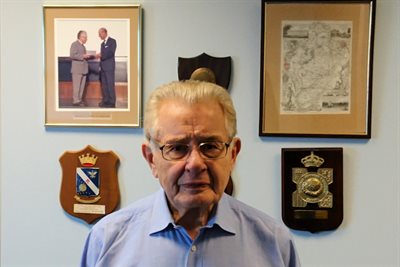
Prof. Vidal Ashkenazi Jan 2017 courtesy of NSL
In August 1998 Vidal retired from his post at the University after 33 years of service, during which time he became the UK’s first Professor of Engineering Surveying, and had established the IESSG as a world-renowned centre of excellence for both teaching and research in Surveying, Geodesy and Navigation. He also played a major part in establishing Engineering Surveying, in particular, as a discipline in its own right in the UK. To mark his academic career a symposium was held in his honour, in October 1998, at which numerous leading national and international researchers gave keynote presentations.
In 1998, after a distinguished academic career, Professor Ashkenazi founded Nottingham Scientific Limited (NSL), creating a new business to bring the University of Nottingham’s innovation and expertise into commercial application. It was during this period that Vidal turned his attention to the emerging European GNSS programme, championing the economic benefits that satellite navigation could deliver to Europe while advocating strongly for strategic independence. His contributions were instrumental in shaping early thinking that would ultimately lead to the Galileo programme. In 2020, NSL’s journey entered a new chapter when the company was acquired and integrated into the GMV group, extending the enduring impact of his work. It was only at that point, at the age of 87, that Vidal finally properly retired.
Vidal’s contribution, nationally and internationally, was well recognised in many ways. He has been Secretary to the Theory and Evaluation section of the International Association of Geodesy, Chair of the Geodesy Sub-Committee of the Royal Society, and was, in 1996, awarded the Alfred Ewing Medal, jointly by the Royal Society and the Institution of Civil Engineers, for his contribution to research in engineering. In 2008 the Royal Institute of Navigation awarded him their highest honour, the Harold Spencer-Jones Gold Medal. In 2017 he was appointed an Officer of the Order of the British Empire (OBE) for his services to science.
However, the most tangible recognition of his work is the success of the research group at Nottingham (and in particular his achievement in establishing the IESSG), and the success of the many students and colleagues who worked with him. He made a significant impact on their lives and careers, and was endlessly encouraging, supportive and proud of their achievements.
He is survived by his wife Esther, their daughters Iris and Alona, and two grandchildren Rachel and Daniel.
He died on the 29th April 2026 at the age of 92.
Authors: Professors Alan Dodson & Terry Moore, and Dr Mark Dumville.