New GGOS Video: Gravity – The Invisible Force Shaping Our Earth
Why does gravity vary across our planet? What can these tiny variations tell us about melting ice, changing water resources, rising sea levels, or processes deep inside the Earth? And how does geodesy help us measure them?
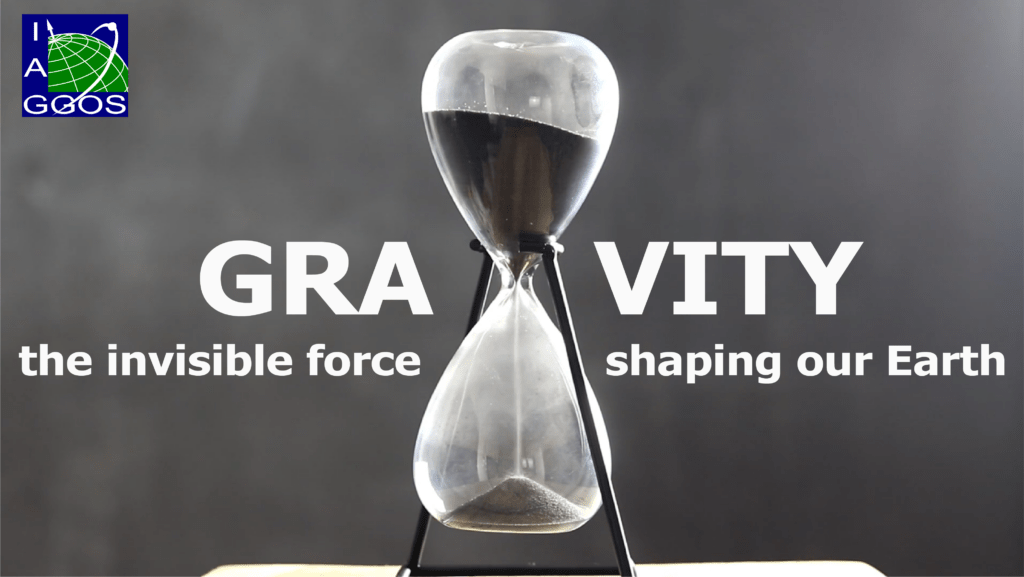
The Global Geodetic Observing System (GGOS) is pleased to present its new short educational video “Gravity – The Invisible Force Shaping Our Earth” spoken in 11 languages (EN, DE, ZH, ES, FR, AR, PT, JP, FA, TR, IT) and the English version with subtitles in 9 languages (EL, RU, HI, NL, KK, BG, SV, FI, NO). In around 8 minutes, the film introduces the fundamentals of gravity and shows how geodesists use gravity observations to better understand our dynamic planet. The video is designed for a broad audience, including anyone interested in Earth sciences, students, geoscientists, and geodesists who would like an accessible introduction to the role of gravity in geodesy.
Gravity as a window into our changing Earth
Gravity is one of the fundamental forces shaping our planet. It keeps us on the ground, the Moon in orbit around the Earth, and the Earth in orbit around the Sun. But Earth’s gravity is not exactly the same everywhere. Our planet is made up of materials with different densities, and mass is continuously being redistributed. Water moves between oceans, continents and the atmosphere. Ice sheets and glaciers gain or lose mass. The Earth’s crust deforms, and processes take place deep within the mantle. All of these changes leave a small but measurable signal in Earth’s gravity field. This makes gravity much more than simply the force that makes objects fall: it acts as a messenger carrying information about changes taking place on and inside our planet.
Where geodesy comes in
Geodesy is the science of measuring the shape, rotation and gravity field of the Earth, together with their changes over time. To understand variations in gravity, geodesists compare the real Earth with a simplified mathematical reference model. Differences between the expected and observed gravity field can reveal where mass is distributed differently than expected and, importantly, how this distribution changes over time. These measurements allow scientists to study processes ranging from global climate change to regional changes in groundwater and processes inside the solid Earth. For example, gravity observations can help us:
- estimate mass loss from glaciers and polar ice sheets,
- monitor changes in water stored on land,
- investigate changes associated with earthquakes and tectonic processes,
- study the Earth’s crust and mantle,
- determine the geoid as a reference surface for physical heights,
- observe changes related to sea level and ocean circulation,
- and better understand the global water cycle.
Measuring gravity from space – and from the ground
The new video also introduces two complementary ways in which geodesists observe gravity.
Satellite gravimetry provides a global and consistent view of Earth’s gravity field. Satellite missions can detect extremely small changes in gravitational attraction and reveal how large amounts of mass are redistributed between ice sheets, oceans and continents. Such observations have become an important tool for studying climate-related processes, including ice-mass loss and changes in terrestrial water storage. Gravity-field models are also essential for precise satellite orbit determination and for calculating the global geoid.
For smaller-scale processes, scientists complement satellite observations with highly sensitive terrestrial, marine and airborne gravimeters. These instruments can detect very small local variations in gravity and are used in applications including groundwater monitoring, volcanic and geothermal research, geotechnical investigations, archaeology and resource exploration.
Together, observations from space and from the Earth’s surface provide a powerful picture of processes occurring across very different spatial and temporal scales.
Making geodesy accessible
“Gravity – The Invisible Force Shaping Our Earth” is the latest addition to the GGOS series of short educational films, following “Discover GGOS & Geodesy” and “Terrestrial Reference Frames – Connecting the World through Geodesy“. The aim of the series is to explain important concepts in modern geodesy in a scientifically sound but easily understandable way and to demonstrate why geodetic observations and products matter far beyond the geodetic community itself. To make the material accessible internationally, the new gravity video is already available in more than 11 languages, with additional translations helping the film reach audiences around the world.
Watch the video
Discover how scientists turn tiny variations in gravity into information about melting ice, moving water, rising seas and processes deep inside our planet.
Learn more
- Satellite Gravimetry: https://geodesy.science/ggos/obs/satellite-gravimetry/
- Terrestrial Gravimetry: https://geodesy.science/ggos/obs/terrestrial-gravimetry/
- Gravity Products: https://geodesy.science/ggos/products/
International Contribution
The video was produced by the GGOS Coordinating Office at BEV (Federal Office of Metrology and Surveying), Austria, with main contributions from Martin Sehnal, Lucas Triebenbacher, Laura Sánchez, Derek van Westrum, and George Vergos; post-production was carried out by Jens Klawonn at the BKG (Federal Agency for Cartography and Geodesy), Germany.
Narration and translation were provided by:
- ENGLISH: Gernot Frischenschlager | Laura Sánchez, Derek van Westrum, George Vergos, Martin Sehnal;
- CHINESE: AI voice (iFLYTEK Xunfei Zhizuo) | Jianghui Geng, Xinlei Luo;
- SPANISH: Ezequiel Antokoletz | Ezequiel Antokoletz, Claudia Tocho;
- FRENCH: Alexandre Couhert | Alexandre Couhert;
- ARABIC: Mohammed Dhaidan AlArjani | Osama Zeid AlGouhiez, Saad AlQahtani, Othman AlRubaia, Eslam Abdulsamie, Sultan AlShahrani – الترجمة: المملكة العربية السعودية – الهيئة العامة للمساحة والمعلومات الجيومكانية (GEOSA);
- PORTUGUESE: Luiz Paulo Souto Fortes | Luiz Paulo Souto Fortes;
- GERMAN: Gernot Frischenschlager | Martin Sehnal, Detlef Angermann;
- JAPANESE: Yu Hirota | Masafumi Ishigaki, Yu Hirota, Takuma Koyanagi, Yoshifumi Hiraoka, Basara Miyahara, Yusuke Yokota, Shun-ichi Watanabe, Toshimichi Otsubo;
- FARSI: Parastoo Alimohammadi | Ismael Foroughi, Mehdi Goli;
- TURKISH: Sevda Olgun | E. Sinem Ince, Sevda Olgun, Metehan Zu;
- ITALIAN: Giulia Casini | Tamara de Francesco, Riccardo Barzaghi, Giulia Casini.
Further subtitle translations:
- GREEK: George Vergos;
- RUSSIAN: Ilya Oshchepkov;
- HINDI: Arnab Laha;
- DUTCH: Lennard Huisman;
- KAZAKH: Alena Yelisseyeva, Shoganbekova Daniya, Urazaliyev Asset;
- BULGARIAN: Lyubka Pashova;
- SWEDISH: Rüdiger Haas;
- FINISH: Markku Poutanen;
- NORWEGIAN: Ove Christian Dahl Omang.
Many thanks to all contributors to this video. It is truly a community project, made possible by the voluntary time, enthusiasm, and commitment of many people, particularly those who supported the translations and narrations in multiple languages and provided footage and other material for the video.
Author: Martin Sehnal (Director of GGOS Coordinating Office)