
GeneralScientific CommitteeDatesAbstract SubmissionRegistrationParticipantsProgrammeKeynote speakersPresentation guidelinesCode of conductTravel AwardTravelGävleMiscellaneousContact
Thanks to all for participating in the TIGER Symposium in Geodesy 2026!

The TIGER Symposium in Geodesy is the official symposium of the International Association of Geodesy (IAG) Commission 3 on Earth rotation and geodynamics. TIGER stands for Tracking and Investigating Geodynamics and Earth Rotation. The 2026 edition will mark the very first meeting of IAG Commission 3 – September 28th to October 1st, 2026.
Commission 3 studies the entire range of physical processes associated with the movement and deformation of the Earth in response to both external and internal forces. In addition to the core focus of Commission 3, the TIGER Symposium will also highlight themes traditionally addressed at the Journées meetings. The TIGER Symposium in Geodesy is also supported by the International Earth Rotation & Reference System Service (IERS), a service of IAG contributing to global reference systems and Earth orientation science.
To foster collaboration across disciplines, IAG Commission 3 works closely with several other IUGG associations – International Association of Volcanology and Chemistry of the Earth’s Interior (IAVCEI), International Association of Cryospheric Sciences (IACS), and International Association of Seismology and Physics of the Earth’s Interior (IASPEI) – through a number of joint sub-commissions, making the TIGER Symposium a place where different geoscientific communities can come together and share and discuss their work.
Following the TIGER Symposium in Geodesy, two more meetings will be arranged in Gävle:
GGOS Topical Meeting on Geohazards, October 2nd, 2026
GGOS Days 2026, October 5th to 7th, 2026
Lantmäteriet is proud to host all these meetings in Gävle (Sweden).
Topics
Contributions on the following topics are welcome:
- Earth rotation (measurement techniques, short vs. long-term variations, climate and angular momentum, core-mantle interactions, atmosphere-ocean-hydrology effects, reference frame links, space geodesy synergies, prediction models at various time scales, interactions between EOP and geophysical models, …) – see the subcommission and working group websites for more details
- Earth tides (solid Earth tides, ocean tide and non-tidal loading, atmospheric loading, hydrological loading, tidal dissipation, earth rheology, tidal measurements (instruments), pole tides, Moon tides, …) – see the subcommission website for more details
- Cryospheric and hydrologic deformation (ice mass loss, glacier dynamics, grounding line migration, ice–ocean–Earth coupling, sea-level impacts, polar GNSS networks, glacial isostatic adjustment, Earth rheology, climate model links, seismicity, …) – see the subcommission, study group and working group websites for more details
- Volcanogeodesy (GNSS & InSAR monitoring, magma source modeling, early warning systems, multi-sensor integration, real-time monitoring, volcano-tectonic links, submarine volcanism, hazard assessment, …) – see the subcommission website for more details
- Seismogeodesy (co-seismic monitoring, post-seismic deformation, GNSS-seismic-InSAR integration, finite-fault modeling, tsunami warning, strain accumulation, …) – see the subcommission website for more details
WARNING – Scam emails are going around asking for travel dates and registration confirmation. Please be aware that this is a scam! Please DO NOT give out any personal information to these or other companies. Please ignore any emails and calls from them or any other travel agent.
Scientific Committee
The scientific organizing committee is based on the members of the IAG Commission 3 Steering committee plus a member of the Journées meetings.
Rebekka Steffen (Lantmäteriet, Sweden)
José M. Ferrándiz (University of Alicante, Spain)
Séverine Rosat (Univ. Strasbourg, France)
Xiaoming Cui (APM of Chinese Academy of Science, Wuhan, China)
Susanna Ebmeier (University of Leeds, United Kingdom)
Matthew Head (University of Illinois Urbana-Champaign, USA)
Sigrid Böhm (TU Wien, Austria)
Christopher Dieck (United States Naval Observatory, USA)
Karen Simon (Canadian Geodetic Survey, Ottawa, Canada)
Matthias Willen (TU Dresden, Germany)
Jean-Mathieu Nocquet (Université Côte D’Azur, IRD, CNRS, OCA & Institut de Physique du Globe de Paris)
Masayuki Kano (Tohoku University, Japan)
Carla Braitenberg (University of Trieste, Italy)
Grace Carlson (University of California, Berkley, USA)
Lambert Caron (Jet Propulsion Lab., California Institute of Technology, Pasadena, USA)
Cheng-Li Huang (Shanghai Observatory, China)
Christian Bizouard ( Observatoire De Paris, France)
Tonie van Dam (University of Utah, USA)
Pavel Novak (University of West Bohemia in Pilsen, Czech Republic)
Ezequiel Antokoletz (BKG Leipzig, Germany)
Chikondi Chisenga (Malawi University of Science and Technology, Malawi)
Laura Fernández (National University of La Plata, Buenos Aires, Argentina)
Alberto Escapa (University of León, Spain)
Laura Sánchez (TU Munich, Germany)
Jérémy Rekier (Royal Observatory of Belgium, Belgium)
Anna Riddell (Geoscience Australia, Australia)
Dates
- 12 May 2026 – Abstract submission deadline
- 12 May 2026 – Application deadline for early career travel support
- 1 June 2026 – Notification of abstract acceptance and travel support result
- 15 June 2026 – Final scientific programme release
- 15 July 2026 – Early-bird registration
- 31 August 2026 – Final registration deadline
- 28 September – 1 October 2026 – TIGER Symposium in Geodesy
- 31 January 2027 – Deadline for paper submission to the IAG Symposia Series by Springer
Abstract Submission
All colleagues working on the topics of Earth rotation and geodynamics or related themes are invited to submit an abstract by May 12th, 2026. Abstracts received after this deadline will not be accepted and will not be included in the final programme of the conference. Authors will be informed of the acceptance/rejection of their abstract by email by June 1st, 2026. By submitting an abstract, the author or one of the authors of a joint work is required to complete the online registration before July 15th, 2026. If no registration has been received by that date for one of the authors of the abstract, it will not be included in the meeting programme. If authors know that their presentation will not be presented, they are asked to withdraw their abstract as soon as possible (by contacting ).
- Participants are invited to submit their papers to the IAG Symposia Series, published by Springer. The IAG Symposia Series is published Open Access, and free of charge to the authors. The cost of publication is borne by the IAG. All presentations, poster and keynote, are eligible. All Symposia Series volumes are peer reviewed and submitted for indexing. Deadline for submitting the full paper is January 31st, 2027. Details will be provided after the symposium.
- No more than one abstract can be submitted by the same first author (except keynote presenters).
- Abstracts cannot be submitted by fax or email.
- Abstracts will be for poster presentations only (except invited abstracts by keynote speakers).
When submitting an abstract, presenting authors are required to provide the following information:
- Title (up to 200 characters)
- Author(s)
- Affiliation(s)
- Main body of the abstract (up to 2000 characters).
- Keywords (please include 3–5 keywords).
- Topic (select 1 out of 5 TIGER2026 topics: Earth rotation, Tides, Cryospheric and hydrologic deformation, Volcanogeodesy, Seismogeodesy)
- Intention to submit a paper to the IAG Symposia Series (yes/maybe/no)
Abstract submission is closed. All presenting authors have been informed about their abstract status on June 1st, 2026.
Licence and copyright
The following licence and copyright agreement is valid for any abstract submitted to the TIGER Symposium in Geodesy 2026:
In submitting the abstract, the authors certify that (1) they are authorised by their co-authors to submit the abstract; (2) they secure the right to reproduce any material that has already been published or copyrighted elsewhere; (3) they agree to the following license and copyright agreement:
- Copyright on any abstracts is retained by the author(s).
- Authors grant any third party the right to use the abstract freely if its original authors and citation details are identified.
The abstract is distributed under the Creative Commons Attribution 3.0 Unported Licence.
Registration
The meetings will take place in person & online. However, virtual attendees cannot give presentations. Registration is open from February 3rd, 2026, to August 31st, 2026. The deadline for Early Bird registration is July 15th, 2026. By registering, the participants agree that their data will be stored internally in the conference records. The data will only be used for meeting-related organisational issues. Acceptance of abstracts will be confirmed by June 1st, 2026.
Registration for virtual attendance
Virtual attendance is free, but registration will be necessary. Virtual attendance allows participants to listen to all talks and join the discussions; however, virtual attendees cannot give presentations.
Registration for in-person attendance
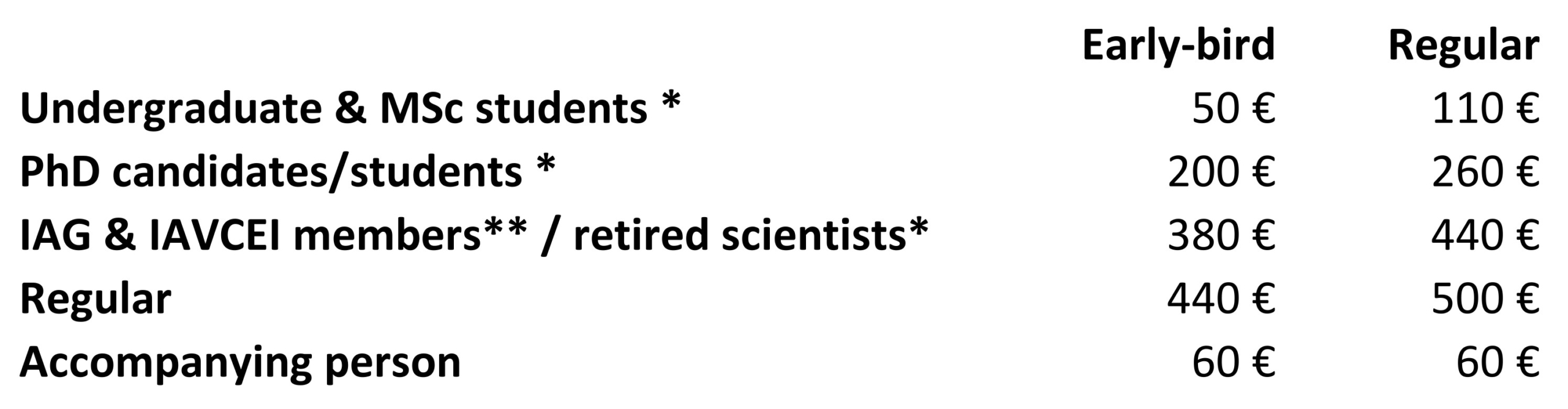
Registration fee includes access to conference facilities, lunch, morning and afternoon tea/coffee, ice breaker, conference dinner, and conference proceedings at the IAGS Proceedings Series in Springer Nature. Accompanying persons can join the icebreaker and conference dinner, but not scientific sessions and daily lunches and coffee/tea breaks. Please be aware that a credit card fee of 4% is added to the final registration fee.
On-site registration and cash payments are not available.
* For student and retired scientist prices, a justification will be required. A confirmation letter in English by the head of the Department/School/University is required for PhD, MSc and Undergraduate student status verification. Please send a copy of your justification to .
** IAG/IAVCEI members must provide proof of valid membership for 2026. Please send the membership certificate/proof to . IAG members can receive those by logging into the IAG membership portal.
If you are not sure, which category you belong to, please get in contact with us at .
Registration for in-person attendance is closed now.
Cancellation policy
Early bird and regular registrations cancelled before August 10th, 2026 will have a 30 € processing fee deducted from their refund. Cancellations received between August 11th and August 31st, 2026, are eligible for 50% refund of the registration fee. No refund is available for cancellations made after September 1st, 2026.
Participants
244Total
101On-site
143Remote
Registrations by country
Loading map…
Fewer registrationsMore registrations
List of Registered Participants
| Abdelrahim Ruby | Benha University | Egypt | Remote |
| Abdisa Koji | Madda Walabu University | Ethiopia | Remote |
| Abhay Pratap Singh | UGA | France | Remote |
| Abhishek Mhamane | University of Stuttgart | Germany | Remote |
| Adrian Nowak | Wrocław University of Environmental and Life Sciences | Poland | On-site |
| Alberto Escapa | University of León | Spain | Remote |
| Aleksander Partyka | Centrum Badań Kosmicznych PAN | Poland | On-site |
| Alessandra Borghi | Istituto Nazionale di Geofisica e Vulcanologia, Sezione di Bologna | Italy | On-site |
| Alexander Turner | Government of Alberta | Canada | Remote |
| Alireza Taheri Dehkordi | Lund University | Sweden | Remote |
| Aman kumar Choudhary | Bharathidasan university | India | Remote |
| Amarjargal SHARAV | Khureltogoot Astronomical Observatory, Institute for Astronomy and Geophysics, Mongolian Academy of Sciences | Mongolia | Remote |
| André Gebauer | Federal Agency for Cartography and Geodesy | Germany | On-site |
| Angela Meneses-Gutierrez | National Research Institute for Earth Science and Disaster Resilience | Japan | On-site |
| Ankita Nayak | India | Remote | |
| Anna Klos | Military University of Technology | Poland | On-site |
| Anna Riddell | Geoscience Australia | Australia | On-site |
| Annet Namugenyi | Institution of Surveyors Uganda | Uganda | Remote |
| Antonio Kruse | TU Delft | Netherlands | On-site |
| Anukul Dwivedi | Indian Institute of Technology | India | Remote |
| Arif Aditiya | Nagoya University | Japan | Remote |
| Arnab Laha | IIT Kanpur | India | Remote |
| Arttu Raja-Halli | Finnish Geospatial Research Institute, National Land Survey | Finland | On-site |
| Astha Moolchandani | Indian Institute of Science Education and Research Mohali | India | On-site |
| Athanassios Ganas | National Observatory of Athens | Greece | Remote |
| Avinash Mahech | WRMS | India | Remote |
| Aya Mohammed fouad | Aya foud | Egypt | Remote |
| Ayelen Pereira | CONICET-UNR | Argentina | Remote |
| Barbara Jenny | DTU Space | Denmark | Remote |
| Barklegn Sebsibe Belayneh | Space Science and Geospatial Institute | Ethiopia | Remote |
| Bemalu Agba | University of Nigeria Nsukka | Nigeria | Remote |
| Benedikt Soja | ETH Zurich | Switzerland | Remote |
| Benjamin Gutknecht | Universität Bonn, IGG | Germany | Remote |
| BHASKAR SHARMA | National Institute for Geoinformatics Science and Technology | India | Remote |
| Boaz Odhiambo Nyakongo | Hungary | On-site | |
| Carine Bruyninx | Royal Observatory of Belgium | Belgium | Remote |
| Carla Braitenberg | University of Trieste | Italia | Remote |
| Caroline van Calcar | TU Delft | The Netherlands | Remote |
| Cecilia Cornero | National University of Rosario | Argentina | Remote |
| Charlotte Petrikowski | Université Grenoble Alpes | France | Remote |
| Chengli Huang | Shanghai Astronomical Observatory | China | On-site |
| Chethan Varadaganahalli Anandagowda | Indian Institute of Science (IISc) | India | On-site |
| Christian Bizouard | Observatoire de Paris | France | On-site |
| Christian Solgaard | Technical University of Denmark | Denmark | On-site |
| Christopher Dieck | US Naval Observatory | USA | On-site |
| Clara Beck | Institute of Geodesy, University of Stuttgart | Germany | Remote |
| Claudia Flohrer | Federal Agency for Cartography and Geodesy (BKG) | Deutschland | Remote |
| Constanza Santori | Universidad de Chile | Chile | On-site |
| Cristian Garcia | GFZ Helmholtz Centre for Geosciences | Germany | On-site |
| Crystel Mae Delos Reyes | Philippine Institute of Volcanology and Seismology | Philippines | Remote |
| Dagva Baatarkhuu | institute of astronomy and geophysics | Mongolia | Remote |
| Daniel Alejandro Rico | Universidad Distrital Francisco José de Caldas | Colombia | Remote |
| Daniela Thaller | Federal Agency for Cartography and Geodesy | Germany | On-site |
| Danjal Berg | Technical University of Denmark | Denmark | On-site |
| Danny Tran | Viphap Co., Ltd. | Vietnam | Remote |
| Daoud Laariara | Université Catholique de Louvain (UCLouvain) | Belgium | On-site |
| Darija Sušac | Fugro | The Netherands | Remote |
| Dave Zilkoski | American Association for Geodetic Surveying | US | Remote |
| Devanshu Ghildiyal | UPES | India | Remote |
| Diana Carolina Hurtado Pulido | Purdue University | USA | On-site |
| Dimitris Papazachariou | Cyprus University of Technology | Cyprus | Remote |
| Dinesh Lamichhane | Jacksonville State University | United States | Remote |
| Dominika Staniszewska | Warsaw University of Technology | Poland | On-site |
| Donna dePolo | University of Colorado Boulder | USA | On-site |
| Dwijendra Nath Pandey | CSIR-National Geophysical Research Institute | India | On-site |
| Edilberto Suarez | Universidad Distrital | Colombia | Remote |
| Efe Turan Ayruk | Yildiz Technical University | Türkiye | Remote |
| Elena González Alonso | Instituto Geográfico Nacional | España | Remote |
| Enikő Barbély | HUN-REN Institute of Earth Physics and Space Science | Hungary | On-site |
| Enrico Serpelloni | Istituto Nazionale di Geofisica e Vulcanologia | Italy | Remote |
| Eri Huntington | University of Bonn | Germany | Remote |
| Ezequiel D. Antokoletz | Federal Agency for Cartography and Geodesy | Germany | On-site |
| Faramarz Nilfouroushan | Lantmäteriet | Sweden | On-site |
| Fathan Arga Alfausta Marsetyo | Bandung Institute of Technology | Indonesia | Remote |
| Federico Ibarra | IGN-Ar | Argentina | Remote |
| Fengchun Shu | Shanghai Astronomical Observatory | China | On-site |
| Filip Kostadinovic | The Republic Geodetic Authority | Republic Geodetic Authority of Serbia | Remote |
| Francesca Silverii | Istituto Nazionale di Geofisica e Vulcanologia | Italy | On-site |
| Francesco Matonti | Leica Geosystems | Switzerland | Remote |
| Francesco Pintori | Istituto Nazionale di Geofisica e Vulcanologia | Italy | On-site |
| FRANCISCO MORA | Cuatro Conceptos | Colombia | Remote |
| Franto Novico | Research Center for Geological Hazards | Indonesia | Remote |
| Franz Meyer | University of Alaska Fairbanks | USA | On-site |
| Fupeng Li | University of Bonn | Germany | On-site |
| Grace Carlson | Indiana University | USA | Remote |
| Grace Ertel | University of New Hampshire | USA | On-site |
| Grace Nield | Durham University | United Kingdom | On-site |
| Greta Bellagamba | University of Iceland | Iceland | On-site |
| Halfdan Pascal Kierulf | Norwegian Mapping Authority | Norway | On-site |
| Halldor Geirsson | University of Iceland | Iceland | On-site |
| Hans Mark Sentamu | ESIPPS | Uganda | Remote |
| Helio L. Guerra Neto | Michigan State University | USA | On-site |
| Helmut Titz | Federal Office of Metrology and Surveying | Austria | Remote |
| Henryk Dobslaw | GFZ Helmholtz Centre for Geosciences | Germany | On-site |
| Holger Steffen | Lantmäteriet | Sweden | On-site |
| Hristo Nikolov | SRTI-BAS | Bulgaria | Remote |
| Ibaad Anwar | Indian Institute of Technology Kanpur | India | Remote |
| Ibnu Nurul Huda | National Research and Innovation Agency | Indonesia | Remote |
| ignacio parada | Chile | Remote | |
| Ilya Oshchepkov | None | None | Remote |
| Imran Hussain | Institute of Mountain Hazards and Environment Chinese Academy of Science | China | Remote |
| Isaac Ojok | Kyambogo University | Uganda | Remote |
| ISMAIL Yakubu | University of Lagos | Nigeria | Remote |
| Iwona Kudłacik | Wroclaw University of Environmental and Life Sciences | Poland | On-site |
| Jaakko Mäkinen | Finnish Geospatial Research Institute FGI | Finland | Remote |
| Jamal Doski | Duhok Polytechnic University | Iraq | Remote |
| Janis Kaminskis | Civil Engineering | Latvia | Remote |
| Jeff Freymueller | Michigan State University | USA | On-site |
| Jefia Idolor | Obafemi Awolowo University | Nigeria | Remote |
| Jenan Rajavarathan | University of Tasmania | Australia | On-site |
| Jiacheng Liu | Nanjing University | China | On-site |
| John Bosco OGWANG | Institute of Survey & Land Management | Uganda | Remote |
| Jolanta Nastula | Centrum Badań Kosmicznych PAN | Poland | On-site |
| Jose Manuel FERRANDIZ | University of Alicante | Spain | On-site |
| Juan Manuel Quilaleo Quintrel | Individual | Chile | Remote |
| Julie Albaric | Univ. Marie and Louis Pasteur, Chrono-environnement | France | Remote |
| Julie Elliott | Michigan State University | USA | On-site |
| Juraj Papco | Slovak University of Technology | Slovakia | Remote |
| Justyna Śliwińska-Bronowicz | Centrum Badań Kosmicznych Polskiej Akademii Nauk (CBK PAN) | Poland | On-site |
| Karen Simon | Canadian Geodetic Survey, Natural Resources Canada | Canada | On-site |
| Kelvin Kirui | The Technical University of Kenya | Kenya | Remote |
| Krishna DVP | Indian Institute of Technology Bombay | India | Remote |
| Kryzelle Faye De Ocampo | Philippine Institute of Volcanology and Seismology | Philippines | Remote |
| Kuforijimi Olorunsola | University of Benin | Nigeria | Remote |
| Lan Zhang | Institute of Earthquake Forecasting, China Earthquake Administration | China | Remote |
| Lara Börger | University of Bonn | Germany | On-site |
| Laura Fernández | Univ. Nac. de La Plata | Argentina | Remote |
| Layachi Abdelkebir | National Higher School of Geodesy and Space Techniques (ENSGTS) | Algeria | On-site |
| Leonid Zotov | Lomonosov Moscow State University | Russia | Remote |
| Li Liu | Shenzhen Polytechnic University | China | On-site |
| Longjiang Tang | GFZ Helmholtz Centre for Geosciences | Germany | Remote |
| Lotfi Massarweh | TU Delft | Netherlands | Remote |
| Lucas Calado | UFPE | Brazil | Remote |
| LUIS RENÉ RUBÍN RODRIGUEZ | INOCAR | Ecuador | Remote |
| Luka Jović | Unaffiliated | Serbia | Remote |
| Lukas Jendges | University of Bonn | Germany | Remote |
| Lyubka Pashova | National Institute of Geophysics, Geodesy and Geography - Bulgarian Academy of Sciences | Bulgaria | Remote |
| Maciej Michalczak | AGH University of Krakow | Poland | On-site |
| MAGDALENA KUZMICZ-CIESLAK | UMBC/GESTAR II, ESI | United States | Remote |
| Malte Winther-Dahl | The Danish Agency for Climate Data | Denmark | Remote |
| Mandip Sond | Natural Resources Canada | Canada | Remote |
| Mara Figueroa Berroca | Jet Propulsion Laboratory | United States | Remote |
| Maria Davis | US Naval Observatory | USA | On-site |
| Marisa Nickola | HartRAO | South Africa | Remote |
| Markku Poutanen | Finnish Geospatial Research Institute FGI, NLS | Suomi | Remote |
| Martin Lidberg | Lantmäteriet | Sverige | On-site |
| Martin Sehnal | BEV - Federal Office of Metrology and Surveying | Austria | Remote |
| Masato Furuya | Hokkaido University | Japan | On-site |
| Matea Tomic | Aalto University | Finland | On-site |
| Matias Ivan Martinez Chamme | Subsecretaria Defensa Civil Salta | Argentina | Remote |
| Matt Garthwaite | CSIRO | Australia | On-site |
| Matthias Willen | TU Dresden | Germany | On-site |
| Małgorzata Wińska | Warsaw University of Technology | Poland | On-site |
| Md Sakaouth Hossain | University of Otago | New Zealand | Remote |
| Mefe Moses | Ahmadu Bello University Zaria | Nigeria | Remote |
| Mingyue Zhang | Leibniz University Hannover | Germany | On-site |
| Mizuki Matsuda | Earthquake Research Institute, the University of Tokyo | Japan | On-site |
| MJ Tourian | Institute of Geodesy | Germany | Remote |
| Mohamed Freeshah | UAE University | UAE | Remote |
| Mohamed Sharouda | State Key Laboratory of Information Engineering in Surveying, Mapping and Remote Sensing (LIESMARS) | China | Remote |
| Mohammad Bagherbandi | University of Gävle | Sweden | On-site |
| MORAD TAHER | Abdelmalek Essaadi University | Morocco | Remote |
| Mostafa Elwan | National Research Institute of Astronomy and Geophysics | Egypt | On-site |
| Mostafa Kiani Shahvandi | Department of Meteorology and Geophysics, University of Vienna | Austria | Remote |
| Muharrem Hilmi Erkoç | Yildiz Technical University | Türkiye | On-site |
| MUHD ASHRAAF MAD GANI | SINGAPORE LAND AUTHORITY | SINGAPORE | Remote |
| Mushtaq Ahmad | Student (Karlstads University) | Sverige | Remote |
| Mustafa Toker | Yuzuncu Yıl University | Türkiye | On-site |
| Mısra Gedik | Boğaziçi University | Türkiye | Remote |
| NABIL MD BOKHTIAR ABID | Al-Farabi Kazakh National University | Kazakhstan | On-site |
| Nadia Poddighe | University of Cagliari | Italy | Remote |
| Nancy Paola Gutiérrez Rueda | Servicio Geológico Colombiano | Colombia | Remote |
| Nidhi Parashar | CSIR - National Geophysical Research Institute | India | On-site |
| Nureldin Gido | Lantmäteriet | Sverige | Remote |
| Octalet Fenelus | Instituto Profesional SANTO TOMÁS | Chile | Remote |
| Oleg Titov | Shanghai Astronomical Observatory | China | On-site |
| Omena Idolor | University of Lagos | Nigeria | Remote |
| Patricia Rosell | Carleton University | Canada | Remote |
| Per-Anders Olsson | Lantmäteriet | Sverige | On-site |
| Peter Clarke | Newcastle University | UK | Remote |
| Pingping Huang | Innovation Academy for Precision Measurement Science and Technology, Chinese Academy of Sciences | China | On-site |
| Piolo Angelo Dumanao | National Mapping and Resource Information Authority | Philippines | Remote |
| Piolo Angelo Rosales | National Mapping and Resource Information Authority | Philippines | Remote |
| Pnina Miller | EarthScope Consortium | United States | Remote |
| Pramod G | Indian Institute of Technology - Kanpur | India | Remote |
| Rachael Nantale | National Building Review Board | Uganda | Remote |
| Rafailia-Maria Mavromatidou | Aristotle University of Thessaloniki | Greece | Remote |
| Raj Sunil Kandregula | Pukyong National University | South Korea | Remote |
| Ratnesh Kushwaha | IIT Kanpur | India | Remote |
| Ravi kumar Muppidi | CSIR NATIONAL GEOPHYSICAL RESEARCH INSTITUTE | India | Remote |
| Raymond Lapastora | NAMRIA | Philippines | Remote |
| Rebekka Steffen | Lantmäteriet | Sweden | On-site |
| Renata Urunova | Institute of Applied Astronomy RAS (IAA RAS) | Russia | On-site |
| Reyko Schachtschneider | GFZ Helmholtz Centre for Geosciences | Germany | On-site |
| Reza Rahimipour | University of Isfahan | Iran | Remote |
| Riccardo Riva | Delft University of Technology | Netherlands | On-site |
| Richard Gross | IAG | USA | On-site |
| Samuel Nahmani | IGN - IPGP | France | Remote |
| Samuel Yadeta | University of Warmia and Mazury in Olsztyn | Poland | Remote |
| Sarmistha Halder | Wadia Institute of Himalayan Geology | India | On-site |
| sasa lazic | RGA | Serbia | Remote |
| Sedigheh Karimi | University of Twente | Netherlands | On-site |
| Severine Rosat | ITES - CNRS | France | On-site |
| Sharyl Byram | US Naval Observatory | USA | On-site |
| Shijie Zhong | University of Colorado at Boulder | USA | On-site |
| Shivam Chawla | Indian Institute of Science Education and Research (IISER) Mohali | India | On-site |
| Sigrid Böhm | TU Wien | Austria | On-site |
| Sindy Lizarazo | Laboratory Magmas and Volcanoes | France | On-site |
| Soran Parang | Canadian Geodetic Survey, Natural Resources Canada | Canada | On-site |
| Stefan Krebs | Agency for Climate Data | Denmark | Remote |
| Sujata Dhar | TU Berlin | Germany | On-site |
| Susanna Ebmeier | University of Leeds | United Kingdom | Remote |
| Susanna Werth | Virginia Tech | USA | On-site |
| Syachrul Arief | Geospatial Information Authority of Indonesia | Indonesia | On-site |
| Takahiro Abe | Nagoya University | Japan | Remote |
| Takumi Kemmochi | Earthquake Research Institute, The University of Tokyo | Japan | On-site |
| Thiziri Saad | Université de Strasbourg EOST | France | On-site |
| Tobias Nilsson | Lantmäteriet | Sweden | On-site |
| Tobias Scheffler | Hochschule Magdeburg-Stendal | Germany | On-site |
| Tohid Nozadkhalil | Istanbul Technical University | Turkey | Remote |
| Ulrich Schreiber | Technical University of Munich (TUM) | Germany | On-site |
| Valentina R. Barletta | Technical University of Denmark | Denmark | On-site |
| Veronique Dehant | Universite catholique de Louvain (UCLouvain) | Belgium | Remote |
| Volker Klemann | GFZ Helmholtz Centre for Geosciences | Germany | On-site |
| Xiaoming Cui | Innovation Academy for Precision Measurement Science and Technology, Chinese Academy of Sciences | China | On-site |
| XueQing Xu | Shanghai Astronomical Observatory, Chinese Academy of Sciences | China | On-site |
| Yohannes Getachew Ejigu | Finnish Geospatial Research Institute | Finland | On-site |
| Yohei Kinoshita | Institute of Systems and Information Engineering, University of Tsukuba | Japan | Remote |
| Yosuke Aoki | Earthquake Research Institute, The University of Tokyo | Japan | On-site |
| Youssef Housien | Faculty of engineering at Shubra - Benha university | Egypt | Remote |
| Yufeng Nie | The Hong Kong Polytechnic University | China | Remote |
| Yuting Cheng | Royal Observatory of Belgium | Belgium | On-site |
| Zhen Hao Ng | Singapore Land Authority | Singapore | Remote |
| Zinovy Malkin | Pulkovo Observatory | Russia | Remote |
| Zouheir FATNASSI | Tunisia | Remote | |
| İlay Farımaz | Yildiz Technical University | Türkiye | Remote |
No matching published participant found.
The TIGER2026 Symposium in Geodesy will be held from September 28th to October 1st, 2026, at Gävle Konserthus.
Daily sessions are scheduled between 08:30 and 17:30, with a lunch break between 12:30 and 13:30 (see overview below). The icebreaker of the symposium will be on Sunday evening (18:00 to 21:00 CEST, September 27th) and the conference dinner on Wednesday evening (September 30th). An ECS (early career scientists) event will be on Tuesday evening.
Detailed programme of the TIGER Symposium 2026 is available here (version as of 18 September 2026; abstracts included) and below the figure.

Monday, September 28
All times in CEST (UTC+2).
08:00 - 08:30 | Registration and poster setup
Please arrive in good time before the start of the TIGER Symposium to collect your badge, if you have not already done so, and to mount your poster if it is scheduled for Monday.
08:30 - 09:00
Opening Session
Chair: Rebekka Steffen
- Welcome, logistics, and safety
09:00 - 10:15
Session: Earth rotation - Modelling and Prediction
Chair: Christian Bizouard
- A New Precession Model based on the Improved Earth’s J2 Long-term Variation | Jia-Cheng Liu (Nanjing University, China) | Onsite
- Short-term EOP forecasting: insights from the 2nd PCC and its ML-oriented follow-up | Justyna Śliwińska-Bronowicz (Centrum Badań Kosmicznych Polskiej Akademii Nauk (CBK PAN), Poland) | Onsite
- Discussion
10:15 - 10:45 | Coffee & Tea Break
Coffee, tea and water will be provided at the venue.
10:45 - 12:30
Poster session presentations - Earth rotation
Chair: Chris Dieck
Short presentations of posters scheduled for Monday (“Earth rotation” session).
12:30 - 13:30 | Lunch Break
Lunch is served at the venue.
13:30 - 14:30
Poster viewing time - Earth rotation
Onsite only
- Status of the IERS Conventions Updates | Sharyl Byram (US Naval Observatory, USA)
- Performance of IERS conventional models for diurnal and semidiurnal variations in UT1 and polar motion, assessed using a VLBI global solution | Sigrid Böhm (TU Wien, Austria)
- Using VLBI delay rate for estimation of the Earth’s instantaneous rotation pole | Oleg Titov (Shanghai Astronomical Observatory, China)
- Determination of the Earth’s dynamical flattening using VLBI observations and the IAU precession-nutation models | Jia-Cheng Liu (Nanjing University, China)
- Reassessment of geophysical fluid contributions to Earth rotation changes at subseasonal time scales | Jolanta Nastula (Centrum Badań Kosmicznych PAN, Poland)
- The role of GNSS data in unveiling the impact of crustal deformation on polar motion | Adrian Nowak (Wrocław University of Environmental and Life Sciences, Poland)
- Lunar Laser Ranging for the Determination of Earth Orientation Parameters | Mingyue Zhang (Leibniz University Hannover, Germany)
- A Machine Learning Ensemble Approach for Short-Term Polar Motion Prediction Using Rapid EOP and EAM Forecasts | Aleksander Partyka (Centrum Badań Kosmicznych PAN, Poland)
- Basic Earth Parameters from VLBI observations using Bayesian inversions in the time domain: updated insights of the Earth’s interior | Yuting Cheng (Royal Observatory of Belgium, Belgium)
- Comparison of Two Liouville-Based Computational Frameworks for Short-Term Earth Rotation Parameter Prediction | Maciej Michalczak (AGH University of Krakow, Poland)
- On the rapid EOP combination and evaluation | Chengli Huang (Shanghai Astronomical Observatory, China)
- Towards a new nutation model | Daoud Laariara (UCLouvain, Belgium)
- Core Flow Contribution to Intradecadal Polar Motion from Rotation and Gravimetric Observations | Daoud Laariara (UCLouvain, Belgium)
- Complete resolutions of polar motion and geodetic excitation equation for Earth’s rotation | XueQing Xu (Shanghai Astronomical Observatory, China)
- Diurnal and sub-diurnal Earth Rotation variations observed using VLBI | Tobias Nilsson (Lantmäteriet, Sweden)
- Advanced Provision of Stable Earth Orientation Parameters (AdvEOP) for Reference Frames | Daniela Thaller (BKG Frankfurt, Germany)
- German Research Unit RING (Rotations IN Physics, Geophysics, and Geodesy) for exploiting the potential of highly-accurate ring lasers for Earth rotation and seismology | Daniela Thaller (BKG Frankfurt, Germany)
- Preliminary Results on Coseismic Polar Motion Excitation: GRACE Forward Modeling and Multi-Method EOP Analysis for Four Megathrust Earthquakes | Li Liu (Shenzhen Polytechnic University, China)
- On the Gravitational Coupling Between the Inner Core and the Mantle in Space Gravimetry | Severiné Rosat (ITES – CNRS, France)
- Excitation of the free core nutation: an updated analysis over the period 1986-2026 | Christian Bizouard (Observatoire de Paris, France)
- Regional atmospheric contributions to ENSO-driven interannual variations in Earth’s rotation (LOD) | Małgorzata Wińska (Warsaw University of Technology, Poland)
- Bridging Multi-Band VLBI Networks: A Comparative Insight into Earth Orientation Parameters | Sujata Dhar (Technische Universität Berlin, Germany)
- Determination of Celestial Pole Offsets Using Intensive Sessions | Renata Urunova (Institute of Applied Astronomy of the Russian Academy of Sciences, Russia)
- Chandler wobble and LOD variations in recent epochs | Christian Bizouard (Observatoire de Paris, France)
14:30 - 16:15
Session: Earth rotation - Geophysical Excitation of Earth Rotation
Chair: Chengli Huang
- A journey from ocean dynamics to the excitation of low-frequency polar motion variability | Lara Börger (University of Bonn, Germany) | Onsite
- Recent advances in the field of Earth rotation: new geophysical insights | Mostafa Kiani Shahvandi (University of Vienna, Austria) | Online
- Discussion
16:15 - 16:45 | Coffee & Tea Break
Coffee, tea and water will be provided at the venue.
16:45 - 17:30
Summary of the day
Chairs: Chengli Huang, Christian Bizouard, Sigrid Böhm, Chris Dieck
Discussion and summary of the day
Tuesday, September 29
All times in CEST (UTC+2).
08:00 - 08:30 | Registration and poster setup
Please arrive in good time before the start of the TIGER Symposium to collect your badge, if you have not already done so, and to mount your poster if it is scheduled for Tuesday.
08:30 - 10:15
Session: Earth rotation - Progress of techniques and observations
Chair: Sigrid Böhm
- Progress in Inertial Earth Rotation Sensing utilizing Large Ring Lasers | Ulrich Schreiber (Technical University of Munich (TUM), Germany) | Onsite
- On the progress of VGOS network and UT1 intensive observation in China | Fengchun Shu (Shanghai Astronomical Observatory, China) | Onsite
- Discussion
10:15 - 10:45 | Coffee & Tea Break
Coffee, tea and water will be provided at the venue.
10:45 - 12:15
Poster session presentations - Tidal and non-tidal loading & Hydrologic signature in geodetic observations
Chair: Xiaoming Cui, Severine Rosat, Grace Carlson, Carla Braitenberg
Short presentations of posters scheduled for Tuesday – sessions “Tidal and non-tidal loading” & “Hydrologic signature in geodetic observations”.
12:15 - 12:30 | Group picture
Group picture on the stairs (either outside or inside, depending on weather).
12:30 - 13:30 | Lunch Break
Lunch is served at the venue.
13:30 - 14:30
Poster viewing time - Tidal and non-tidal loading & Hydrologic signature in geodetic observations
Onsite only
- Influence of Atmospheric Tides on Celestial Pole Offsets and Its Modulation by Climate Variability | Xiaoming Cui (Innovation Academy for Precision Measurement Science and Technology, Chinese Academy of Sciences, China)
- Characterizing ocean tide aliasing errors for improved gravity field recovery | Chethan Varadaganahalli Anandagowda (Interdisciplinary Centre for Water Research (ICWaR), Indian Institute of Science, India)
- Upper mantle anelasticity and its frequency dependence resolved by GPS in 3-D ocean tide loading displacements | Pingping Huang (Newcastle University, UK)
- Integrated Altimetry and Tide Gauge Analysis of Sea Level Change and Land Subsidence in Alexandria (1993-2026) | Mostafa Elwan (National Research Institute of Astronomy and Geophysics (NRIAG), Egypt)
- Evaluation of non-tidal loading effects derived from a high-resolution barotropic ocean model TiME with timeseries from superconducting gravimeters | Ezequiel D. Antokoletz (Federal Agency for Cartography and Geodesy (BKG), Germany)
- Solid Earth Tide Residuals as Indicators of the 18.6-Year Lunar Nodal Cycle in GNSS Time Series | Nabil Md Bokhtiar Abid (Al-Farabi Kazakh National University, Kazakhstan)
- Ocean Tide Loading in East Antarctica: A Comparison of SPOTL and LoadDef Solutions Using GNSS Observations | Arttu Raja-Halli (Finnish Geospatial Research Institute, National Land Survey, Finland)
- Optimization of Stochastic Models in Kinematic PPP for Ocean Tidal Loading Detection in East Antarctica | Yohannes Getachew Ejigu (Finnish Geospatial Research Institute, National Land Survey, Finland)
- Constraining Mantle Rheology with Long-Period Tides: comparison of modelled responses with superconducting gravimeters, low-degree time-variable space gravity, and length-of-day observations | Thiziri Saad (Université de Strasbourg EOST, France)
- GNSS-Based Insights into Topographic Effects on Rainfall-Induced Crustal Deformation During an Extreme Typhoon Event | Syachrul Arief (Geospatial Information Authority of Indonesia, Indonesia)
- Hydrologically Induced Viscoelastic Deformation in the Amazon Basin | Antonio Kruse (TU Delft, Netherlands)
- Hydrology-deformation coupling in the Central-Northern Apennines, Italy, from integrated satellite and in situ observations | Francesca Silverii (Istituto Nazionale di Geofisica e Vulcanologia, Italy)
- Estimation of the Hydrological Mass Balance in Europe from GNSS Observations | Alessandra Borghi (Istituto Nazionale di Geofisica e Vulcanologia, Italy)
- GRACE-derived land uplift model in Fennoscandia: Assessing the impact of hydrological loading on land uplift rates and uncertainty | Mohammad Bagherbandi (University of Gävle and KTH, Sweden)
- Towards Self-Consistent GNSS and GRACE Trends Across Canada | Soran Parang (Canadian Geodetic Survey, Natural Resources Canada, Canada)
- Joint inversion of GRACE and GRACE-FO for simultaneous estimation of terrestrial water storage anomalies and water fluxes | Sedigheh
Karimi (University of Twente, Netherlands) - FEATS-G: Quantifying the Potential of Quantum Space Gravimetry | Reyko Schachtschneider (GFZ Helmholtz Centre for Geosciences, Germany)
- Augmenting the ESA Earth System Model 3.0: Auxiliary datasets for geodetic method development | Henryk Dobslaw (GFZ Helmholtz Centre for Geosciences, Germany)
- Threats of Relative Sea Level Rise in Coastal Communities: InSAR and GNSS Measurements for Decadal Time Scales surrounding Lake Pontchartrain | Carolina Hurtado-Pulido (Purdue University, USA)
- Underestimated loading-driven land subsidence by Earth models amplifies relative sea-level rise | Fupeng Li (University of Bonn, Germany)
- Statewide Land Subsidence Using InSAR Analysis and Aquifer Storage Loss in Punjab, India | Shivam Chawla (IISER – Indian Institute of Science Education and Research, India)
- Multi-sensor InSAR-Derived Vertical Land Motion and Infrastructure Risk Assessment in Mumbai, India | Madhusmita Moolchandani (Odisha Space Application Centre (ORSAC), India)
14:30 - 16:15
Session: Tidal and non-tidal loading
Chair: Xiaoming Cui, Severine Rosat
- Self-Consistent Models of Earth’s Mantle and Core From Long-Period Seismic and Tidal Constraints | Federico Munch (ETH Zurich, Switzerland) | Onsite
- Improved hydrodynamical modelling of shallow-water tides by an updated bottom friction approach | Roman Sulzbach (GFZ Helmholtz Centre for Geosciences, Germany) | Onsite
- Discussion
16:15 - 16:45 | Coffee & Tea Break
Coffee, tea and water will be provided at the venue.
16:45 - 17:30
Summary of the day
Chair: Chengli Huang, Christian Bizouard, Sigrid Böhm, Chris Dieck, Xiaoming Cui, Severine Rosat
Discussion and summary of the day
18:00 - 22:00 | ECS Event
Event for early career scientists – Detailed information will be provided to all registered participants for this event.
Wednesday, September 30
All times in CEST (UTC+2).
08:00 - 08:30 | Registration and poster setup
Please arrive in good time before the start of the TIGER Symposium to collect your badge, if you have not already done so, and to mount your poster if it is scheduled for Tuesday.
08:30 - 10:15
Session: Hydrologic signature in geodetic observations
Chair: Grace Carlson, Carla Braitenberg
- Multi-Sensor Geodesy for Quantifying Water Storage Change, Groundwater Depletion and Recharge | Susanna Werth (Virginia Tech, USA)
- Towards a better understanding of GNSS-inferred TWS changes over Europe | Anna Klos (Military University of Technology, Poland)
- Discussion
10:15 - 10:45 | Coffee & Tea Break
Coffee, tea and water will be provided at the venue.
10:45 - 12:30
Poster session presentations - Cryospheric deformation of the solid Earth
Chair: Matthias Willen, Karen Simon
Short presentations of posters scheduled for Wednesday – session “Cryospheric deformation of the solid Earth”.
12:30 - 13:30 | Lunch Break
Lunch is served at the venue.
13:30 - 14:30
Poster viewing time - Cryospheric deformation of the solid Earth
Onsite only
- GIAmachine: a community-driven rescue and recovery initiative for legacy sea level and glacial isostatic adjustment modeling data | Holger Steffen (Lantmäteriet, Sweden)
- Geodetic Separation of Land Motion and Sea-Level Change in a GIA-Dominated Region | Muharrem Hilmi Erkoç (Yildiz Technical University, Türkiye)
- Climate-Driven Crustal Deformation on Svalbard | Halfdan P. Kierulf (Norwegian Mapping Authority, Norway)
- Time dependent Glacial Isostatic Adjustment in Iceland | Greta Bellagamba (University of Iceland, Iceland)
- Understanding Jakobshavn’s mass-transport variability from observations of ice, land, and ocean | Danjal L. Berg (Technical University of Denmark, Denmark)
- The Greenland GNSS Network (GNET): Long-Term Stability and Validation of Geodetic-Grade GNSS Measurements of Greenland’s 3D Bedrock Displacement from 1995-2025 | Christian Solgaard (Technical University of Denmark, Denmark)
- How is GRD affecting the Ice Dynamics and Sea-Level Rise Potential of the Northeast Greenland Ice Stream? | Grace Ertel (University of New Hampshire, USA)
- Turning GNSS Stations into Virtual Scales for Glaciers: A Paired Approach to Monitor Outlet Glacier Mass Change and Constrain GIA | Valentina Barletta (Technical University of Denmark, Denmark)
- Rethinking GIA: An Empirical Estimate of GIA-Induced Vertical Motion in the Great Lakes Basin | Helio L. Guerra Neto (Michigan State University, USA)
- Multi-scale Post-Fire Permafrost Deformation Revealed by InSAR, Onsite Survey and LiDAR in North Yukon, Canada | Masato Furuya (Hokkaido University, Japan)
- Reconciling inferences of mantle viscosity and late Quaternary ice history – the importance of an asthenosphere and 3-D viscosity | Shijie Zhong (University of Colorado at Boulder, USA)
- Modelling Canada’s complex 3D crustal motions using GNSS data and geophysical models | Karen M. Simon (Canadian Geodetic Survey, Natural Resources Canada, Canada)
- Unmasking the Signal Masquerade: Case studies of Surface Loading and Tectonic Aliasing for each Other | Jeff T. Freymueller (Michigan State University, USA)
- Absolute gravimetry in South Patagonia for geodynamic applications | André Gebauer (Federal Agency for Cartography and Geodesy, Germany)
- Multi-decadal changes in the Karakoram and Himalayan region glaciers since the 1970s | Sarmistha Halder (Wadia Institute of Himalayan Geology, India)
- Sensitivity of Antarctic GPS-derived bedrock motion to surface mass balance loading corrections and reference-frame realisation strategies | Jenan Rajavarathan (University of Tasmania, Australia)
- Tectonic strain in the Antarctic plate: constraints from GNSS, GRACE observations, and GIA models | Dwijendra N. Pandey (CSIR- National Geophysical Research Institute, India)
- How to account for ice sheets’ mass changes and GIA within a global inversion for sea-level contributions from satellite data? | Matthias Willen (TU Dresden, Germany)
- 3D vs. 1D viscosity structures when interpreting GIA induced VLM in Antarctica | Volker Klemann (GFZ Helmholtz Centre for Geosciences, Germany)
- Geodetic observations in West Antarctica reveal geodynamically consistent 3-D mantle viscosity | Donna dePolo (University of Colorado Boulder, USA)
- Observing surface elevation change in Dronning Maud Land using satellite altimetry data | Matea Tomić (Aalto University, Finland)
- Constraining viscosity structures for GIA modelling | Reyko Schachtschneider (GFZ Helmholtz Centre for Geosciences, Germany)
- The Geodynamics In ANTarctica based on REprocessing GNSS DAta INitiative (GIANT-REGAIN) Phase 2 | Matthias Willen (TU Dresden, Germany)
14:30 - 16:15
Session: Cryospheric deformation of the solid Earth
Chair: Matthias Willen, Karen Simon
- Constraining Earth structure and rheology beneath the Antarctic Peninsula: insights from GNSS data in a low viscosity region | Grace Nield (Durham University, UK) | Onsite
- Modelling the GIA contribution to secular geocentre and polar motion | Ricardo Riva (Delft University of Technology, Netherlands) | Onsite
- Discussion
16:15 - 16:45 | Coffee & Tea Break
Coffee, tea and water will be provided at the venue.
16:45 - 17:30
Summary of the day
Chair: Grace Carlson, Carla Braitenberg, Matthias Willen, Karen Simon
Discussion and summary of the day
19:00 - 22:00 | Conference dinner
Conference dinner.
Thursday, October 1
All times in CEST (UTC+2).
08:00 - 08:30 | Registration and poster setup
Please arrive in good time before the start of the TIGER Symposium to collect your badge, if you have not already done so, and to mount your poster if it is scheduled for Tuesday.
08:30 - 10:15
Session: Seismogeodesy
Chair: Jean-Mathieu Nocquet
- Evaluation of Subduction Zone Slip Behavior Through Multidisciplinary Data Sets: The Example of Alaska | Julie Elliott (Michigan State University, USA)
- Rethinking Intraplate Earthquakes: The Role of Inelastic Deformation in Stress Build-up | Angela Meneses-Gutierrez (National Research Institute for Earth Science and Disaster Resilience, Japan)
- Discussion
10:15 - 10:45 | Coffee & Tea Break
Coffee, tea and water will be provided at the venue.
10:45 - 12:30
Poster session presentations - Seismogeodesy & Volcanogeodesy
Chair: Jeff Freymueller
Short presentations of posters scheduled for Thursday – sessions “Seismogeodesy” & “Volcanogeodesy”.
12:30 - 13:30 | Lunch Break
Lunch is served at the venue.
13:30 - 14:30
Poster viewing time - Seismogeodesy & Volcanogeodesy
Onsite only
- Post-seismic off-fault moment tensor solutions after the 2023 Türkiye-Syria co-seismic mainshock (Mw 7.8, 7.7) and early on-fault aftershock sequence (SE-Anatolia, Türkiye) | Mustafa Toker (Yuzuncu Yıl University, Türkiye)
- AI-Based Multi-Source Integration of GNSS-Derived TEC for Pre-Seismic Ionospheric Anomaly Detection | Layachi Abdelkebir (National Higher School of Geodesy and Space Techniques (ENSGTS), Algeria)
- Postseismic Deformation in Andaman Nicobar Islands following the 2004 Sumatra-Andaman Megathrust Earthquake | Nidhi Parashar (CSIR – National Geophysical Research Institute, India)
- Assessment of the network operation of high-resolution Lippmann tiltmeters installed for the monitoring of the Mur-M\”{u}rz fault line (Austria) | Enikő Barbély (HUN-REN Institute of Earth Physics and Space Science, Hungary)
- Assessing GNSS Detectability of Transient Tectonic Deformation Under Cascadia-Constrained Observational Conditions | Cristian Garcia (GFZ Helmholtz Centre for Geosciences, Germany)
- Benchmarking Low-Cost and Geodetic-Grade GNSS and Accelerometer Systems for Seismogeodesy: The Shake Table Experiment Dataset | Iwona Kudłacik (Wrocław University of Environmental and Life Sciences, Poland)
- EPOS-GNSS Data and Products for Geodynamics | Rui Fernandes (University of Beira Interior, Portugal)
- A multiparametric and unsupervised-learning approach to characterize seismic and deformation variability during Villarrica’s eruptive cycle (2018-2019) | Constanza Santori (Universidad de Chile, Chile)
- Flank instability of Mauna Loa Volcano, Hawai’i, modulated by magma intrusion and eruption | Mizuki Matsuda (Earthquake Research Institute, The University of Tokyo, Japan)
- Integration of EGMS and GNSS Data for Strain Mapping and Uplift Acceleration Analysis at Campi Flegrei | Francesco Pintori (Istituto Nazionale di Geofisica e Vulcanologia, Italy)
- Detecting transient ground deformation associated with the 2015 magma intrusion event at Sakurajima Volcano, Japan, with GNSS kinematic positioning | Takumi Kemmochi (Earthquake Research Institute, The University of Tokyo, Japan)
- Galeras volcano slow deformation detected by ALOS-2 and Sentinel-1 interferometry (2016-2022) and BEM modeling of the deformation source | Sindy Lizarazo (Laboratory Magmas and Volcanoes, France)
- Monitoring of the Santorini 2025 volcano-tectonic unrest: contribution of GNSS data and international networks | Athanassios Ganas (National Observatory of Athens, Greece)
14:30 - 16:15
Session: Volcanogeoedesy
Chair: Constanza Santori
- Crustal deformation around volcanoes and glaciers in a rifting environment | Halldór Geirsson (University of Iceland, Iceland) | Onsite
- Monitoring active volcanoes with kinematic GNSS positioning | Yosuke Aoki (Earthquake Research Institute, The University of Tokyo, Japan) | Onsite
- Discussion
16:15 - 16:45 | Coffee & Tea Break
Coffee, tea and water will be provided at the venue.
16:45 - 17:00
Summary of the day
Chairs: nn
Discussion and summary of the day
17:00 - 17:30
Wrap up and Closing
Chair: Rebekka Steffen
Wrap up and closing of the TIGER Symposium in Geodesy 2026
Keynote speakers
Earth rotation
Lara Börger (University of Bonn, Germany)
Justyna Śliwińska-Bronowicz (Polish Academy of Sciences, Poland)
Fengchun Shu (Shanghai Astronomical Observatory, China)
Ulrich Schreiber (Technical University of Munich, Germany)
Jia-Cheng Liu (Nanjing University, China)
Mostafa Kiani Shahvandi (University of Vienna, Austria)
Earth tides and geodynamics
Roman Sulzbach (GFZ Helmholtz Centre for Geosciences, Germany)
Federico Munch (ETH Zurich, Switzerland)
Hydrologic signature in geodetic observations
Susanna Werth (Virginia Tech, USA)
Anna Klos (Military University of Technology, Warsaw, Poland)
Cryospheric deformation
Grace Nield (Durham University, UK)
Riccardo Riva (Delft University of Technology, Netherlands)
Seismogeodesy
Angela Meneses-Gutierrez (National Research Institute for Earth Science and Disaster Resilience, Japan)
Julie Elliott (Michigan State University, USA)
Volcanogeodesy
Halldór Geirsson (University of Iceland, Iceland)
Yosuke Aoki (The University of Tokyo, Japan)
Presentation guidelines
To support inclusive participation, we ask all presenters to follow the guidelines below when preparing talks and posters. These recommendations help ensure content is accessible to a wide range of attendees, including those with visual, auditory, or cognitive accessibility needs.
For poster presenters:
Poster Format
Please prepare your poster in portrait orientation with a maximum size of A0:
Width: 84.1 cm (33.11 in)
Height: 118.9 cm (46.81 in)
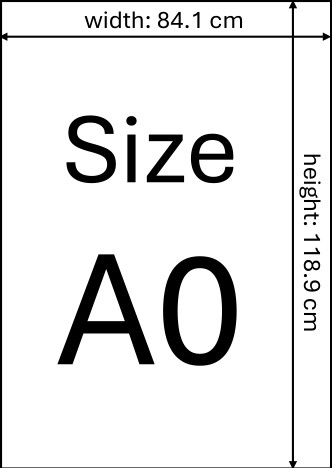
Please note that posters must be printed in advance and brought to the symposium. Printing facilities will not be available at the venue.
To enable virtual participants to view the posters, we kindly ask all presenters to upload a PDF version of their poster using the link provided in the email that will be sent to all poster presenters.
Poster Setup
Please mount your poster in the morning before the first session, between 08:00 and 08:30 CEST. A daily poster list will be provided, and each poster board will be assigned a number.
Poster Viewing Session
The official poster viewing time is 13:30–14:30 CEST, immediately following lunch. We encourage presenters to be present at their posters during this period to interact and discuss with attendees. In addition, please be around your poster also during the coffee breaks.
Two-Minute Poster Presentation
All poster presenters will have the opportunity to give a brief 2-minute presentation to introduce and promote their poster. These presentations will take place before lunch (10:45–12:30 CEST) on the day of your poster session.
Please prepare a presentation of no more than two slides and upload it as a PDF using the same link provided in the email that will be sent to all poster presenters.
General
Use large, readable fonts (recommended minimum: 24–32 pt for body text depending on poster size).
Ensure sufficient spacing between text blocks and figures.
Avoid low-contrast colour combinations (e.g., light grey on white).
Prioritise clear visual hierarchy (title → sections → details).
Ensure figures remain understandable when viewed from a short distance (1–2 metres).
Do not rely on colour alone to communicate information.
Ensure that all abbreviations and symbols are explained.
Aim for clarity over density: fewer, clearer elements are preferred over crowded posters.
Use colour -blind-friendly palettes for all plots and diagrams. Have a look here to learn more about using the right colours. Suitable colourmaps can be found here. Suitable colours can be found here, here, or here.
For keynote presenters:
Presentation format
Keynote presentations have a length of 25 minutes plus 5 minutes for questions.
Please use the upload link provided to all keynote speakers via email.
We recommend to use a 16:9 format for the slides.
General
Use a minimum font size of 24 pt for main text (larger for titles and key messages where possible).
Use high-contrast text and background combinations (e.g., dark text on a light background).
Avoid relying solely on colour to convey meaning (use labels, patterns, or symbols in addition to colour).
Keep slides visually uncluttered, focusing on one main idea per slide where possible.
Use sans-serif fonts (e.g., Arial, Helvetica, Calibri) for better readability.
Ensure figures, plots, and diagrams are legible when projected (avoid overly dense labels or small axis text).
Ensure that all abbreviations and symbols are explained.
Aim for clarity over density: fewer, clearer elements are preferred over crowded slides.
Consider that some attendees may access content in non-ideal viewing conditions (e.g., large rooms, mobile devices, or printed posters).
Use colour -blind-friendly palettes for all plots and diagrams. Have a look here to learn more about using the right colours. Suitable colourmaps can be found here. Suitable colours can be found here, here, or here.
Code of conduct
The workshop will follow the Code of Conduct of The International Union of Geodesy and Geophysics (IUGG) and their anti-harassment guidelines. IUGG opposes any discrimination or harassment based on such factors as age, citizenship, disability, ethnic origin, gender identity, language, political or other opinion, religion, or sexual orientation. We will follow IUGG’s Anti-Harassment Guidelines to prevent any form of harassment or discrimination, and to ensure an inclusive atmosphere that encourages the free expression and exchange of scientific ideas and results.
All attendees of the TIGER Symposium in Geodesy 2026 have a role to play in creating an inviting and harassment-free environment through their own behavior and by discouraging harassment and discrimination by others.
Behavior
- All attendees of the TIGER Symposium in Geodesy 2026 are treated with respect and consideration, valuing a diversity of views and opinions.
- The TIGER Symposium in Geodesy 2026 creates an environment to allow for the professional exchange of information.
- Be considerate, respectful and collaborative. Communicate openly with respect for others, critiquing ideas rather than individuals.
- Avoid personal attacks directed toward other attendees, the local organizers or guests. Be mindful of your surroundings and of your fellow participants.
- Alert the local organizers if you notice a dangerous situation or someone in distress.
Unacceptable Behavior
- Discrimination, harassment or intimidation is unacceptable and will not be tolerated. The local organizers may take any action necessary and deemed appropriate (see below) if attendees engage in unacceptable behavior including removal from the General Assembly without warning or refund.
- Recording or taking photography of another individual’s presentation without the explicit permission of the local organizers is not allowed.
- Disruption of talks at oral or poster sessions, any receptions, or at other events organized by the TIGER Symposium in Geodesy 2026 in other venues.
Reporting Unacceptable Behavior
- If you are the subject to unacceptable behavior or may have witnessed such behavior that violates professional and respectful participant conduct, please immediately notify the chairperson of the session if the incident has occurred during the meeting or local organizers.
- Notification can be done by contacting a local organizer on-site (e.g. at the registration desk) or you can e-mail your concern to .
- All reports will remain confidential.
Actions to prevent unacceptable behavior
- If a clear case of verbal discrimination, harassment or intimidation during a scientific session is established to have occurred, the Chairperson should act immediately to stop it. If the situation deteriorates, the Chairperson should ask the offender to leave the room.
- If any form of harassment occurs in a less openly visible way (e.g. during social activities or informal gatherings), the affected person and/or witness(es) should immediately report it to one of the organizers. The affected person has the option to pursue a formal procedure.
- In cases described above, the organizer should prepare written notes of the incident, attaching any evidence and identifying any witnesses. The organizer should then give the alleged offender the opportunity to be heard and to respond to the allegation.
- A full report of the incident should then be sent to the local organizers , who will promptly report to the IUGG Officers any case of harassment that occurred during an IUGG-supported meeting.
- Harassment incidents or behavior that occur outside IUGG activities referred to above will be considered only when a formal investigation of the case has been conducted by the relevant authority (e.g. the institution, to which the individual is affiliated) and made known to the IUGG Executive Committee. In those cases that involve an IUGG or Association officer, the Executive Committee may decide to take disciplinary actions against that person.
Travel Award
Travel awards for early career scientists will be provided via funding from IAG, IASPEI, IAVCEI, IACS, NSF (National Science Foundation) and the Carl Trygger Foundation. Application for travel award is closed. All applicants have been notified.
Travel
Gävle (Sweden) is located about 150 km to the north of Stockholm.
Arrival by airplane: The closest airport is Stockholm Arlanda Airport (airport code ARN), which has daily connections to many European and worldwide destinations through scheduled services of a large number of international airlines. It is the largest airport in Sweden. The airport has frequent train connections to Gävle via the station Arlanda C, which is located between the terminals 5 and 4.
Arrival by train: Gävle’s railway station is located very close to the city centre. Timetables and tickets are supplied by SJ.
Arrival by car: Those wishing to drive to Gävle need to enter the Scandinavian peninsula taking either a ferry to Gothenburg, Stockholm or Trelleborg, or using the Øresund Bridge, the connection between Denmark (Copenhagen) and Sweden (Malmö).
Visas: Sweden is a member of the European Union; therefore no visa is needed for E.U. citizens. Non ‐ E.U. participants should contact their nearest Swedish Embassy or Consulate for further information. For a complete list of countries who do need to apply for a visa, check this list of nationals who must be in possession of visas when entering Sweden. If you do need a visa, please visit this webpage to find more details. Those who require a formal invitation for the purpose of obtaining a visa, or raising travel funds in their country, may contact the local organizers via . A paid registration as well as an abstract submission to the meeting is required to receive a formal invitation letter. Participants who need to receive an official letter of invitation to obtain a visa, to raise travel funds, or for administrative purposes should ideally at the very latest apply for this document six to four months prior to the conference.
Travel insurance: Travel insurance and medical care, when needed, are solely under the responsibility of the participants.
Gävle
Gävle is a city located in Sweden, officially part of Norrland (the northernmost of the three traditional lands of Sweden). Gävle has around 100,000 inhabitants and is the 2nd largest city of Norrland (after Umeå). Gävle is famous for its goat, a goat made of hay raised during Christmas time in Gävle. Unfortunately, you won’t see it during your stay, but you may spot a couple of small colored goats made of stone in the streets. Besides this, a rock in the harbour of Gävle is very famous around sea-level researchers: the Celsius rock.
Travel to Gävle: More information can be found on the “Travel” tab and in the document provided to all registered attendees via the registration confirmation email.
Travel within Gävle: Several bus lines are available in Gävle that operate under X-trafik. Tickets can be obtained via the app or on the bus. No cash can be used. Payment is done with credit cards.
Hotels: Several hotels are located in the city centre. A list with codes for the time of the TIGER Symposium in Geodesy will be distributed to those who registered for the meeting via the registration confirmation email.
Conference venue: The meeting will take place at Gävle Konserthus. The venue is in walking distance of the city centre (500 m).
Conference dinner: The conference dinner will take place at Lilla Gasklockan, which is a bit further outside, but still within walking distance (2.3 km). A city bus (line 14) stops in front of the venue of the conference dinner as well as in the city centre.
Tourist information: All information is available online. In addition, you can find so-called InfoPoints througout the city.
Climate & Clothing: Temperatures can be between 0℃ and 20℃. Snow is very unlikely end of September and early October, but rain and wind are more common during the fall season.
Gävle & surrounding
Here are a few suggestions to visit, if you arrive earlier or stay a bit longer in Sweden:
Gävle:
Swedish Railway Museum
Swedish Prison Museum
Norrlandet seaside hiking trail
County Museum of Gävleborg
Near surrounding:
Billuddens nature reserve (close to Skutskär) – see changes in coastline due to the ongoing land uplift and a former fishing hamlet next to a natural harbor
Rönnåsen (close to Ockelbo) – see a former gravel beach (Klapperstensfält) of the Baltic Sea at ~190 m altitude (due to land uplift)
Further away:
Stockholm – Sweden’s capital
Uppsala – Scandinavia’s largest cathedral
Falun – Falun mine (UNESCO World Heritage Site)
High Coast – World’s highest coastline (UNESCO World Heritage Site, together with the Finnish Kvarken)
Miscellaneous
Q: Do I need a visa for Sweden?
A: Check this list of countries, whose nationals must apply for a visa before entering Sweden.
Q: How do I get a visa for Sweden?
A: Go to this website and check the guidelines on how to apply for a visa. If you need an invitation letter, please send an email to together with your registration confirmation for the TIGER 2026 Symposium in Geodesy.
Q: Where can I print my poster?
A: We recommend printing your poster at your work, but in case you forgot it or lost it on your way to Gävle, there is a printing shop not too far away from the conference venue: Reklam2002. Printing an A0 poster costs about 400 SEK (~38 Euros), can be done within a day, and the poster needs to be send via email or you stop by and have it ready on an USB drive.
Q: Where can I buy groceries?
A. ICA & Coop are in the city centre (close to most hotels), but other stores within a 2 km radius around the city centre are available as well.
Q. What does the power socket look like in Sweden?
A. Type F,C socket, 230V.
Q. Do I need to tip in Sweden?
A. It is not standard practice.
Q. What is the emergency number in Sweden?
A. 112. SMHI provides weather information and warnings.
Q. Can I swim at the beach?
A. Yes, but the water can be cold in October.
Q. Can I see the northern lights (aurora borealis) in Gävle?
A. Yes, it is possible to see the northern lights in Gävle, if sun activity is high. Check the forecast here or here or download an app to your mobile phone (e.g., “My Aurora Forecast”).
Q. I arrive a bit earlier or stay a bit longer in Gävle. What can I do?
A. Please check the “Gävle” tab for additional infos.
Q. How far is it to Onsala Space Observatory?
A. Onsala Space Observatory is close to Gothernburg in southern Sweden, along the west coast. You can reach Kungsbacka (the closest town to Onsala Space Observatory) with the train/bus within 6 hours or in about 7 hours with car. Please let us know (), if you are considering or are interested to visit Onsala Space Observatory during your stay in Sweden.
Any other question or a suggestion for the website? Ask us here.
Contact
Conference Coordination Team: or ask your question here.
Local Organizing Committee
Rebekka Steffen (Lantmäteriet, Sweden)
Holger Steffen (Lantmäteriet, Sweden)
Tobias Nilsson (Lantmäteriet, Sweden)
Per-Anders Olsson (Lantmäteriet, Sweden)
Faramarz Nilfouroushan (Lantmäteriet & University of Gävle, Sweden)
IAG as part of the IUGG


IAG Related Organisations
IAG collaborates closely with numerous organizations within geodesy and beyond. See the list for details.


This website is provided by the IAG Secretariat and the GGOS Coordinating Office, which are hosted by the BEV – Federal Office of Metrology and Surveying (Bundesamt für Eich- und Vermessungswesen) in Vienna, Austria.