• Link to LinkedIn
  • Link to Youtube
  • Link to Facebook
  • Link to Instagram
  • Link to X
  • Link to Telegram
  • Link to Behance
  • Link to Rss this site
  • Link to Mail
  • NEWS
  • EVENTS
  • JOBS
  • MEMBER
  • Sitemap
    • Home
      • NEWS
      • EVENTS
      • JOBS
      • MEMBERSHIP
    • ⭐ About Geodesy
    • 🏛️ IAG | International Association of Geodesy
      • About IAG
      • Structure
      • 🎓 ECS – Early Career Scientists
      • 🌈 IDEA – Inclusion, Diversity, Equity, Accessibility
    •   └─ Comissions
      • 1️⃣ Reference Frames
      • 2️⃣ Gravity Field
      • 3️⃣ Earth Rotation & Geodynamics
      • 4️⃣ Positioning & Applications
    •   └─ Inter Commission Committees
      • 📚 ICCT – Theory
      • 🌊 ICCM – Marine Research
      • 🌥️ ICCC – Climate Research
    •   └─ Project QuGe
    •   └─ Services
    • 🌍 GGOS | Global Geodetic Observing System
      • About GGOS
      • Structure
      • 🛰️ Observations
      • 📦 Products
      • ⚙️ Services
  • Shopping Cart Shopping Cart
    0Shopping Cart
geodesy.science - IAG website
  • GGOS
    • Home
      • NEWS
      • EVENTS
      • JOBS
      • MEMBERSHIP
    • ⭐ About Geodesy
    • 🏛️ IAG | International Association of Geodesy
      • About IAG
      • Structure
      • 🎓 ECS – Early Career Scientists
      • 🌈 IDEA – Inclusion, Diversity, Equity, Accessibility
    •   └─ Comissions
      • 1️⃣ Reference Frames
      • 2️⃣ Gravity Field
      • 3️⃣ Earth Rotation & Geodynamics
      • 4️⃣ Positioning & Applications
    •   └─ Inter Commission Committees
      • 📚 ICCT – Theory
      • 🌊 ICCM – Marine Research
      • 🌥️ ICCC – Climate Research
    •   └─ Project QuGe
    •   └─ Services
    • 🌍 GGOS | Global Geodetic Observing System
      • About GGOS
      • Structure
      • 🛰️ Observations
      • 📦 Products
      • ⚙️ Services
  • About
    • About GGOS
      • What is GGOS?
      • Why GGOS?
      • Dual Roles of GGOS
      • Vision and Mission
      • GGOS History
  • Structure
    • Governance & Leadership
      • Governing Board GB
      • Executive Committee EC
    • Coordinating Office CO
    • Science Panel
    • Bureaus
      • BNO – Networks and Observations
      • BPS – Products and Standards
    • Focus Areas
      • Geohazards Monitoring
      • Geodetic Space Weather Research
      • Artificial Intelligence for Geodesy (AI4G)
    • GGOS Affiliates
      • GGOS Japan
      • GGOS D-A-CH
      • GGOS IberAtlantic
    • GGOS Committees & Working Groups
  • Observations
  • Services
  • Products
  • Resources
    • Resources Overview
    • Outreach Materials
    • Logos & Organisation Chart
    • Reports and Articles
    • Presentations and Videos
    • GGOS Meeting Reports
    • Terms of Reference and Strategy
  • Click to open the search input field Click to open the search input field Search
You are here: Home1 / IAG GGOS2 / GGOS Observations3 / GNSS Radio Occultation
Follow a manual added link

GNSS Radio Occultation

During the last two decades, the satellite-based GNSS radio occultation technique has been developed as an innovative remote sensing method for vertical profiling of the Earth’s lower and upper atmosphere on a global scale with numerous applications, e.g. in tropospheric, ionospheric, space weather and climate sciences.
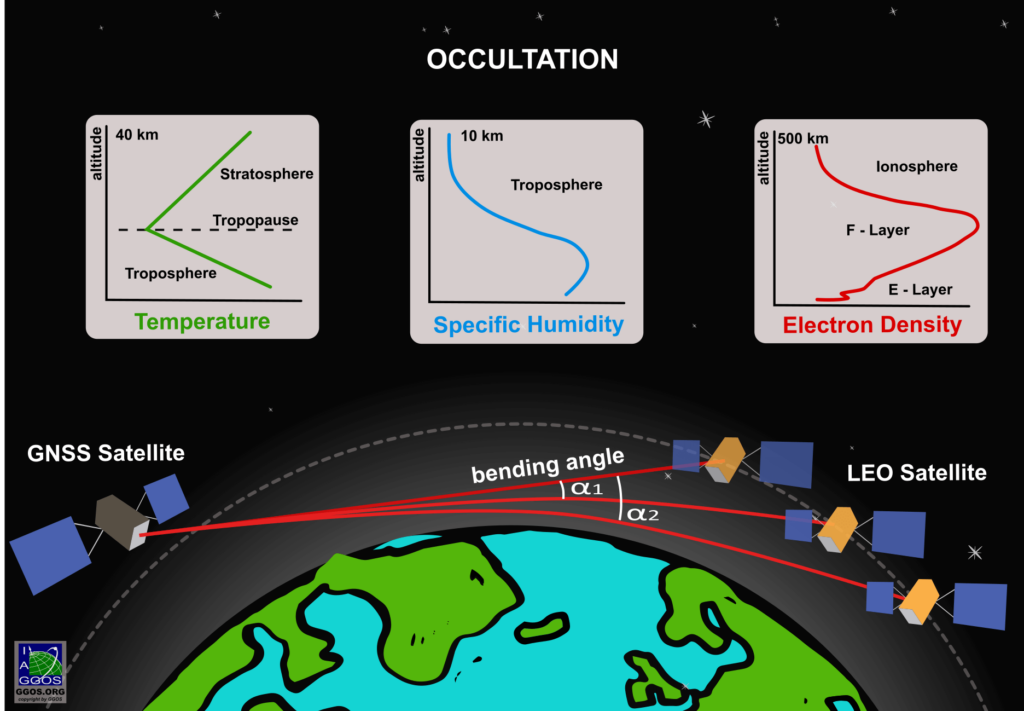
© GGOS (Created by Martin Sehnal) Info Info

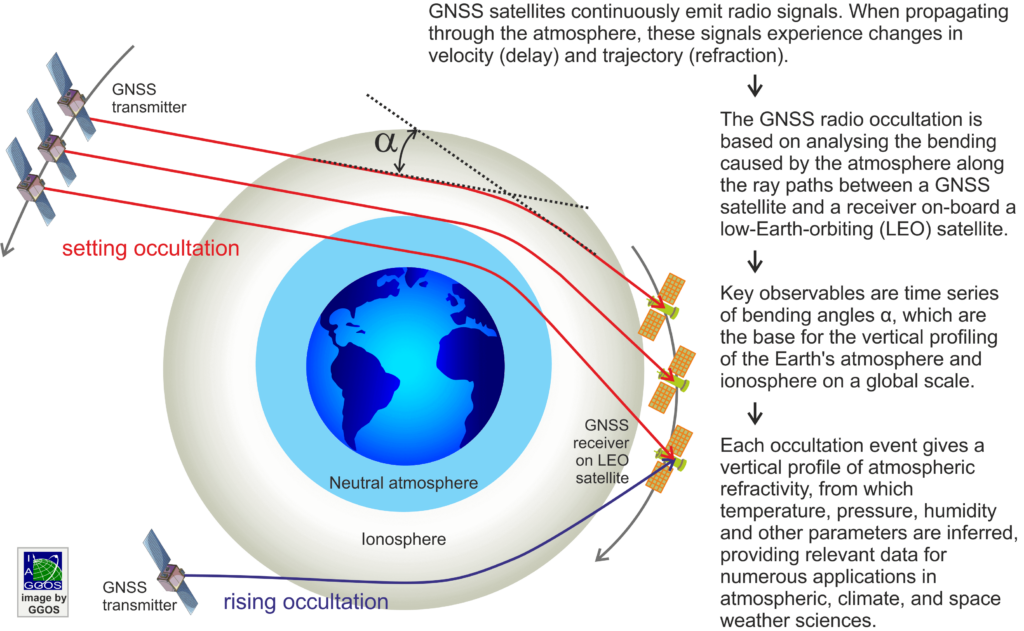
Figure 1: Vertical profiling of the Earth’s lower atmosphere (troposphere, stratosphere) and upper atmosphere (ionosphere) by means of GNSS occultation measurements. [Figure by M. Sehnal ©GGOS]

With a GNSS receiver onboard a low-Earth orbiting (LEO) satellite with an altitude of less than 1000 km, the signal transmitted by a GNSS satellite can be received by the LEO satellite passing through the Earth’s atmosphere in a limb sounding geometry. This refers to the GNSS Radio Occultation (GNSS-RO) technique, which allows to observe global characteristics of the Earth’s lower and upper atmosphere, with a unique combination of global coverage, high precision, high vertical resolution, long-term stability, and all-weather viewing (occultation, Latin: occultare: to cover something).

As can be seen from Fig. 1 the signal source, i.e. the GNSS transmitter, can reach an elevation angle below zero from the LEO receiver perspective. It is distinguished between setting and rising occultations as defined by increasing or decreasing signal elevations, i.e. the signal bending (see Fig. 2). The strength of bending will change due to the vertical variation of the atmospheric refractive index. In the neutral atmosphere, the refractive index is depending on temperature and humidity, in the ionosphere on the electron density. For the evaluation of the RO measurements the precise knowledge of LEO and GNSS satellite positions and velocities is required.

Final data products of GNSS-RO are refractivity, air pressure, and temperature profiles in the altitude range up to around 40 km and the lower troposphere water vapor information, as well as electron density profiles from 60 km up to the LEO orbital height. With only one LEO satellite, around 500 globally distributed atmospheric profiles are available daily for “GPS-only” usage. With a multi-GNSS capability of the satellite receiver (also considering, e.g. Galileo satellites) this number increases significantly.
Read More ...
© GGOS (Created by Laura Sanchez) Info Info

Figure 2: Setting and rising GNSS Radio Occultation scenarios for monitoring the upper atmosphere (ionosphere) and the lower atmosphere (neutral atmosphere). [Figure by L. Sánchez ©GGOS]


Applications

In the lower troposphere, GNSS-RO measurements can be used for the estimation of the planetary boundary layer height and for the determination of tropospheric water vapor. All leading weather service centers assimilate GNSS-RO data and there is a significant high impact of GNSS-RO data for the reduction of forecast errors.
The high accuracy of global GNSS-RO observations in the upper troposphere and lower stratosphere (UTLS) make them ideal for lower atmospheric and climate applications as well as for weather forecast. To be more specific, long-term GNSS-RO data are used for climate monitoring and trend detection in the UTLS and serve as benchmark data for the validation and calibration of other satellite datasets. The high vertical resolution of GNSS-RO observations allows for studying the tropopause dynamics and related UTLS phenomena like gravity wave analysis.

A precise knowledge of the electron density as the most important key parameter of the ionosphere is essential for ionosphere research. It also plays a crucial role in a wide range of applications, e.g. positioning, navigation and autonomous driving. Ionosphere is also seen as a manifestation of space weather, i.e. it reflects the response of the Earth to solar phenomena such as solar wind and coronal mass ejections.

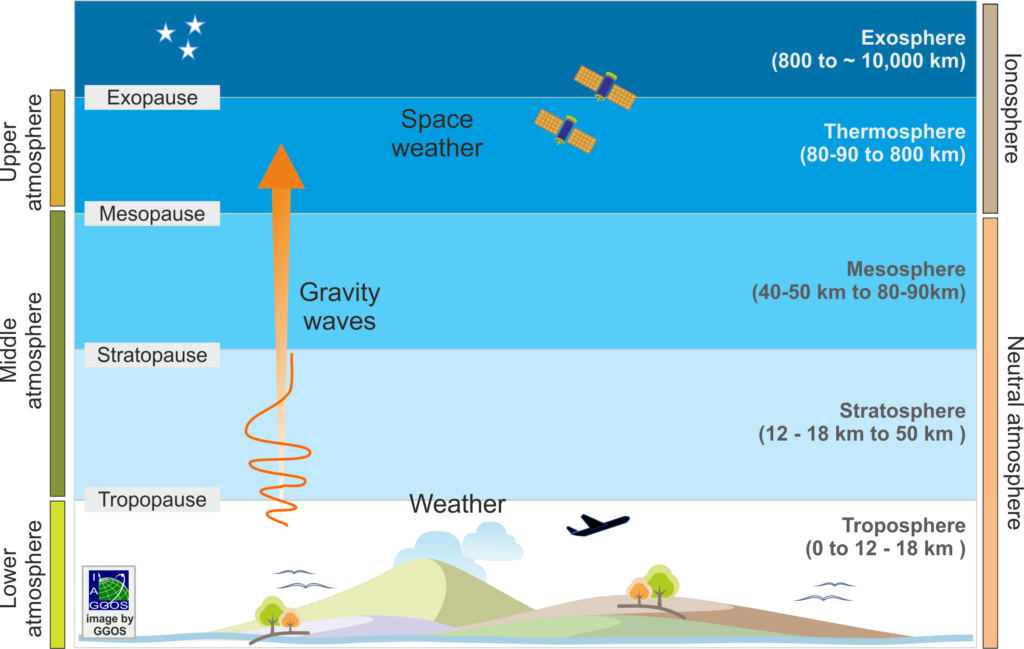
The thermosphere coincides with the region of highest ionization (see Fig. 3). Consequently, strong physical interactions exist between the thermospheric neutral density as the most important non-gravitational quantity in precise orbit determination of LEO satellites and the electron density of the ionosphere.

Infrastructure

The US GPS/MET mission (launch 1995) was pioneering the GNSS-RO technique and provided the proof-of-concept. The international breakthrough of GNSS-RO for operational applications came with the German satellite CHAMP, which was launched on July 15, 2000 and delivered highly accurate observation data in near-real time until the end of the mission in 2010. Important follow-on missions are Formosat-3/COSMIC, Metop, GRACE, GRACE-FO, TerraSAR-X/TanDEM-C and Formosat-7/COSMIC-2. Recently, also commercial satellite operators such as SPIRE provide GNSS-RO data with high quality from small satellite constellations.
© GGOS (Created by Laura Sanchez) Info Info

Figure 3: Stratification of the atmosphere according to the altitude (left), the temperature (mid) and the ionization (right). [Figure by L. Sánchez ©GGOS]

Further Information

In the frame of the International Association of Geodesy (IAG), the following components concentrate on advancing sciences and applications of GNSS-RO:

  • IAG Sub-Commission 4.3: Atmospheric Remote Sensing

  • IAG Inter-Commission Committee on Geodesy for Climate Research (ICCC)

  • GGOS Focus Area on Geodetic Space Weather Research

Additional (selected) sources are:
  • GFZ - GNSS Radio Occultation

  • GFZ - Radio Occultation Data

  • COSMIC

    Constellation Observing System for Meteorology Ionosphere and Climate

  • NASA

    GNSS Radio Occultation Data in the AWS Cloud

  • Satellite Mission - Formosat 7

  • Terrasar-X

    Science Service System

  • Tandemx

  • Metop Series

    Polar-orbiting satellites providing global data for weather forecasts up to 10 days and climate monitoring

  • EUMETSAT

    ROM SAF Radio Occultation Climate Data Record – GRACE

© GGOS (Prepared by: J. Wickert, T. Schmidt, M. Schmidt, L. Sanchez, M. Sehnal)

Share

  • GNSS%20Radio%20Occultation' data-av_svg_icon='facebook' data-av_iconset='svg_entypo-fontello' title='' data-avia-related-tooltip='Share on Facebook'> Facebook Facebook Share on Facebook
  • GNSS%20Radio%20Occultation&url=https://geodesy.science/?p=11075' data-av_svg_icon='x-twitter' data-av_iconset='svg_entypo-fontello' title='' data-avia-related-tooltip='Share on X'> X-twitter X-twitter Share on X
  • Whatsapp Whatsapp Share on WhatsApp
  • GNSS%20Radio%20Occultation&media=https%3A%2F%2Fgeodesy.science%2Fwp-content%2Fuploads%2Fggos-obs-GNSS-Occultation.svg' data-av_svg_icon='pinterest' data-av_iconset='svg_entypo-fontello' title='' data-avia-related-tooltip='Share on Pinterest'> Pinterest Pinterest Share on Pinterest
  • GNSS%20Radio%20Occultation&url=https://geodesy.science/item/gnss-radio-occultation/' data-av_svg_icon='linkedin' data-av_iconset='svg_entypo-fontello' title='' data-avia-related-tooltip='Share on LinkedIn'> Linkedin Linkedin Share on LinkedIn
  • GNSS%20Radio%20Occultation&body=https://geodesy.science/item/gnss-radio-occultation/' data-av_svg_icon='mail' data-av_iconset='svg_entypo-fontello' title='' data-avia-related-tooltip='Share by Mail'> Mail Mail Share by Mail

Geodetic Observations - Geodesy

Observation Types

  • GNSS Radio Occultation
  • Icon GGOS Observation Technique© TheNounProject
    VLBI
  • Icon GGOS Observation Technique© TheNounProject
    SLR / LLR – Laser Ranging
  • Icon GGOS Observation Technique© TheNounProject
    DORIS
  • Icon GGOS Observation Technique© TheNounProject
    GNSS
  • Icon GGOS Observation Technique© TheNounProject
    Satellite Altimetry
  • Icon GGOS Observation Technique© TheNounProject
    Satellite Gravimetry
  • Icon GGOS Observation Technique© TheNounProject
    Terrestrial Gravimetry
  • Icon GGOS Observation Technique© TheNounProject
    Tide Gauge Measurements
  • Icon GGOS Observation Technique© TheNounProject
    GNSS Reflectometry
  • Icon GGOS Observation Technique© TheNounProject
    Quantum Gravimetry
  • Icon GGOS Observation Technique© TheNounProject
    Optical Atomic Clocks
  • Icon GGOS Observation Technique
    GGOS Core Sites
Search Search

IAG as part of the IUGG

  
The International Association of Geodesy (IAG)  is a constituent association of the International Union of Geodesy and Geophysics (IUGG).

IAG Related Organisations

IAG collaborates closely with numerous organizations within geodesy and beyond. See the list for details.

Sitemap

  • Home | geodesy.science
  • ⠀└─ 📰News
  • ⠀└─ 📅 Events
  • ⠀└─ 💼 Jobs
  • ⠀└─ 👥 Membership
  • ⭐ About Geodesy
  • 🏛️ IAG | Int. Association of Geodesy
  • ⠀└─ ➡️ Commissions:
  • ⠀⠀◻️ 1 – Reference Frames
  • ⠀⠀◻️ 2 – Gravity Field
  • ⠀⠀◻️ 3 – Earth Rotation & Geodynamics
  • ⠀⠀◻️ 4 – Positioning and Applications
  • ⠀└─ 🔀 Inter Commission Committees:
  • ⠀⠀◻️ ICCT – Theory
  • ⠀⠀◻️ ICCM – Marine Research
  • ⠀⠀◻️ ICCC – Climate Research
  • ⠀└─ ⏰ Project QuGe
  • ⠀└─ ⚙️ IAG Services
  •  🌎 GGOS | Observing System
  • ⠀└─ About GGOS
  • ⠀└─ Structure
  • ⠀└─ Observations
  • ⠀└─ Products
  • ⠀└─ Services

References

Geodesy Glossary

Media Library

IAG Cloud | Public Documents

Terms of Use / Privacy Policy

IAG Statutes

IAG By-laws

Contact Us

Contact

Follow Us

LinkedIn

BlueSky

X (Twitter)

Facebook

Instagram

YouTube

Telegram

RSS Feed

Mailing List

This website is provided by the IAG Secretariat and the GGOS Coordinating Office, which are hosted by the BEV – Federal Office of Metrology and Surveying (Bundesamt für Eich- und Vermessungswesen) in Vienna, Austria.

Website Language Translation

The primary language of this website is English – however, the integrated GTranslate tool enables automatic translation into several languages:

Please note that translations into other languages may not be accurate. For reliable information, refer to the English version of the website.

2026 © Copyright | IAG - International Association of Geodesy
  • Link to LinkedIn
  • Link to Youtube
  • Link to Facebook
  • Link to Instagram
  • Link to X
  • Link to Telegram
  • Link to Behance
  • Link to Rss this site
  • Link to Mail
Scroll to top Scroll to top Scroll to top
Accessibility Adjustments

Powered by OneTap

How long do you want to hide the toolbar?
Hide Toolbar Duration
Select your accessibility profile
Vision Impaired Mode
Enhances website's visuals
Seizure Safe Profile
Clear flashes & reduces color
ADHD Friendly Mode
Focused browsing, distraction-free
Blindness Mode
Reduces distractions, improves focus
Epilepsy Safe Mode
Dims colors and stops blinking
Content Modules
Font Size

Default

Line Height

Default

Color Modules
Orientation Modules