• Link to LinkedIn
  • Link to Youtube
  • Link to Facebook
  • Link to Instagram
  • Link to X
  • Link to Telegram
  • Link to Behance
  • Link to Rss this site
  • Link to Mail
  • NEWS
  • EVENTS
  • JOBS
  • MEMBER
  • Sitemap
    • Home
      • NEWS
      • EVENTS
      • JOBS
      • MEMBERSHIP
    • ⭐ About Geodesy
    • 🏛️ IAG | International Association of Geodesy
      • About IAG
      • Structure
      • 🎓 ECS – Early Career Scientists
      • 🌈 IDEA – Inclusion, Diversity, Equity, Accessibility
    •   └─ Comissions
      • 1️⃣ Reference Frames
      • 2️⃣ Gravity Field
      • 3️⃣ Earth Rotation & Geodynamics
      • 4️⃣ Positioning & Applications
    •   └─ Inter Commission Committees
      • 📚 ICCT – Theory
      • 🌊 ICCM – Marine Research
      • 🌥️ ICCC – Climate Research
    •   └─ Project QuGe
    •   └─ Services
    • 🌍 GGOS | Global Geodetic Observing System
      • About GGOS
      • Structure
      • 🛰️ Observations
      • 📦 Products
      • ⚙️ Services
  • Shopping Cart Shopping Cart
    0Shopping Cart
geodesy.science - IAG website
  • GGOS
    • Home
      • NEWS
      • EVENTS
      • JOBS
      • MEMBERSHIP
    • ⭐ About Geodesy
    • 🏛️ IAG | International Association of Geodesy
      • About IAG
      • Structure
      • 🎓 ECS – Early Career Scientists
      • 🌈 IDEA – Inclusion, Diversity, Equity, Accessibility
    •   └─ Comissions
      • 1️⃣ Reference Frames
      • 2️⃣ Gravity Field
      • 3️⃣ Earth Rotation & Geodynamics
      • 4️⃣ Positioning & Applications
    •   └─ Inter Commission Committees
      • 📚 ICCT – Theory
      • 🌊 ICCM – Marine Research
      • 🌥️ ICCC – Climate Research
    •   └─ Project QuGe
    •   └─ Services
    • 🌍 GGOS | Global Geodetic Observing System
      • About GGOS
      • Structure
      • 🛰️ Observations
      • 📦 Products
      • ⚙️ Services
  • About
    • About GGOS
      • What is GGOS?
      • Why GGOS?
      • Dual Roles of GGOS
      • Vision and Mission
      • GGOS History
  • Structure
    • Governance & Leadership
      • Governing Board GB
      • Executive Committee EC
    • Coordinating Office CO
    • Science Panel
    • Bureaus
      • BNO – Networks and Observations
      • BPS – Products and Standards
    • Focus Areas
      • Geohazards Monitoring
      • Geodetic Space Weather Research
      • Artificial Intelligence for Geodesy (AI4G)
    • GGOS Affiliates
      • GGOS Japan
      • GGOS D-A-CH
      • GGOS IberAtlantic
    • GGOS Committees & Working Groups
  • Observations
  • Services
  • Products
  • Resources
    • Resources Overview
    • Outreach Materials
    • Logos & Organisation Chart
    • Reports and Articles
    • Presentations and Videos
    • GGOS Meeting Reports
    • Terms of Reference and Strategy
  • Click to open the search input field Click to open the search input field Search
You are here: Home1 / IAG GGOS2 / GGOS Observations3 / Optical Atomic Clocks
Follow a manual added link
Icon GGOS Observation Technique

Optical Atomic Clocks

At present, the use of optical atomic clocks for geodetic observations and geodetic networks is in an experimental stage. However, it could become a very important operational technique in the future. Experimental atomic clocks (or frequency standards) in metrology laboratories today provide extremely precise frequencies based on a rich variety of energy transitions in different atomic species. The experiments make use of sophisticated quantum metrology procedures. Evaluations of the frequency measurements show mind-blowing precision with relative frequency inaccuracies that are currently at the level of 10-18 only, making the measurements the most precise of any physical quantity.  
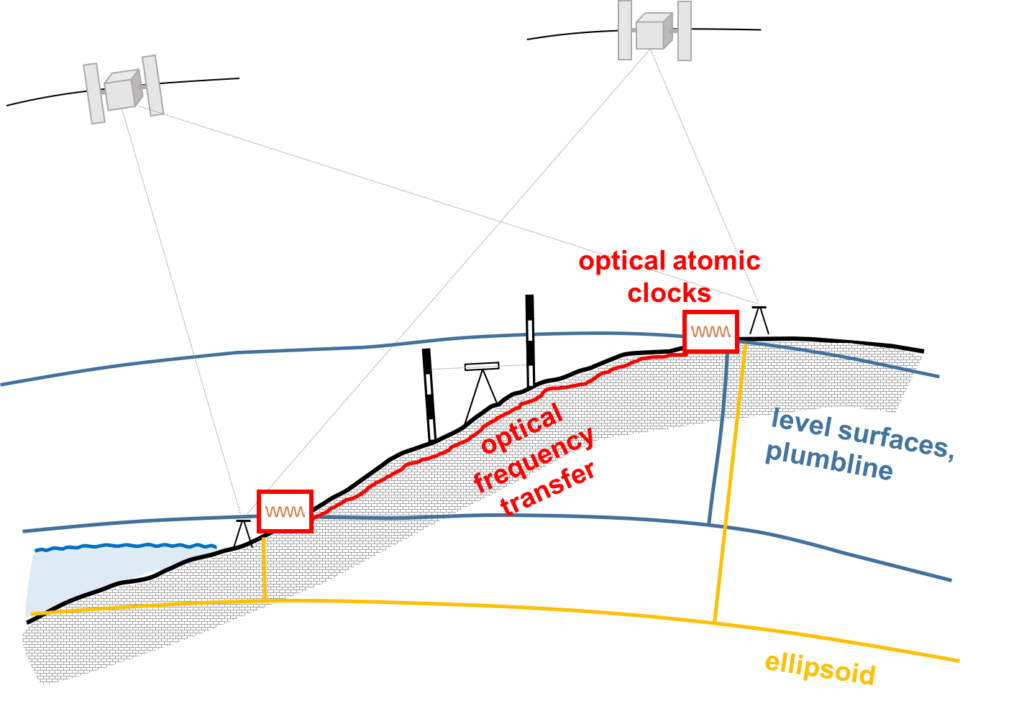
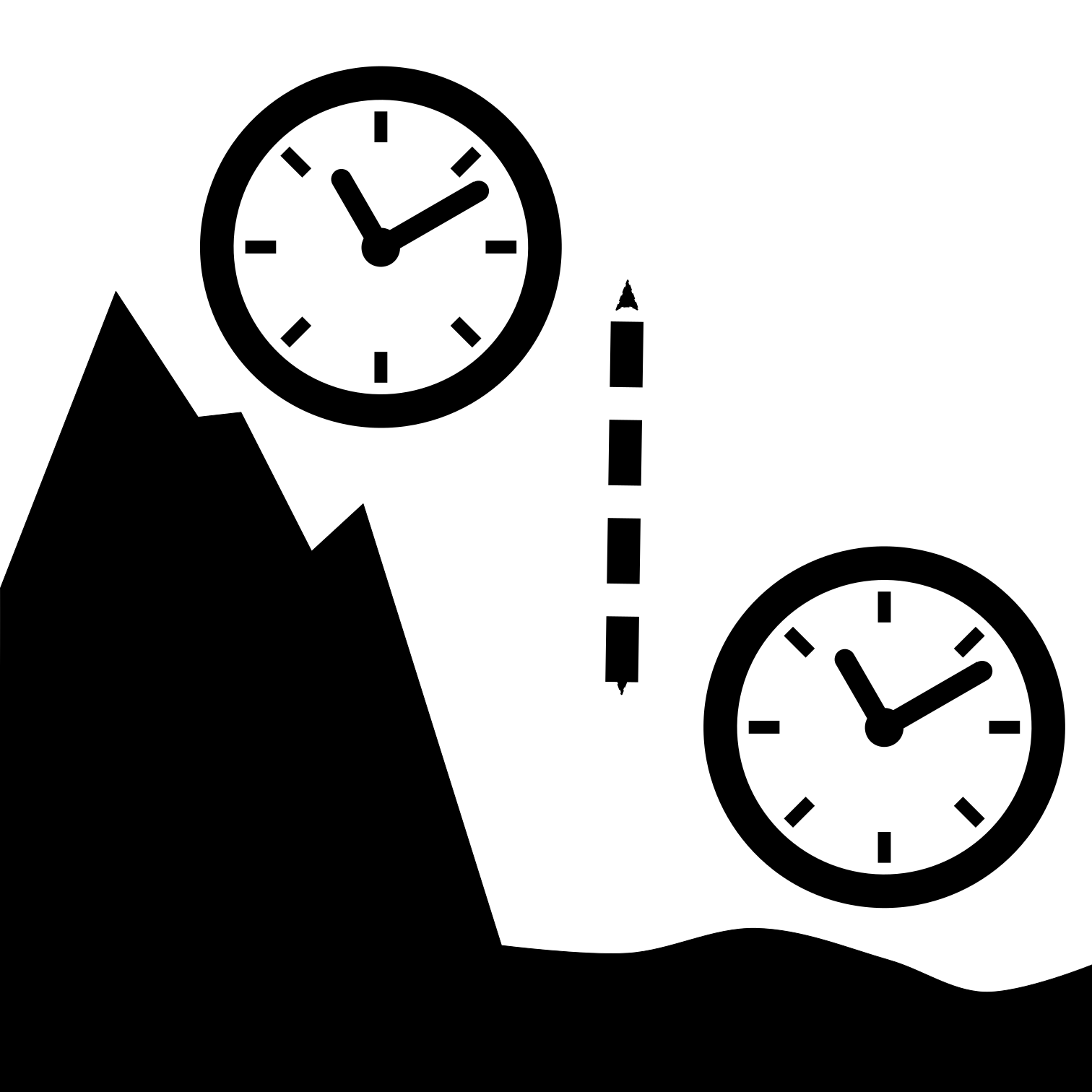
Caption: Determination of potential differences by comparing frequencies of optical atomic clocks located at different heights.
Jakob Flury Info Info

Determination of potential differences by comparing frequencies of optical atomic clocks located at different heights.

When frequencies generated by clocks at different sites are compared at this level of precision (10-18), the comparison contains the relativistic gravitational frequency redshift due to the different height (and gravity potential) of the sites, as described by General Relativity. Today, the most accurate frequency transfer between sites is by phase-stabilized optical fiber, which has been demonstrated to work on continental scale without loss of precision (see figure above). In the future, also optical frequency transfer through satellites will be a candidate technology. Remote frequency comparisons are essential for the preparation of a re-definition of the second (as an unit of the International System of Units) that is currently ongoing led by the Consultative Committee on Time and Frequency (CCTF, https://www.bipm.org/en/committees/cc/cctf) of the Bureau International des Poids et Mesures (BIPM).

Read More ...

Chronometric Leveling

On the other hand, the measurement of the frequency redshift between sites makes chronometric leveling possible by converting frequency differences to height differences and gravity potential differences. The results of chronometric leveling are comparable to the determination of height and potential differences by classical methods such as first order spirit leveling or the gravimetric GNSS/geoid approach. The fascination and important strength of the relativistic approach is, however, that it is a much more direct measurement technique and immediately based on atomic standards. For future continental or global height systems, it is expected that the relativistic method in combination with the classical approaches will provide a much more clearly defined, homogeneous, stable and accessible reference.

In recent years, successful long-distance optical comparisons of optical atomic clocks have been demonstrated between the metrology laboratories PTB (Braunschweig, Germany), Observatoire de Paris (Paris) and NPL (London) (see https://doi.org/10.1038/ncomms12443). The results between PTB and Observatoire de Paris so far correspond to a few decimeters accuracy in height difference. In 2019, in a very promising experiment using the world’s best transportable optical atomic clocks, chronometric leveling has been demonstrated to an accuracy of 4 cm over a height difference of 450 m at the Tokyo SkyTree tower (see https://doi.org/10.1038/s41566-020-0619-8). At present, remote frequency comparisons are addressed in numerous international research projects in the time and frequency metrology community.

More Information

  • Relativistic geodesy with clocks - Working Group

    In the frame of the International Association of Geodesy (IAG), the working group Relativistic geodesy with clocks of the IAG’s project Novel Sensors and Quantum Technology for Geodesy (QuGe) is devoted to advance science and application of relativistic Geodesy. In these activities, other applications of optical atomic clocks such as configurations of space borne clocks are studied as well. More information at https://geodesy.science/quge/structure/wg-q-3/

  • Chronometric Leveling - EOS Article

    A comprehensive summary of the goals and challenges of chronometric leveling is presented by B. den Hond in Einstein Says: It’s 309.7-Meter O’Clock, see https://eos.org/features/einstein-says-its-309-7-meter-oclock

  • Lasers and Ultracold Atoms for a Changing Earth - EOS Article

    Article: Lasers and Ultracold Atoms for a Changing Earth. EOS, 102 – Van Camp, M., Pereira dos Santos, F., Murböck, M:, Petit, G., Müller, J. (https://doi.org/10.1029/2021EO210673)

Further Information

  • Clock Network

    Lisdat C., Grosche G., Quintin N., et al. (2016). A clock network for geodesy and fundamental science. Nature communications, 7(1), 1-7, https://doi.org/10.1038/ncomms12443

  • Transportable optical lattice clocks

    Takamoto M., Ushijima I., Ohmae N.,et al.  (2020). Test of general relativity by a pair of transportable optical lattice clocks. Nature Photonics, 14(7), 411-415, https://doi.org/10.1038/s41566-020-0619-8

© GGOS (Prepared by: Jakob Flury)

Share

  • Facebook Facebook Share on Facebook
  • X-twitter X-twitter Share on X
  • Whatsapp Whatsapp Share on WhatsApp
  • Pinterest Pinterest Share on Pinterest
  • Linkedin Linkedin Share on LinkedIn
  • Mail Mail Share by Mail

Geodetic Observations - Geodesy

Observation Types

  • GNSS Radio Occultation
  • Icon GGOS Observation Technique© TheNounProject
    VLBI
  • Icon GGOS Observation Technique© TheNounProject
    SLR / LLR – Laser Ranging
  • Icon GGOS Observation Technique© TheNounProject
    DORIS
  • Icon GGOS Observation Technique© TheNounProject
    GNSS
  • Icon GGOS Observation Technique© TheNounProject
    Satellite Altimetry
  • Icon GGOS Observation Technique© TheNounProject
    Satellite Gravimetry
  • Icon GGOS Observation Technique© TheNounProject
    Terrestrial Gravimetry
  • Icon GGOS Observation Technique© TheNounProject
    Tide Gauge Measurements
  • Icon GGOS Observation Technique© TheNounProject
    GNSS Reflectometry
  • Icon GGOS Observation Technique© TheNounProject
    Quantum Gravimetry
  • Icon GGOS Observation Technique© TheNounProject
    Optical Atomic Clocks
  • Icon GGOS Observation Technique
    GGOS Core Sites
Search Search

IAG as part of the IUGG

  
The International Association of Geodesy (IAG)  is a constituent association of the International Union of Geodesy and Geophysics (IUGG).

IAG Related Organisations

IAG collaborates closely with numerous organizations within geodesy and beyond. See the list for details.

Sitemap

  • Home | geodesy.science
  • ⠀└─ 📰News
  • ⠀└─ 📅 Events
  • ⠀└─ 💼 Jobs
  • ⠀└─ 👥 Membership
  • ⭐ About Geodesy
  • 🏛️ IAG | Int. Association of Geodesy
  • ⠀└─ ➡️ Commissions:
  • ⠀⠀◻️ 1 – Reference Frames
  • ⠀⠀◻️ 2 – Gravity Field
  • ⠀⠀◻️ 3 – Earth Rotation & Geodynamics
  • ⠀⠀◻️ 4 – Positioning and Applications
  • ⠀└─ 🔀 Inter Commission Committees:
  • ⠀⠀◻️ ICCT – Theory
  • ⠀⠀◻️ ICCM – Marine Research
  • ⠀⠀◻️ ICCC – Climate Research
  • ⠀└─ ⏰ Project QuGe
  • ⠀└─ ⚙️ IAG Services
  •  🌎 GGOS | Observing System
  • ⠀└─ About GGOS
  • ⠀└─ Structure
  • ⠀└─ Observations
  • ⠀└─ Products
  • ⠀└─ Services

References

Geodesy Glossary

Media Library

IAG Cloud | Public Documents

Terms of Use / Privacy Policy

IAG Statutes

IAG By-laws

Contact Us

Contact

Follow Us

LinkedIn

BlueSky

X (Twitter)

Facebook

Instagram

YouTube

Telegram

RSS Feed

Mailing List

This website is provided by the IAG Secretariat and the GGOS Coordinating Office, which are hosted by the BEV – Federal Office of Metrology and Surveying (Bundesamt für Eich- und Vermessungswesen) in Vienna, Austria.

Website Language Translation

The primary language of this website is English – however, the integrated GTranslate tool enables automatic translation into several languages:

Please note that translations into other languages may not be accurate. For reliable information, refer to the English version of the website.

2026 © Copyright | IAG - International Association of Geodesy
  • Link to LinkedIn
  • Link to Youtube
  • Link to Facebook
  • Link to Instagram
  • Link to X
  • Link to Telegram
  • Link to Behance
  • Link to Rss this site
  • Link to Mail
Scroll to top Scroll to top Scroll to top
Accessibility Adjustments

Powered by OneTap

How long do you want to hide the toolbar?
Hide Toolbar Duration
Select your accessibility profile
Vision Impaired Mode
Enhances website's visuals
Seizure Safe Profile
Clear flashes & reduces color
ADHD Friendly Mode
Focused browsing, distraction-free
Blindness Mode
Reduces distractions, improves focus
Epilepsy Safe Mode
Dims colors and stops blinking
Content Modules
Font Size

Default

Line Height

Default

Color Modules
Orientation Modules