
• Link to LinkedIn
  • Link to Youtube
  • Link to Facebook
  • Link to Instagram
  • Link to X
  • Link to Telegram
  • Link to Behance
  • Link to Rss this site
  • Link to Mail
  • NEWS
  • EVENTS
  • JOBS
  • MEMBER
  • Sitemap
    • Home
      • NEWS
      • EVENTS
      • JOBS
      • MEMBERSHIP
    • ⭐ About Geodesy
    • 🏛️ IAG | International Association of Geodesy
      • About IAG
      • Structure
      • 🎓 ECS – Early Career Scientists
      • 🌈 IDEA – Inclusion, Diversity, Equity, Accessibility
    •   └─ Comissions
      • 1️⃣ Reference Frames
      • 2️⃣ Gravity Field
      • 3️⃣ Earth Rotation & Geodynamics
      • 4️⃣ Positioning & Applications
    •   └─ Inter Commission Committees
      • 📚 ICCT – Theory
      • 🌊 ICCM – Marine Research
      • 🌥️ ICCC – Climate Research
    •   └─ Project QuGe
    •   └─ Services
    • 🌍 GGOS | Global Geodetic Observing System
      • About GGOS
      • Structure
      • 🛰️ Observations
      • 📦 Products
      • ⚙️ Services
  • Shopping Cart Shopping Cart
    0Shopping Cart
geodesy.science - IAG website
  • GGOS
    • Home
      • NEWS
      • EVENTS
      • JOBS
      • MEMBERSHIP
    • ⭐ About Geodesy
    • 🏛️ IAG | International Association of Geodesy
      • About IAG
      • Structure
      • 🎓 ECS – Early Career Scientists
      • 🌈 IDEA – Inclusion, Diversity, Equity, Accessibility
    •   └─ Comissions
      • 1️⃣ Reference Frames
      • 2️⃣ Gravity Field
      • 3️⃣ Earth Rotation & Geodynamics
      • 4️⃣ Positioning & Applications
    •   └─ Inter Commission Committees
      • 📚 ICCT – Theory
      • 🌊 ICCM – Marine Research
      • 🌥️ ICCC – Climate Research
    •   └─ Project QuGe
    •   └─ Services
    • 🌍 GGOS | Global Geodetic Observing System
      • About GGOS
      • Structure
      • 🛰️ Observations
      • 📦 Products
      • ⚙️ Services
  • About
    • About GGOS
      • What is GGOS?
      • Why GGOS?
      • Dual Roles of GGOS
      • Vision and Mission
      • GGOS History
  • Structure
    • Governance & Leadership
      • Governing Board GB
      • Executive Committee EC
    • Coordinating Office CO
    • Science Panel
    • Bureaus
      • BNO – Networks and Observations
      • BPS – Products and Standards
    • Focus Areas
      • Geohazards Monitoring
      • Geodetic Space Weather Research
      • Artificial Intelligence for Geodesy (AI4G)
    • GGOS Affiliates
      • GGOS Japan
      • GGOS D-A-CH
      • GGOS IberAtlantic
    • GGOS Committees & Working Groups
  • Observations
  • Services
  • Products
  • Resources
    • Resources Overview
    • Outreach Materials
    • Logos & Organisation Chart
    • Reports and Articles
    • Presentations and Videos
    • GGOS Meeting Reports
    • Terms of Reference and Strategy
  • Click to open the search input field Click to open the search input field Search
You are here: Home1 / IAG GGOS2 / GGOS Observations3 / Quantum Gravimetry
Follow a manual added link
Icon GGOS Observation Technique

Quantum Gravimetry

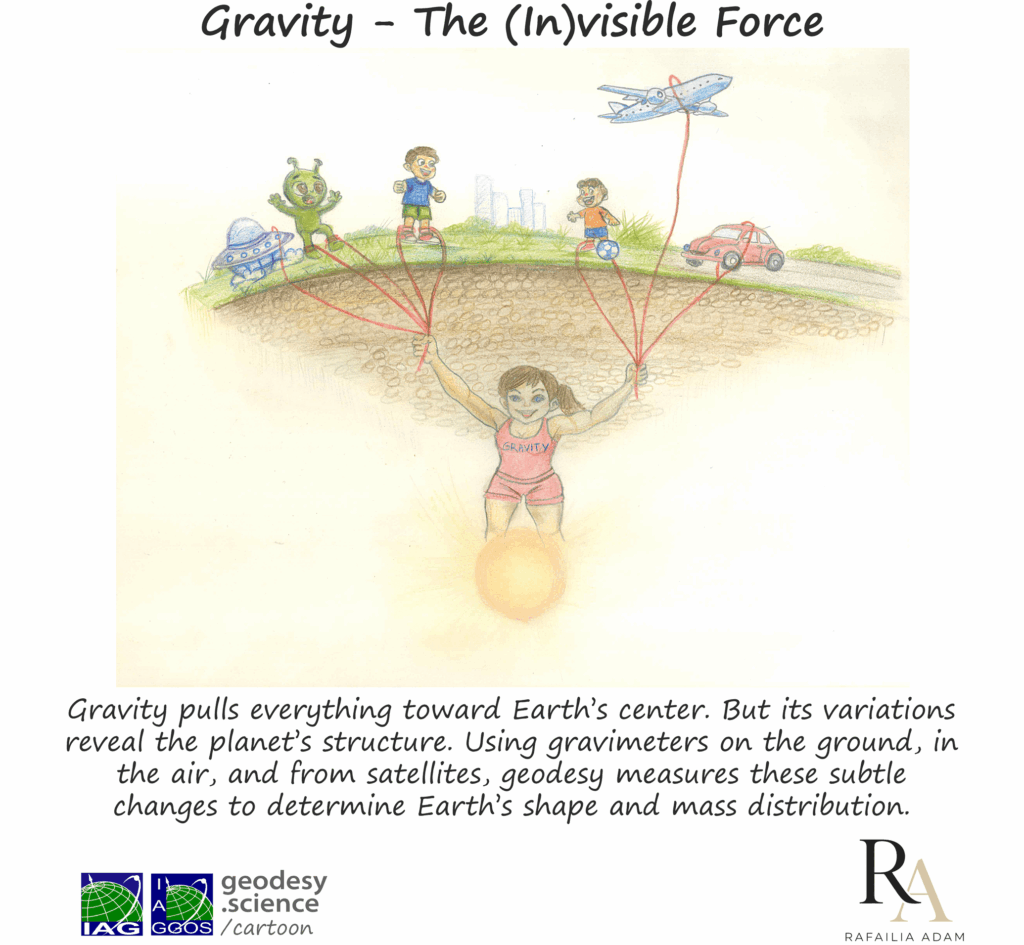
Gravimetry is the measurement of gravity, and gravity (also referred to as gravitation) is the universal force of attraction acting between all masses. On the Earth’s surface, gravity is a superposition of the gravitational attraction of masses and the centrifugal acceleration due to the rotation of the Earth. Time and space dependent changes of gravity yield valuable information on the distribution and movement of Earth’s masses. The more sensitive the sensor is in measuring gravity, the smaller changes in the distribution of Earth’s masses can be identified. This is of high importance for modelling and monitoring geodynamic and geophysical processes such as glacier melting, groundwater changes, flooding, volcanism, etc. (gravity field – temporal variations). Gravity measurements can be based on the analysis of satellite orbits, using sensors on dedicated gravity satellite missions, or using terrestrial techniques.
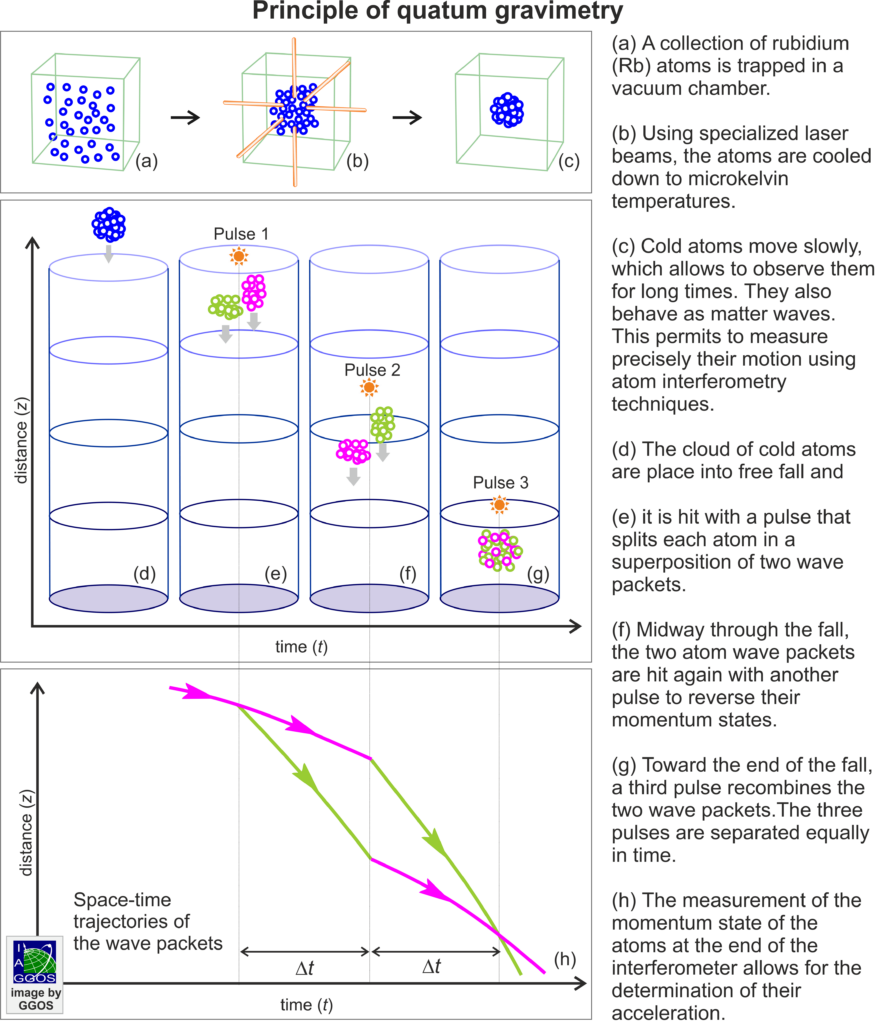
© GGOS (created by Laura Sanchez) Info Info

Quantum gravimetry measures the acceleration of gravity, g, by using freely falling atoms as test masses. Gravimeters employing quantum mechanical techniques comprise the newest class of instruments, and they promise to combine the best characteristics of classical absolute and relative gravimeters:  portable, absolute devices (with accuracies of a few 10s of nms-2) that can run continuously (like the best relative instruments). In a quantum gravimeter, a cloud of atoms is first trapped in a vacuum chamber and cooled down with lasers to microkelvin temperatures, before being released or launched upwards in free fall. The measurement of their acceleration is then performed via atom interferometry, a technology that exploits the wave character of matter and the possibility to manipulate “atomic waves” using lasers. The atoms are thus exposed during their fall to a sequence of three laser pulses, which puts them in a quantum superposition of two different momentum states that initially separate and finally recombine, creating an atom interferometer. The relative population of each momentum state at the end of the interferometer is directly dependents on the local acceleration of gravity, g.  Like classic free fall instruments, quantum gravimeters can tie their length and time measurements back to metrological standards, making them truly capable of absolute measurements.

Read More ...

Quantum gravimeter devices

Quantum gravimeters have been in development for about 30 years, and the technology is mature enough that commercial devices are now available. Unlike mechanical, classical absolute gravimeters, quantum instruments have very little recoil (the test masses are tiny) and they can run more or less continuously at a high rate (having no moving parts to wear out).  Quantum instruments thus combine into one package the two separate and desirable aspects of previous classical instruments:  absolute measurement and continuous operation. In particular, these instruments have shown excellent short-term stability and similar accuracy (in the same low 10-8 ms-2 range as assessed in international comparisons) as classical absolute gravimeters.
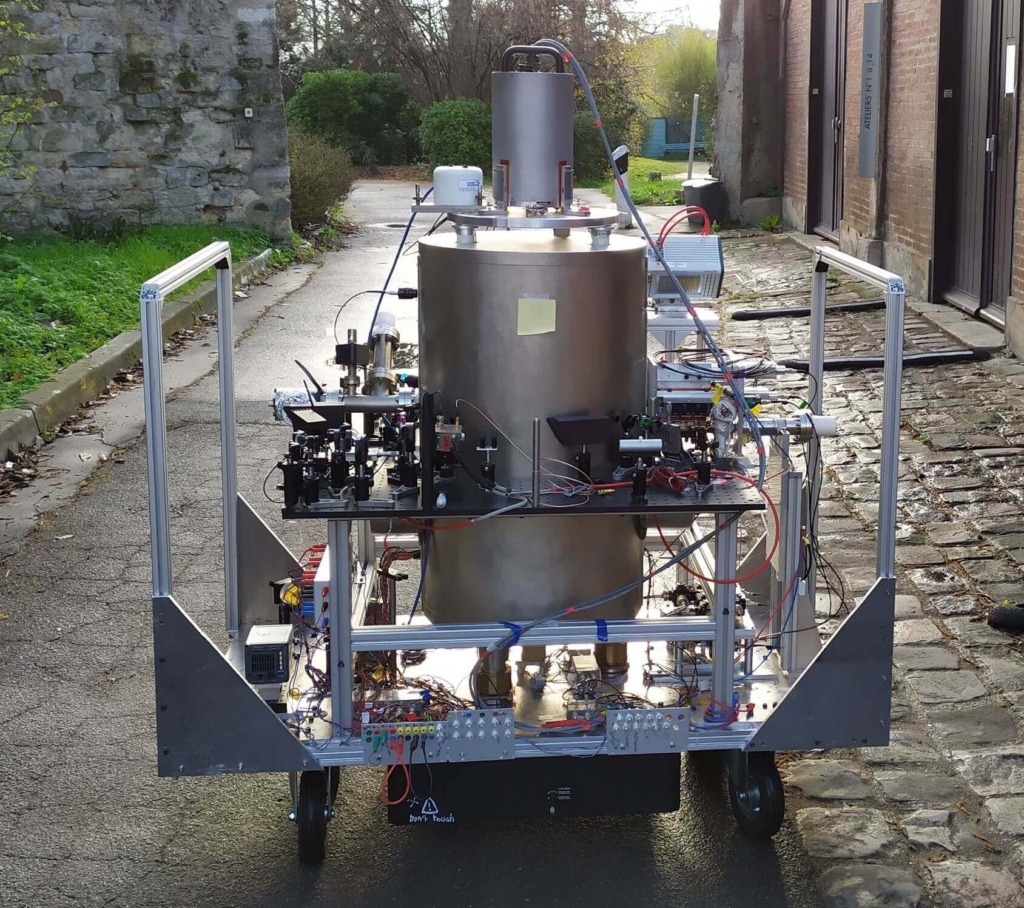
© S. Merlet - https://syrte.obspm.fr Info Info

Drop chamber of the SYRTE gravimeter at Paris Observatory premises (courtesy S. Merlet).

Quantum gravimeters are now being deployed in the field. Static measurements are being performed in reference geodetic stations, as well as on sites of high geophysical interest, such as near volcanos. Shipborne and airborne measurement campaigns have also been realized with compact sensors placed on gyrostabilized platforms. Applications to Earth gravity field mapping in space are also envisioned, see for instance https://quantumbusinessnetwork.de/horizon-europe%e3%80%89quantum-technologies-for-space-gravimetry/.

Further Information
  • IAG Project - QuGe

    In the frame of the International Association of Geodesy (IAG), the recent established project “Novel Sensors and Quantum Technology for Geodesy (QuGe)”  leads current research on advancing science and application of quantum physics in Geodesy.

    https://quge.iag-aig.org/

© GGOS (Prepared by: Franck Pereira dos Santos, Derek van Westrum, Laura Sánchez)

Share

  • Facebook Facebook Share on Facebook
  • X-twitter X-twitter Share on X
  • Whatsapp Whatsapp Share on WhatsApp
  • Pinterest Pinterest Share on Pinterest
  • Linkedin Linkedin Share on LinkedIn
  • Mail Mail Share by Mail

Geodetic Observations - Geodesy

Observation Types

  • GNSS Radio Occultation
  • Icon GGOS Observation Technique© TheNounProject
    VLBI
  • Icon GGOS Observation Technique© TheNounProject
    SLR / LLR – Laser Ranging
  • Icon GGOS Observation Technique© TheNounProject
    DORIS
  • Icon GGOS Observation Technique© TheNounProject
    GNSS
  • Icon GGOS Observation Technique© TheNounProject
    Satellite Altimetry
  • Icon GGOS Observation Technique© TheNounProject
    Satellite Gravimetry
  • Icon GGOS Observation Technique© TheNounProject
    Terrestrial Gravimetry
  • Icon GGOS Observation Technique© TheNounProject
    Tide Gauge Measurements
  • Icon GGOS Observation Technique© TheNounProject
    GNSS Reflectometry
  • Icon GGOS Observation Technique© TheNounProject
    Quantum Gravimetry
  • Icon GGOS Observation Technique© TheNounProject
    Optical Atomic Clocks
  • Icon GGOS Observation Technique
    GGOS Core Sites
Search Search

IAG as part of the IUGG

  
The International Association of Geodesy (IAG)  is a constituent association of the International Union of Geodesy and Geophysics (IUGG).

IAG Related Organisations

IAG collaborates closely with numerous organizations within geodesy and beyond. See the list for details.

Sitemap

  • Home | geodesy.science
  • ⠀└─ 📰News
  • ⠀└─ 📅 Events
  • ⠀└─ 💼 Jobs
  • ⠀└─ 👥 Membership
  • ⭐ About Geodesy
  • 🏛️ IAG | Int. Association of Geodesy
  • ⠀└─ ➡️ Commissions:
  • ⠀⠀◻️ 1 – Reference Frames
  • ⠀⠀◻️ 2 – Gravity Field
  • ⠀⠀◻️ 3 – Earth Rotation & Geodynamics
  • ⠀⠀◻️ 4 – Positioning and Applications
  • ⠀└─ 🔀 Inter Commission Committees:
  • ⠀⠀◻️ ICCT – Theory
  • ⠀⠀◻️ ICCM – Marine Research
  • ⠀⠀◻️ ICCC – Climate Research
  • ⠀└─ ⏰ Project QuGe
  • ⠀└─ ⚙️ IAG Services
  •  🌎 GGOS | Observing System
  • ⠀└─ About GGOS
  • ⠀└─ Structure
  • ⠀└─ Observations
  • ⠀└─ Products
  • ⠀└─ Services

References

Geodesy Glossary

Media Library

IAG Cloud | Public Documents

Terms of Use / Privacy Policy

IAG Statutes

IAG By-laws

Contact Us

Contact

Follow Us

LinkedIn

BlueSky

X (Twitter)

Facebook

Instagram

YouTube

Telegram

RSS Feed

Mailing List

This website is provided by the IAG Secretariat and the GGOS Coordinating Office, which are hosted by the BEV – Federal Office of Metrology and Surveying (Bundesamt für Eich- und Vermessungswesen) in Vienna, Austria.

Website Language Translation

The primary language of this website is English – however, the integrated GTranslate tool enables automatic translation into several languages:

Please note that translations into other languages may not be accurate. For reliable information, refer to the English version of the website.

2026 © Copyright | IAG - International Association of Geodesy
  • Link to LinkedIn
  • Link to Youtube
  • Link to Facebook
  • Link to Instagram
  • Link to X
  • Link to Telegram
  • Link to Behance
  • Link to Rss this site
  • Link to Mail
Scroll to top Scroll to top Scroll to top
Accessibility Adjustments

Powered by OneTap

How long do you want to hide the toolbar?
Hide Toolbar Duration
Select your accessibility profile
Vision Impaired Mode
Enhances website's visuals
Seizure Safe Profile
Clear flashes & reduces color
ADHD Friendly Mode
Focused browsing, distraction-free
Blindness Mode
Reduces distractions, improves focus
Epilepsy Safe Mode
Dims colors and stops blinking
Content Modules
Font Size

Default

Line Height

Default

Color Modules
Orientation Modules