• Link to LinkedIn
  • Link to Youtube
  • Link to Facebook
  • Link to Instagram
  • Link to X
  • Link to Telegram
  • Link to Behance
  • Link to Rss this site
  • Link to Mail
  • NEWS
  • EVENTS
  • JOBS
  • MEMBER
  • Sitemap
    • Home
      • NEWS
      • EVENTS
      • JOBS
      • MEMBERSHIP
    • ⭐ About Geodesy
    • 🏛️ IAG | International Association of Geodesy
      • About IAG
      • Structure
      • 🎓 ECS – Early Career Scientists
      • 🌈 IDEA – Inclusion, Diversity, Equity, Accessibility
    •   └─ Comissions
      • 1️⃣ Reference Frames
      • 2️⃣ Gravity Field
      • 3️⃣ Earth Rotation & Geodynamics
      • 4️⃣ Positioning & Applications
    •   └─ Inter Commission Committees
      • 📚 ICCT – Theory
      • 🌊 ICCM – Marine Research
      • 🌥️ ICCC – Climate Research
    •   └─ Project QuGe
    •   └─ Services
    • 🌍 GGOS | Global Geodetic Observing System
      • About GGOS
      • Structure
      • 🛰️ Observations
      • 📦 Products
      • ⚙️ Services
  • Shopping Cart Shopping Cart
    0Shopping Cart
geodesy.science - IAG website
  • GGOS
    • Home
      • NEWS
      • EVENTS
      • JOBS
      • MEMBERSHIP
    • ⭐ About Geodesy
    • 🏛️ IAG | International Association of Geodesy
      • About IAG
      • Structure
      • 🎓 ECS – Early Career Scientists
      • 🌈 IDEA – Inclusion, Diversity, Equity, Accessibility
    •   └─ Comissions
      • 1️⃣ Reference Frames
      • 2️⃣ Gravity Field
      • 3️⃣ Earth Rotation & Geodynamics
      • 4️⃣ Positioning & Applications
    •   └─ Inter Commission Committees
      • 📚 ICCT – Theory
      • 🌊 ICCM – Marine Research
      • 🌥️ ICCC – Climate Research
    •   └─ Project QuGe
    •   └─ Services
    • 🌍 GGOS | Global Geodetic Observing System
      • About GGOS
      • Structure
      • 🛰️ Observations
      • 📦 Products
      • ⚙️ Services
  • About
    • About GGOS
      • What is GGOS?
      • Why GGOS?
      • Dual Roles of GGOS
      • Vision and Mission
      • GGOS History
  • Structure
    • Governance & Leadership
      • Governing Board GB
      • Executive Committee EC
    • Coordinating Office CO
    • Science Panel
    • Bureaus
      • BNO – Networks and Observations
      • BPS – Products and Standards
    • Focus Areas
      • Geohazards Monitoring
      • Geodetic Space Weather Research
      • Artificial Intelligence for Geodesy (AI4G)
    • GGOS Affiliates
      • GGOS Japan
      • GGOS D-A-CH
      • GGOS IberAtlantic
    • GGOS Committees & Working Groups
  • Observations
  • Services
  • Products
  • Resources
    • Resources Overview
    • Outreach Materials
    • Logos & Organisation Chart
    • Reports and Articles
    • Presentations and Videos
    • GGOS Meeting Reports
    • Terms of Reference and Strategy
  • Click to open the search input field Click to open the search input field Search
You are here: Home1 / IAG GGOS2 / GGOS Observations3 / COST-G – Int. Combination Service for Time-variable Gravity Fiel...

COST-G

Combination Service for Time-Variable Gravity Fields
COST-G IAG Service Data
Go To Service

Overview

The International Combination Service for Time-variable Gravity Fields (COST-G) is the Product Center of the International Gravity Field Service (IGFS) for time-variable gravity fields. COST-G provides consolidated monthly global gravity models in terms of spherical harmonic (SH) coefficients and thereof derived grids by combining existing solutions or normal equations (NEQs) from COST-G analysis centers (ACs) and partner analysis centers (PCs).

The NASA/DLR GRACE satellite mission provided 15 years (2002-2017) of observations of the changing Earth masses in the Earth system, e.g. the ice masses in Greenland. Several analysis centers are engaged in the determination of these mass variations, many of them are Analysis or Partner Analysis Centers in COST-G. Its successor mission GRACE-FO, implemented and operated by NASA and the German Research Centre for Geosciences (GFZ), is now in space and continues to provide data of the same quality as GRACE.

Earth observation (EO) satellites yield a wealth of data for scientific, operational, and commercial exploitation. Observations, derived from the Gravity Recovery and Climate Experiment (GRACE) mission, and by GRACE-FO (Follow-on), deliver fundamental insights into the global water cycle, ice mass redistributions, ocean circulation and the solid Earth. For example, changes in continental water storage control the regional water budget and can, in extreme cases, result in floods and droughts that often claim a high toll on infrastructure, the economy and human lives.

Objectives

Due to different processing strategies, individual solutions of the analysis centers may differ in terms of mass variation. COST-G aims at consolidating these monthly global gravity models in terms of spherical harmonic coefficients (Level 2) and derived grids (Level 3) by combining the solutions of the individual centers.

The COST-G ACs adopt different analysis methods but apply agreed-upon consistent processing standards to deliver time-variable gravity field models, e.g. from GRACE/GRACE-FO low-low satellite-to-satellite tracking (ll-SST), high-low satellite-to-satellite tracking (hl-SST) such as for ESA’s Swarm mission, Satellite Laser Ranging (SLR).

COST-G recognizes and emphasizes the existence and acknowledges the contribution of every individual AC and PC. Their participation is a crucial and mandatory prerequisite to the consolidation of monthly global gravity fields within COST-G.

COST-G performs a quality control of the individual contributions before combination. COST-G provides:

  • Combined gravity field solutions in SH coefficients (Level-2 products) derived from a weighted combination of individual contributions generated by the different ACs,
  • Spatial grids and other high-level products (Level-3 products) of the Combined Solutions for hydrological, oceanic, and polar ice sheets applications.

Services

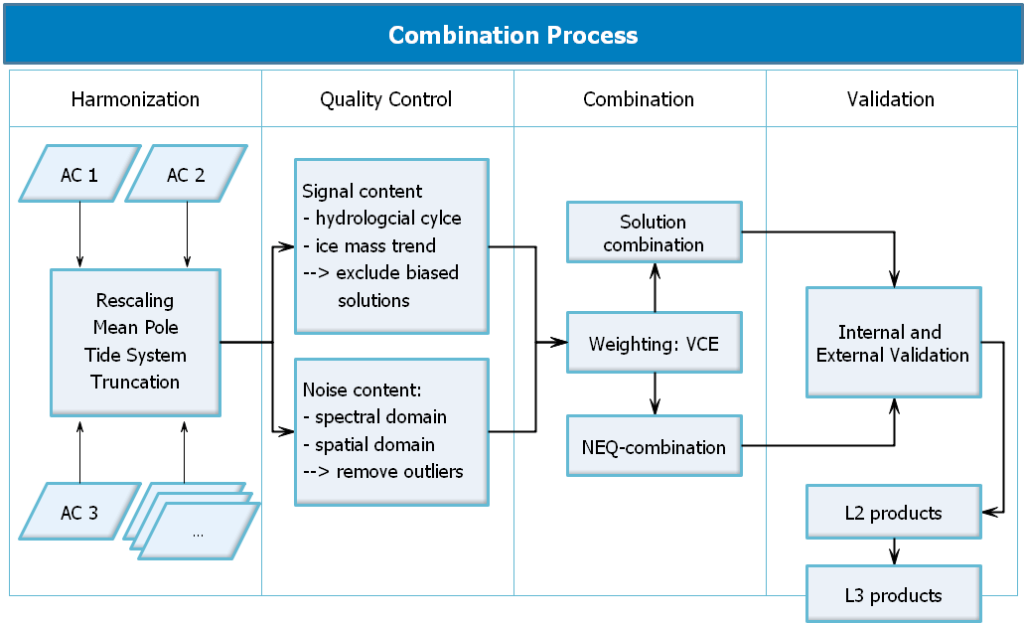
COST-G combines the gravity field solutions of various analysis centers (ACs). Currently, solutions are provided for GRACE, GRACE-FO and Swarm. The combination procedure consists of four major steps:

  1. Harmonization: the various solutions are transformed to a common system
  2. Quality control: the signal content as well as the noise content is evaluated in order to eliminate biased solutions and/or outliers.
  3. Combination is performed on two levels:
    1. Solution level, i.e. the spherical harmonic coefficients are combined using variance component estimation (VCE); details can be found in Jean et al. (2018)
    2. Normal-EQuation-level (NEQ), i.e. the normal equations of the analysis centers are combined; details can be found in Meyer et al. (2019)
  4. Internal and external validation ensure the quality of the product
COST-G_Combination
© COST-G Info Info

Evaluation of Models

Evaluation of the models is performed in a two-stage process by the validation center and the product evaluation group.

Validation Centers focus on a noise assessment of the derived solutions. Tasks of the VC include:

  • Evaluation of the noise of the solutions over dedicated areas of low variability
  • Evaluation of the quality of the solutions through comparison with external data sets such as altimetry
  • Validation through LEO satellite orbit tests

The Product Evaluation Group focuses on the assessment of the signal contribution. Tasks of the PEG include assessing COST-G products for studying mass variations related to:

  • Terrestrial water storage over non-glaciated regions
  • Bottom pressure variations in the oceans
  • Ice mass changes in Antarctica and in Greenland

Public outreach

The Level-2 products are made available through the International Center for Global Earth Models (ICGEM, http://icgem.gfz-potsdam.de).

The Level-3 products by the Information System and Data Center (ISDC, https://isdc.gfz-potsdam.de).

The products can be visualized at the COST-G Plotter (http://cost-g.org/) and the Gravity Information Service (GravIS, http://gravis.gfz-potsdam.de).

Data Policy

Access to global gravity field models, derived products, once offered by the center, shall be unrestricted for any external user.

Reference

Jäggi A. et al. (2020) International Combination Service for Time-Variable Gravity Fields (COST-G). In: . International Association of Geodesy Symposia. Springer, Berlin, Heidelberg. https://doi.org/10.1007/1345_2020_109

Other references:

Jean, Y., Meyer, U. & Jäggi, A. Combination of GRACE monthly gravity field solutions from different processing strategies. J Geod 92, 1313–1328 (2018). https://doi.org/10.1007/s00190-018-1123-5

Meyer, U., Jean, Y., Kvas, A. et al. Combination of GRACE monthly gravity fields on the normal equation level. J Geod 93, 1645–1658 (2019). https://doi.org/10.1007/s00190-019-01274-6

Staff

COST-G is hosted by the AIUB Bern.

  • Chair of the Directing Board: Adrian Jäggi
  • Vice-Chair of the Directing Board: Frank Flechtner
  • Analysis Center Coordinator: Ulrich Meyer

The staff is allocated part-time and responds to queries on a best-effort basis.

Point of Contact

Dr. Ulrich Meyer (Analysis Center Coordinator)
Post address: Sidlerstrasse 5, 3012 Bern, Schwitzerland
Telephone: +41 31 631 8146
E-Mail:

(last update: 11/2020)

IAG SERVICES

Geometric & General Services

  • IERS iag service earth rotation reference system frame© IERS
    IERS – Int. Earth Rotation and Reference Systems Service
  • IGS iag service gnss global navigation satellite system© IGS
    IGS – International GNSS Service
  • ILRS laser ranging service iag© ILRS
    ILRS – International Laser Ranging Service
  • IVS VLBI Service IAG© IVS
    IVS – International VLBI Service for Geodesy and Astrometry
  • IDS iag service DORIS© IDS
    IDS – International Doris Service
  • PSMSL Permanent Service for Mean Sea Level IAG© PSMSL
    PSMSL – Permanent Service for Mean Sea Level

Gravity Services

  • IGFS iag service gravity field© IGFS
    IGFS – International Gravity Field Service
  • ICGEM iag service© ICGEM
    ICGEM – International Centre for Global Earth Models
  • IDEMS iag service DEM digital elevation model© IDEMS
    IDEMS – International Digital Elevation Model Service
  • IGETS iag service© IGETS
    IGETS – International Geodynamics and Earth Tide Service
  • ISG service geoid IAG© ISG
    ISG – International Service for the Geoid
  • BGI gravimetric service IAG© BGI
    BGI – International Gravimetric Bureau

IAG as part of the IUGG

  
The International Association of Geodesy (IAG)  is a constituent association of the International Union of Geodesy and Geophysics (IUGG).

IAG Related Organisations

IAG collaborates closely with numerous organizations within geodesy and beyond. See the list for details.

Sitemap

  • Home | geodesy.science
  • ⠀└─ 📰News
  • ⠀└─ 📅 Events
  • ⠀└─ 💼 Jobs
  • ⠀└─ 👥 Membership
  • ⭐ About Geodesy
  • 🏛️ IAG | Int. Association of Geodesy
  • ⠀└─ ➡️ Commissions:
  • ⠀⠀◻️ 1 – Reference Frames
  • ⠀⠀◻️ 2 – Gravity Field
  • ⠀⠀◻️ 3 – Earth Rotation & Geodynamics
  • ⠀⠀◻️ 4 – Positioning and Applications
  • ⠀└─ 🔀 Inter Commission Committees:
  • ⠀⠀◻️ ICCT – Theory
  • ⠀⠀◻️ ICCM – Marine Research
  • ⠀⠀◻️ ICCC – Climate Research
  • ⠀└─ ⏰ Project QuGe
  • ⠀└─ ⚙️ IAG Services
  •  🌎 GGOS | Observing System
  • ⠀└─ About GGOS
  • ⠀└─ Structure
  • ⠀└─ Observations
  • ⠀└─ Products
  • ⠀└─ Services

References

Geodesy Glossary

Media Library

IAG Cloud | Public Documents

Terms of Use / Privacy Policy

IAG Statutes

IAG By-laws

Contact Us

Contact

Follow Us

LinkedIn

BlueSky

X (Twitter)

Facebook

Instagram

YouTube

Telegram

RSS Feed

Mailing List

This website is provided by the IAG Secretariat and the GGOS Coordinating Office, which are hosted by the BEV – Federal Office of Metrology and Surveying (Bundesamt für Eich- und Vermessungswesen) in Vienna, Austria.

Website Language Translation

The primary language of this website is English – however, the integrated GTranslate tool enables automatic translation into several languages:

Please note that translations into other languages may not be accurate. For reliable information, refer to the English version of the website.

2026 © Copyright | IAG - International Association of Geodesy
  • Link to LinkedIn
  • Link to Youtube
  • Link to Facebook
  • Link to Instagram
  • Link to X
  • Link to Telegram
  • Link to Behance
  • Link to Rss this site
  • Link to Mail
Scroll to top Scroll to top Scroll to top
Accessibility Adjustments

Powered by OneTap

How long do you want to hide the toolbar?
Hide Toolbar Duration
Select your accessibility profile
Vision Impaired Mode
Enhances website's visuals
Seizure Safe Profile
Clear flashes & reduces color
ADHD Friendly Mode
Focused browsing, distraction-free
Blindness Mode
Reduces distractions, improves focus
Epilepsy Safe Mode
Dims colors and stops blinking
Content Modules
Font Size

Default

Line Height

Default

Color Modules
Orientation Modules