• Link to LinkedIn
  • Link to Youtube
  • Link to Facebook
  • Link to Instagram
  • Link to X
  • Link to Telegram
  • Link to Behance
  • Link to Rss this site
  • Link to Mail
  • NEWS
  • EVENTS
  • JOBS
  • MEMBER
  • Sitemap
    • Home
      • NEWS
      • EVENTS
      • JOBS
      • MEMBERSHIP
    • ⭐ About Geodesy
    • 🏛️ IAG | International Association of Geodesy
      • About IAG
      • Structure
      • 🎓 ECS – Early Career Scientists
      • 🌈 IDEA – Inclusion, Diversity, Equity, Accessibility
    •   └─ Comissions
      • 1️⃣ Reference Frames
      • 2️⃣ Gravity Field
      • 3️⃣ Earth Rotation & Geodynamics
      • 4️⃣ Positioning & Applications
    •   └─ Inter Commission Committees
      • 📚 ICCT – Theory
      • 🌊 ICCM – Marine Research
      • 🌥️ ICCC – Climate Research
    •   └─ Project QuGe
    •   └─ Services
    • 🌍 GGOS | Global Geodetic Observing System
      • About GGOS
      • Structure
      • 🛰️ Observations
      • 📦 Products
      • ⚙️ Services
  • Shopping Cart Shopping Cart
    0Shopping Cart
geodesy.science - IAG website
  • GGOS
    • Home
      • NEWS
      • EVENTS
      • JOBS
      • MEMBERSHIP
    • ⭐ About Geodesy
    • 🏛️ IAG | International Association of Geodesy
      • About IAG
      • Structure
      • 🎓 ECS – Early Career Scientists
      • 🌈 IDEA – Inclusion, Diversity, Equity, Accessibility
    •   └─ Comissions
      • 1️⃣ Reference Frames
      • 2️⃣ Gravity Field
      • 3️⃣ Earth Rotation & Geodynamics
      • 4️⃣ Positioning & Applications
    •   └─ Inter Commission Committees
      • 📚 ICCT – Theory
      • 🌊 ICCM – Marine Research
      • 🌥️ ICCC – Climate Research
    •   └─ Project QuGe
    •   └─ Services
    • 🌍 GGOS | Global Geodetic Observing System
      • About GGOS
      • Structure
      • 🛰️ Observations
      • 📦 Products
      • ⚙️ Services
  • About
    • About GGOS
      • What is GGOS?
      • Why GGOS?
      • Dual Roles of GGOS
      • Vision and Mission
      • GGOS History
  • Structure
    • Governance & Leadership
      • Governing Board GB
      • Executive Committee EC
    • Coordinating Office CO
    • Science Panel
    • Bureaus
      • BNO – Networks and Observations
      • BPS – Products and Standards
    • Focus Areas
      • Geohazards Monitoring
      • Geodetic Space Weather Research
      • Artificial Intelligence for Geodesy (AI4G)
    • GGOS Affiliates
      • GGOS Japan
      • GGOS D-A-CH
      • GGOS IberAtlantic
    • GGOS Committees & Working Groups
  • Observations
  • Services
  • Products
  • Resources
    • Resources Overview
    • Outreach Materials
    • Logos & Organisation Chart
    • Reports and Articles
    • Presentations and Videos
    • GGOS Meeting Reports
    • Terms of Reference and Strategy
  • Click to open the search input field Click to open the search input field Search
You are here: Home1 / IAG GGOS2 / GGOS Observations3 / Tide Gauge Measurements
Follow a manual added link
Icon GGOS Observation Technique

Tide Gauge Measurements

For over 200 years, we have been observing the height of the ocean using tide gauges. Perhaps more accurately called water level sensors, as they can be used in areas where there is little or no tide, they can be used to monitor variations in heights across a wide range of timescales, from high frequency waves, storm surges and tides, to long term changes in ocean currents, changes due to the expansion of warming water, and the melting of glaciers and ice caps.
© PSMSL Info Info

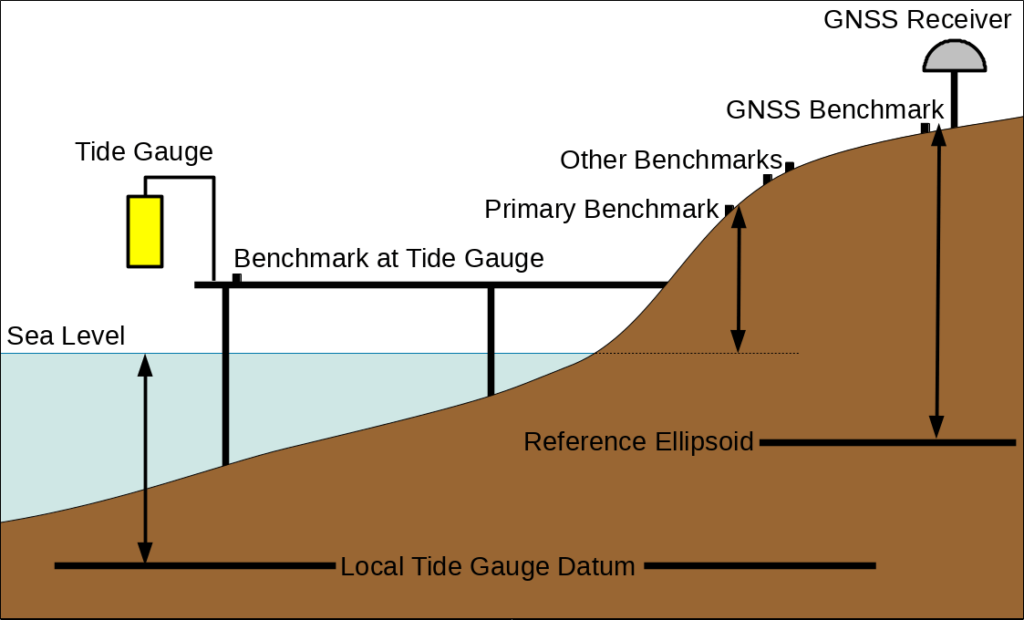
A typical tide gauge – water heights are effectively tied to a physical point on land, the primary benchmark, by measuring heights above a local tide gauge datum defined a fixed distance below the benchmark. The stability of the primary benchmark is monitored by regular comparison with a network of nearby benchmarks. Ideally, local land movement should be monitored by co-locating the sites with a GNSS receiver.

Read More ...

The earliest gauges were simple marked staffs on harbour walls which an observer would use to read water levels. During the 19th century automatically recording gauges were developed, where a float on the water was attached by a system of pulleys to a pen which would draw levels on a rotating chart. Modern sites tend to either rely on pressure sensors in the water, or acoustic or radar sensors measuring heights by bouncing beams off the surface from above. Recent developments have shown that GNSS receivers can be used as tide gauges by comparing the direct signal with the multipath reflection off the surface of the water.

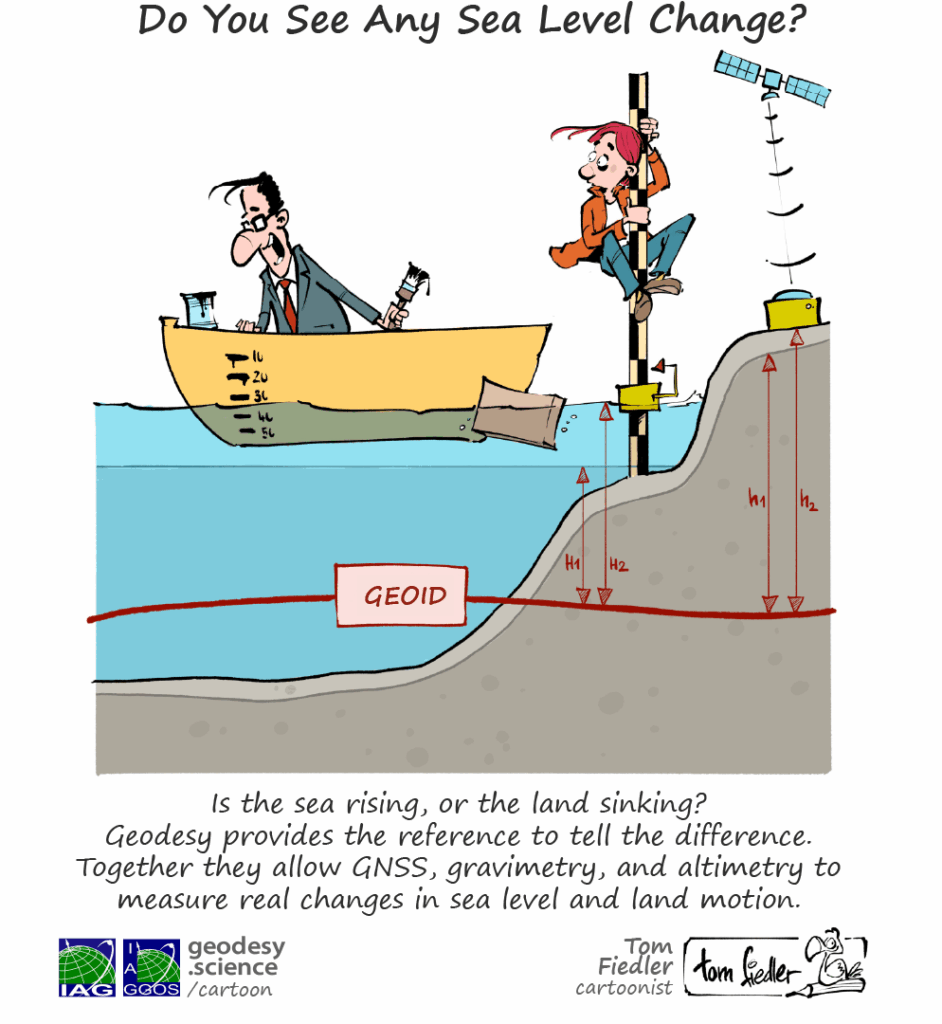
Tide gauges actually measure relative sea level, that is the height of the sea relative to a fixed point on land, usually a physical marker called a benchmark. Thus, changes in relative sea level can also result from local movements in the land. For this reason, tide gauges have played an important historical role in geodesy. Some of the earliest records come from the Baltic, where apparently falling sea levels result from land still rising after being compressed under ice sheets during the last glacial period. Tide gauges were also used to define Mean Sea Level for many national and regional levelling systems.

Co-locating tide gauges with other geodetic sensors that measure land movement, such as GNSS receivers, can enable us to separate the sea level part of the signal from the portion due to local land movement. However, even then the sea level can be affected by other geophysical processes, such as crustal motion or variations in gravity.
© PSMSL Info Info

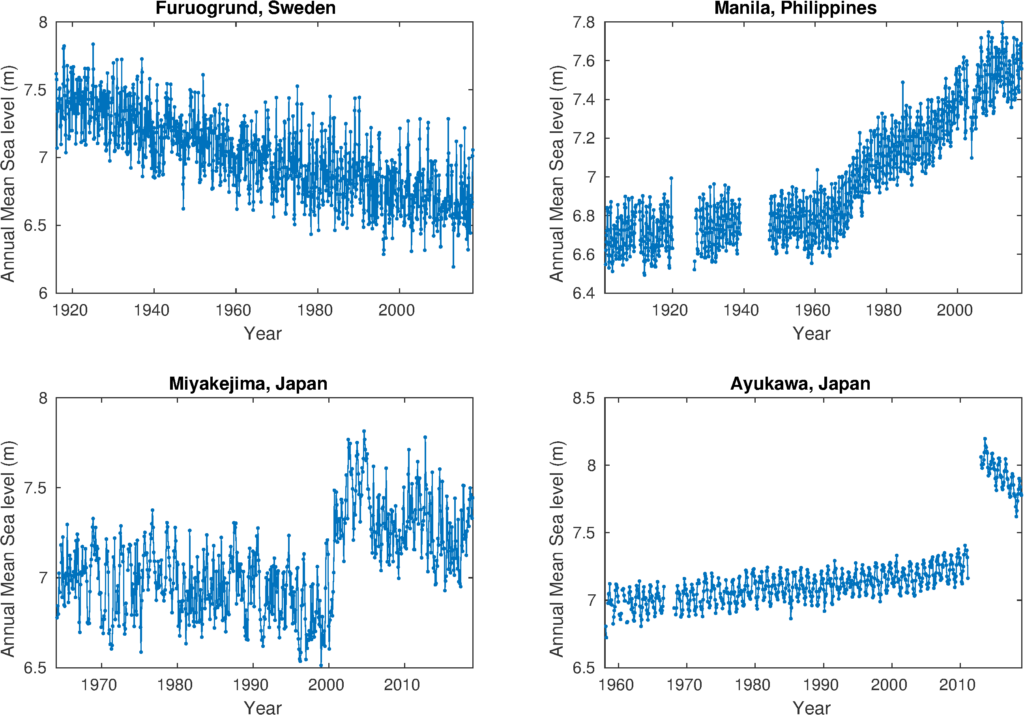
Examples of land movement signals in tide gauge records. In Furuogrund, land rising faster than sea levels due to recovery post ice age produces an apparent falling trend. In Manila, rising sea levels are exacerbated due to rapid subsidence caused by groundwater extraction. Ayukawa shows a sudden land movement due to 2011 Tōhoku earthquake. Miyakejima, a volcanic island, shows a rapid period of subsidence following an eruption. (Image: PSMSL, Data: Swedish Meteorological and Hydrological Institute; National Mapping and Resource Information Authority, Phillipines; Japan Meteorological Agency; Japan Oceanographic Data Center).

Service
  • PSMSL

    Permanent Service for Mean Sea Level

© GGOS (Prepared by: Andrew Matthews)

Share

  • Facebook Facebook Share on Facebook
  • X-twitter X-twitter Share on X
  • Whatsapp Whatsapp Share on WhatsApp
  • Pinterest Pinterest Share on Pinterest
  • Linkedin Linkedin Share on LinkedIn
  • Mail Mail Share by Mail

Geodetic Observations - Geodesy

Observation Types

  • GNSS Radio Occultation
  • Icon GGOS Observation Technique© TheNounProject
    VLBI
  • Icon GGOS Observation Technique© TheNounProject
    SLR / LLR – Laser Ranging
  • Icon GGOS Observation Technique© TheNounProject
    DORIS
  • Icon GGOS Observation Technique© TheNounProject
    GNSS
  • Icon GGOS Observation Technique© TheNounProject
    Satellite Altimetry
  • Icon GGOS Observation Technique© TheNounProject
    Satellite Gravimetry
  • Icon GGOS Observation Technique© TheNounProject
    Terrestrial Gravimetry
  • Icon GGOS Observation Technique© TheNounProject
    Tide Gauge Measurements
  • Icon GGOS Observation Technique© TheNounProject
    GNSS Reflectometry
  • Icon GGOS Observation Technique© TheNounProject
    Quantum Gravimetry
  • Icon GGOS Observation Technique© TheNounProject
    Optical Atomic Clocks
  • Icon GGOS Observation Technique
    GGOS Core Sites
Search Search

IAG as part of the IUGG

  
The International Association of Geodesy (IAG)  is a constituent association of the International Union of Geodesy and Geophysics (IUGG).

IAG Related Organisations

IAG collaborates closely with numerous organizations within geodesy and beyond. See the list for details.

Sitemap

  • Home | geodesy.science
  • ⠀└─ 📰News
  • ⠀└─ 📅 Events
  • ⠀└─ 💼 Jobs
  • ⠀└─ 👥 Membership
  • ⭐ About Geodesy
  • 🏛️ IAG | Int. Association of Geodesy
  • ⠀└─ ➡️ Commissions:
  • ⠀⠀◻️ 1 – Reference Frames
  • ⠀⠀◻️ 2 – Gravity Field
  • ⠀⠀◻️ 3 – Earth Rotation & Geodynamics
  • ⠀⠀◻️ 4 – Positioning and Applications
  • ⠀└─ 🔀 Inter Commission Committees:
  • ⠀⠀◻️ ICCT – Theory
  • ⠀⠀◻️ ICCM – Marine Research
  • ⠀⠀◻️ ICCC – Climate Research
  • ⠀└─ ⏰ Project QuGe
  • ⠀└─ ⚙️ IAG Services
  •  🌎 GGOS | Observing System
  • ⠀└─ About GGOS
  • ⠀└─ Structure
  • ⠀└─ Observations
  • ⠀└─ Products
  • ⠀└─ Services

References

Geodesy Glossary

Media Library

IAG Cloud | Public Documents

Terms of Use / Privacy Policy

IAG Statutes

IAG By-laws

Contact Us

Contact

Follow Us

LinkedIn

BlueSky

X (Twitter)

Facebook

Instagram

YouTube

Telegram

RSS Feed

Mailing List

This website is provided by the IAG Secretariat and the GGOS Coordinating Office, which are hosted by the BEV – Federal Office of Metrology and Surveying (Bundesamt für Eich- und Vermessungswesen) in Vienna, Austria.

Website Language Translation

The primary language of this website is English – however, the integrated GTranslate tool enables automatic translation into several languages:

Please note that translations into other languages may not be accurate. For reliable information, refer to the English version of the website.

2026 © Copyright | IAG - International Association of Geodesy
  • Link to LinkedIn
  • Link to Youtube
  • Link to Facebook
  • Link to Instagram
  • Link to X
  • Link to Telegram
  • Link to Behance
  • Link to Rss this site
  • Link to Mail
Scroll to top Scroll to top Scroll to top
Accessibility Adjustments

Powered by OneTap

How long do you want to hide the toolbar?
Hide Toolbar Duration
Select your accessibility profile
Vision Impaired Mode
Enhances website's visuals
Seizure Safe Profile
Clear flashes & reduces color
ADHD Friendly Mode
Focused browsing, distraction-free
Blindness Mode
Reduces distractions, improves focus
Epilepsy Safe Mode
Dims colors and stops blinking
Content Modules
Font Size

Default

Line Height

Default

Color Modules
Orientation Modules