
Annual Report 2025 of IAG to IUGG
ACTIVITIES
IAG Scientific Assembly 2025
IAG has held its quadrennial Scientific Assembly halfway through its four-year term 2023-2027. It took place in-person in Rimini (Italy) on September 1-5, 2025. Under the theme “Geodesy for a changing environment” 14 symposia have been successfully held, covering the scientific scope of all IAG components as well as the broader importance of geodesy in data management, outreach and networking with science and policy. Approximately 600 persons attended. The Congress Center in Rimini offered excellent facilities, allowing for lively discussions in a pleasant
atmosphere. The Local Organizing Committee (LOC), headed by Prof. Susanna Zerbini and Prof. Stefano Gandolfi (both from the University of Bologna), did an excellent job in preparing the event and in offering immediate advice and assistance during the conference week. The Scientific Organizing Committee (SOC) was chaired by the IAG Secretary General D. Thaller. All IAG components were represented with at least one symposium of their own, and there were also 3 joint symposia on the overarching topics geodetic space weather, machine learning in geodesy, and geohazard monitoring. In total, 695 abstracts were submitted, with main authors from 68 countries. China had about 135 submissions, followed by Germany with almost 130 submissions. Contributions
were divided by the SOC into 300 oral presentations and 395 posters. The premises at the Congress Center made it possible to hold 4 oral sessions in parallel. Poster sessions of 90 minutes were scheduled at the end of each of four days, so that the poster contributions also received the attention they deserved. A new feature in the program of the IAG Scientific Assembly was implemented in Rimini at the suggestion of the IAG Secretary General: four “Highlight Sessions” that dealt with important topics in geodesy at a very general, overarching level. These were plenary sessions (not in parallel with others) in the large amphitheatre, so that all participants had the opportunity to attend:
- Northeast Italy with focus on the Po Plain – Impacts of changing climate on the region;
- Geodesy for Climate and Water;
- Future Geodetic Satellite Missions and new Technologies;
- Geodetic Monitoring for Geohazards.
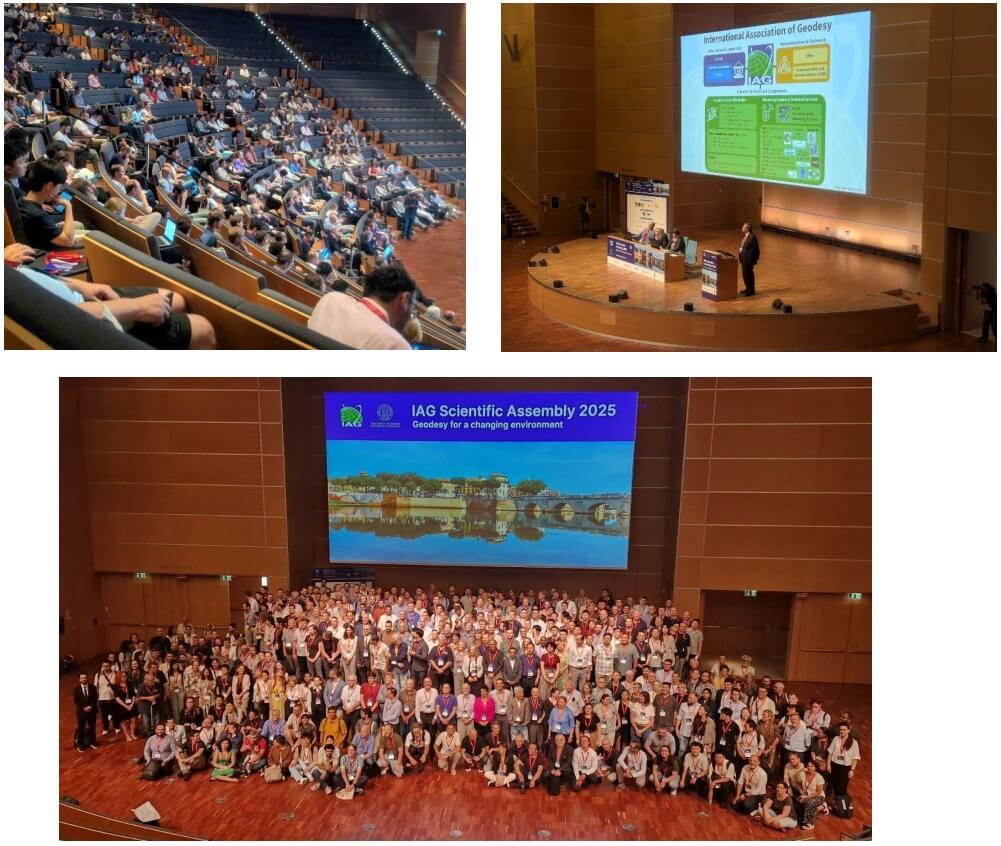
Fig. 1 IAG Scientific Assembly: Opening Ceremony in the large amphitheater in the Congress Center in Rimini (top);
Group photo of the participants (bottom)
All in all, there has been an extremely diverse program of presentations and posters that provided an excellent overview of the numerous topics covered by the IAG. The proceedings of the IAG Scientific Assembly in Rimini will be published as a separate volume in the Springer IAG Symposia Series. In addition, numerous IAG components (Commissions, Working Groups, Study Groups, etc.) also took advantage of the opportunity to hold their splinter meetings in Rimini. For the first time at an IAG Scientific Assembly, social events were planned with a focus on improving
diversity: a dinner for Early Career Scientists (ECS) and a “Women in Geodesy” breakfast. Both events were met with great interest and contributed to networking.
Activities of Commissions, Inter-Commission Committees, GGOS and Services
- 3rd ICCC Workshop – Geodesy for Climate Research, March 24 – 25, 2025, online
- 15th International School on “The Determination and Use of the Geoid”, April 7 – 11, 2025, Almaty, Kazakhstan
- ICCM Seafloor and marine geodesy splinter meeting, April 30, 2025, Vienna, Austria
- 3rd IAG Commission 4 Symposium, May 13 – 15, 2025, Wuhan, China
- 2025 Glacial Isostatic Adjustment workshop: Advancing Models and Observational Constraints, June 2 – 6, 2025, Sydney, British Columbia, Canada
- SIRGAS Geodesy virtual School 2025, “Terrestrial Reference Frame. Geodynamic and atmospheric monitoring”, June 3, 5, 6, 10, and 12, 2025, (on average 187 participants per day)
- EUREF Symposia 2025, June 25 – 26, 2025, Covilhã, Portugal
- 1st GGOS IberAtlantic Summer School, July 13 – 18, 2025, Yebes Observatory, Spain
- IGFS Summer School on “Satellite-based Hydrological Data Assimilation”, 26 – 28 August 2025, Aalborg, Denmark
- IAG Scientific Assembly 2025, September 1 – 5, 2025, Rimini, Italy
- GGOS Days 2025, September 3 – 5, 2025, Rimini, Italy, in-person, (175 contributions)
- VTW2025 – 10th International VLBI Technology Workshop, October 21– 25, 2025, Gothenburg, Sweden
- 5th IVS Training School on VLBI for Geodesy and Astrometry, October 26 – 28, 2025, Gothenburg, Sweden
- 16th SIRGAS School “VLBI and SLR Data Processing”, October 27 – November 1, 2025, San Juan, Argentina
- IDS DORIS School & DORIS Days 2025, November 3 –5, 2025, Athens, Greece
The IAG entities maintain their web pages (accessible via https://geodesy.science/iag/structure/).
Communication and Outreach Branch (COB); future permanent IAG Secretariat at BEV
Following the agreement in 2024, to expand the GGOS Coordination Office at BEV to take on the role of a permanent IAG Secretariat, the technical transition between the COB (Budapest) and the BEV (Vienna) has been successfully mastered. New IAG web presence: M. Sehnal and his team from the BEV have made great efforts with the support of the COB and the IAG Office, so that the IAG websites were launched in June 2025 with a new design and improved content, features and functionalities: https://geodesy.science/iag/.
IAG Membership
By the end of 2025, there were a total of 274 active members, of which 39 were students and 52 were retired members. Students and retired members are free of the annual fee. IAG Office and the BEV team have set-up a new IAG Membership Portal on the IAG web site. Application for membership, secure payment, and membership management are integrated in one place. The entire process is handled through a modern, highly automated online system. The Portal was launched in January 2026, making IAG individual membership faster and more convenient.
IAG Task Force on Inclusion
The Task Force on Inclusion, aiming at increasing diversity within the IAG in terms of gender, geographical distribution, generation balance / career stage (“3G”), has continued its activities in 2025 along the same lines. It presented its final report to the IAG EC with concrete recommendations. As a response, an ECS representative (M. Ravanelli) has been invited as a permanent (non-voting) observer to all upcoming IAG EC meetings. The need for greater diversification was also evident at the Scientific Assembly in Rimini, where only slightly more than a quarter of the participants were female (“gender balance”) and countries from Latin America, Africa, and Asia (with the exception of China) were comparatively under-represented (“geographical balance”). Generational balance is also weak, as ECS usually have little project funding to attend conferences. IAG has significantly supported ECS to attend the Scientific Assembly by offering numerous travel awards, as explained below.
Publications
COB and BEV have continued publishing online the monthly IAG Newsletter and GIM International. The IAG Office has edited and published The Geodesist’s Handbook 2024 and The IAG Travaux 2023-2025 (mid-term Activity Report). Both publications are open access, available via the IAG website and come with a main DOI as well as individual DOIs for each chapter, ensuring that the contributions of IAG components can be cited precisely and independently. Based on the agreement with Springer Verlag, IAG Symposia Series are open access, and free of charge
to the symposia participants. The following book was published in 2025 in the IAG Symposia Series: Volume 157: Together Again for Geodesy: Proceedings of the General Assembly of the International Association of Geodesy, Berlin, Germany, 11–20 July, 2023.
The Journal of Geodesy (JoG) received about 400 manuscript submissions in 2025, with an increase of submissions by 14% over 2024, but a lower acceptance rate of about 25%. The impact factor of the Journal is 4.0 (2024). The JoG is ranked the 13th among 102 journals in geochemistry and geophysics.
Awards
IAG Travel Awards to participate to the IAG Scientific Assembly 2025 were granted to 34 persons, all of them being ECS, in total of 29300 €. In addition, 5 ECS received Travel Awards to participate in other IAG-sponsored Symposia, in total of 4500 €. At the Opening Ceremony of the IAG Scientific Assembly 2025, IAG has presented:
- The IAG Young Author’s Award 2023 to Dr. Safoora Zaminpardaz;
- The IAG Young Author’s Award 2024 to Dr. Justyna Śliwińska-Bronowicz;
- The IAG Best Reviewer’s Award 2023 to Dr. Bailing Li;
- The IAG Best Reviewer’s Award 2024 to Dr. Judit Benedek.
Obituaries
The following obituary was published in the IAG Newsletter: Bernard Chovitz (1924–2025).
 ADMINISTRATION
IAG Executive Committee (EC)
The EC 2023-2027 held its 6th and 7th meetings in-person (with hybrid option) in Vienna (Austria), on April 26, 2025, and in Rimini (Italy), on August 31, 2025, respectively.
IAG Bureau
The IAG Bureau (President, Vice-President, and Secretary General) discussed day-to-day decisions through e-mail exchanges and regular monthly online meetings.
IAG Council
The IAG Council, with currently 73 members, normally meets only at the IUGG General Assemblies. However, this time, the IAG Bureau took the opportunity to convene the Council on September 1st, 2025, at the IAG Scientific Assembly in Rimini in order to present some topics and plans to the Council, as well as to gather suggestions from Council members. There was a great deal of interest and vivid fruitful discussions. Two topics, which entail a structural change in the IAG and will be submitted to the Council for a vote at the next IUGG General Assembly, were on the agenda: i) the establishment of a permanent IAG Secretariat at the BEV and ii) the conclusions and recommendations of the IAG Task Force on Inclusion. An important scientific milestone within the IAG was the definition and establishment of the “Essential Geodetic Variables (EGV)”. A lively exchange concerned attracting new countries into IUGG/IAG membership, by reaching out to active geodesists in those countries.
OUTLOOK TO FUTURE ACTIVITIES
Preparation of the IUGG/IAG General Assembly 2027
All IAG Bureau members have attended the IUGG Executive Committee Meeting, July 17-18, 2025 in Incheon, Republic of Korea. The preparation of the IUGG General Assembly in 2027 “One Earth One Future” has been addressed across all IUGG Associations, together with the local organizers and Korean scientists. The overall strategy, next actions and regular follow-up meetings concerning the local organisation and the scientific program will be implemented in 2026 and 2027.
Preparation of the IAG/IAGA joint Scientific Assembly 2029
In 2029, the IAG Scientific Assembly will take place jointly with IAGA (International Association for Geomagnetism and Aeronomy). The Councils of both IAG and IAGA have been informed by the respective Secretaries General D. Thaller and M. Korte and are endorsing this initiative. The call for applications for the venue has been launched and is open until Q1/2026.
IAG becomes a partner of the UN-GGCE
The United Nations Global Geodetic Center of Excellence (UN-GGCE) was established in 2023 with the goal of working with United Nations Member States, universities and geodetic organizations to sustain and enhance the global geodesy supply chain and the global geodetic reference frame. The supply chain includes geometric and gravimetric satellites and ground stations that make geodetic observations, the data centers that archive and distribute the observations, the analysis centers where the observations are analyzed for geodetic products like the positions of ground stations, reference frames, Earth orientation parameters, and gravity models. Since much of the global geodesy supply chain relies on the IAG’s Scientific Services, the IAG recently became an official partner of the UN-GGCE. The UN-GGCE Partnership Program was created to recognize the partners’ efforts to sustain the global geodesy supply chain. The IAG is a scientific organization that has been serving scientists since 1862. The data and products provided by the IAG’s Services have been used to gain greater understanding of the geodetic properties of the Earth including its shape, gravity, and rotation and how they change in space and time. Besides their scientific applications, IAG’s data and products are also being increasingly used by society for positioning and navigation services. By partnering with the UN-GGCE, the IAG will be better able to meet the future needs of not only scientists but also of society and its increasing reliance on geodetic data and products.
Author: Daniela Thaller (IAG Secretary General)
This is the official annual report of IAG to IUGG. View the report as PDF here: https://geodesy.science/wp-content/uploads/IAGreport-toIUGG_2025.pdf