News and Activities
GGOS IberAtlantic (GGOS IA) functions as a regional node of GGOS, focusing on geodetic activities across the Iberian Peninsula and the Atlantic region. GGOS IA fosters collaboration among geodetic institutions while promoting scientific research and technological development tailored to the region’s unique geophysical characteristics.


ICERS 2026 – Int. Conference of Environmental Remote Sensing and GIS
Other, 📅 Event UpdateFollowing the successful and inspiring first conference held in 2024, the Faculty of Geodesy of the University of Zagreb is proud to announce the second edition of ICERS 2026. The conference will take place from 1st to 3rd July 2026, at the National and University Library in Zagreb (Ulica Hrvatske bratske zajednice 4).
Having set high standards in knowledge exchange, ICERS 2026 will once again bring together a global community of experts, academics, and enthusiasts. This Conference serves as a unique meeting point for sharing the latest advancements and applied solutions in the fields of remote sensing and GIS, offering fresh perspectives on addressing complex environmental challenges. Special emphasis will be placed on geospatial solutions for climate change, sustainable development, and effective resource management. Participants are invited to engage in dynamic discussions shaping the future of our planet, with a particular focus on the transformative power of geospatial data. This conference provides an ideal platform for collaboration, strengthening partnerships, and presenting your latest research activities and projects at the global level.
Key conference themes will include:
The ICERS 2026 Keynote Speakers will be:
We invite all interested to present their research or to join as attendees. More information can be found on the conference website.
Important deadlines for authors and participants:
The regular registration fee is €275.00, while a reduced price of €185.00 is secured for students (amounts include VAT). The fee includes access to all sessions, the exhibition area, B2B networking activities, materials, and refreshments.
ICERS will offer travel grants for PhD students and young scientists (up to 35 years of age). Further details regarding the application process are available at the website.
The conference is organized as part of the project “Assessment of the Long-term Climatic and Anthropogenic Effects on the Spatio-temporal Vegetated Land Surface Dynamics in Croatia using Earth Observation Data” (ALCAR) funded by the Croatian Science Foundation.
The Head of the Scientific and Organizing Committee is Assoc. Prof. Mateo Gašparović, PhD. The Scientific Committee consists of distinguished international experts:
· Prof. Xinlian Liang, China
· Prof. Virginia Ruiz-Villanueva, Switzerland
· Assoc. Prof. Sudhir Kumar Singh, India
· Assoc. Prof. Gordana Kaplan, Turkey
· Dino Dobrinić, PhD, Croatia
· Iva Gašparović, PhD, Croatia
· Valentas Gružauskas, PhD, Lithuania
· Damir Klobučar, PhD, Croatia
· Katarina Pavlek, PhD, Croatia
· Ivan Pilaš, PhD, Croatia
· Ronald Pöppl, PhD, Austria
· Dorijan Radočaj, PhD, Croatia
· Imelda Somodi, PhD, Hungary
· Yongze Song, PhD, Australia
Serving on the Organizing Committee alongside Prof. Gašparović are Prof. Mladen Zrinjski, Assist. Prof. Sergej Baričević, Dino Dobrinić, PhD, Katarina Pavlek, PhD, Ivana Jarak, MSc, Klara Pejnović, MSc, Filip Radić, MSc, Katarina Barnjak, MSc, Marijo Seničić, MSc.
For all details, instructions, and news, please visit the official conference website or contact the organizers via email: .
Authors: Katarina Barnjak, Ivana Jarak, Katarina Pavlek, Klara Pejnović, Filip Radić, Mateo Gašparović
The New IAG Membership Portal
IAG, 🏛️ Organisation NewsWe are pleased to announce the launch of the new IAG Membership Portal, making IAG membership management easier, faster, and more convenient than ever before.
The entire membership process is now handled through a modern and highly automated online system. Registration, selection of membership type, payment, and membership management are all integrated in one place, fully replacing the former manual membership application and significantly accelerating the processing.
People can register in just a few steps, choose their membership type, complete payment securely, and manage their membership at any time. In their personal account, members can conveniently download their membership certificate, invoices, and payment confirmations whenever needed.
Payments can be completed immediately and without transaction fees using our secure credit card or Google Pay payment options. Bank transfer is also available, but it is not recommended outside the European Union due to longer processing times, possible extra bank fees and currency exchange fees.
The following IAG membership types are available through the portal:
FULL Membership: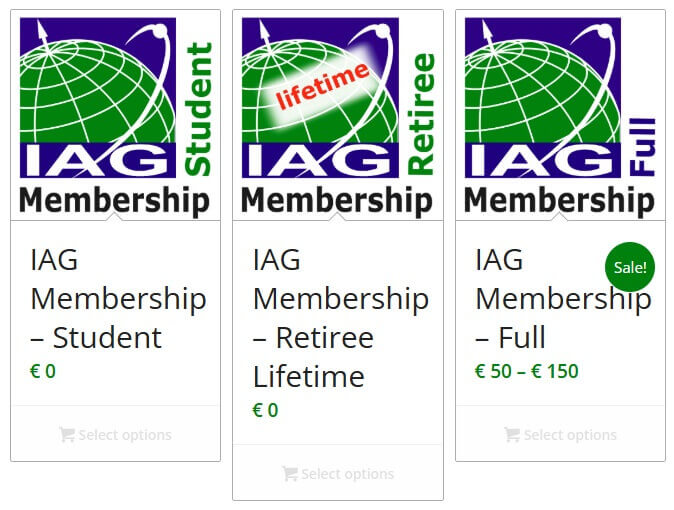
1 year for € 50,- or 4 years for € 150,- (25% discount compared to four 1-year memberships)
STUDENT Membership:
1 year for € 0,- (certificate from a University or College required)
RETIREE Membership:
Lifetime membership for € 0,-
The IAG represents a strong and growing international community. Currently, around 270 people are active IAG members, and 813 individuals in total have benefited from IAG membership over the years.
Membership Benefits: IAG membership offers several important benefits, including reduced registration fees for specific IAG meetings (such as the IAG Scientific Assembly and various IAG Symposia), a reduced individual subscription rate to the Journal of Geodesy, and the opportunity to support IAG activities: Membership fees contribute to funding of workshops in developing countries, of IAG Awards, and of travel grants for young scientists.
Renew Membership: We would also like to remind former members to consider renewing their membership to enjoy these benefits again. In 2026, several major events will offer reduced registration fees for IAG members, such as the REFAG Symposium, the XI Hotine-Marussi Symposium, the TIGER Symposium in Geodesy, the Gravity Geoid and Height Systems Symposium (GGHS2026), and others.
⚠️ For all current and former members: an account has already been created in the new system. You can access it at https://geodesy.science/member/login/ using the email address you originally used for your IAG Membership registration. If you are logging in for the first time, please use the “Reset Password” option to set your password before signing in. If you have questions or encounter any issues, please contact us: https://geodesy.science/contact
We hope your interest in becoming an IAG Member has been sparked and that you will apply and enjoy the convenient functionality of the new IAG Membership Portal.
Author: Martin Sehnal, Christina Dimopoulou
ISC Statement on International Scientific Collaboration
Other, 📰 General NewsInternational Scientific Collaboration: Vital Yet Vulnerable
The Governing Board of the International Science Council (ISC) has released a powerful statement highlighting the urgent need to protect and strengthen global cooperation in science. At a time when global challenges are becoming more complex and interconnected, international scientific collaboration is not a luxury, it is a necessity. Yet, the foundations of this collaboration, built painstakingly over decades, are increasingly fragile.
Science as Globally Shared Knowledge
Science represents a unique form of knowledge: one that is shared across borders and cultures, and one that the world needs more than ever. From climate change and biodiversity loss to public health crises and social inequality, the challenges humanity faces today cannot be addressed by any single nation alone. International collaboration lies at the very heart of science, enabling collective understanding and joint solutions. However, despite its immense value, this collaborative system is now under growing strain.
Recognizing the critical importance of science for both national and global wellbeing, the ISC calls on decision makers worldwide to safeguard the principles of science and protect its institutions. Maintaining—and ideally strengthening—international scientific cooperation is essential for the future.
Two Centuries of Progress Through Science
Over the past 200 years, science has been instrumental in improving quality of life, driving economic growth, and deepening humanity’s understanding of nature and society. All nations rely on science to advance health, social progress, and economic development. These benefits are made possible through sustained investments in research, including support from governments, the private sector, and philanthropic organizations, as well as through extensive collaboration within the global scientific community.
Because knowledge transcends national boundaries, this collective approach has become even more critical in the face of existential threats to planetary and societal health. Shared scientific efforts allow nations to pool expertise, data, and resources to confront risks that affect us all.
Openness, Responsibility, and Global Trust
Science also plays a role in advancing economic, security, and geostrategic objectives. In this context, the frequently cited policy principle of science being “as open as possible and as closed as necessary” must be applied with caution. The ISC warns that this mantra should not be extended beyond legitimate needs, as excessive restrictions risk undermining the openness that makes science effective and trustworthy.
Through science, humanity has both contributed to and uncovered the profound impacts of human activity and technology on the planet. In recent decades, international collaboration among scientists has helped identify these risks and develop strategies to mitigate and adapt to them. Importantly, such cooperation has often transcended geostrategic tensions, driven by a shared interest in protecting the global commons.
Core Principles and Shared Responsibility
At the foundation of all scientific disciplines lies a common set of principles: empiricism, transparency, quality assurance, and openness. These principles enable science to function as a universal system of knowledge. While the application of scientific knowledge is rightly shaped by the societies in which it is embedded, the integrity of the scientific process itself must be preserved.
The ISC emphasizes that international scientific collaboration must continue and that responsibility for sustaining research should be more equitably shared. Nations that invest in and support science not only protect scientific outcomes but also benefit socially, economically, and politically. Ignoring science, by contrast, increases risks to the global commons and undermines collective resilience. Scientific cooperation also plays a vital role in fostering peaceful dialogue among countries.
Renewing the Contract Between Science and Society
The scientific community, for its part, must remain faithful to its core principles while engaging more closely and meaningfully with society. The relationship—the “contract”—between science and society must be continually renewed, ensuring that science can make its essential contributions to peace, security, and wellbeing.
As a global NGO bringing together scientific unions, associations, and academies, the ISC reaffirms its commitment to the vision of science as a global public good. It calls on all sectors of society to recognize that the free and responsible practice of science is a collective endeavor—one that is crucial to the advancement of all humanity.