• Link to LinkedIn
  • Link to Youtube
  • Link to Facebook
  • Link to Instagram
  • Link to X
  • Link to Telegram
  • Link to Behance
  • Link to Rss this site
  • Link to Mail
  • NEWS
  • EVENTS
  • JOBS
  • MEMBER
  • Sitemap
    • Home
      • NEWS
      • EVENTS
      • JOBS
      • MEMBERSHIP
    • ⭐ About Geodesy
    • 🏛️ IAG | International Association of Geodesy
      • About IAG
      • Structure
      • 🎓 ECS – Early Career Scientists
      • 🌈 IDEA – Inclusion, Diversity, Equity, Accessibility
    •   └─ Comissions
      • 1️⃣ Reference Frames
      • 2️⃣ Gravity Field
      • 3️⃣ Earth Rotation & Geodynamics
      • 4️⃣ Positioning & Applications
    •   └─ Inter Commission Committees
      • 📚 ICCT – Theory
      • 🌊 ICCM – Marine Research
      • 🌥️ ICCC – Climate Research
    •   └─ Project QuGe
    •   └─ Services
    • 🌍 GGOS | Global Geodetic Observing System
      • About GGOS
      • Structure
      • 🛰️ Observations
      • 📦 Products
      • ⚙️ Services
  • Shopping Cart Shopping Cart
    0Shopping Cart
geodesy.science - IAG website
  • GGOS
    • Home
      • NEWS
      • EVENTS
      • JOBS
      • MEMBERSHIP
    • ⭐ About Geodesy
    • 🏛️ IAG | International Association of Geodesy
      • About IAG
      • Structure
      • 🎓 ECS – Early Career Scientists
      • 🌈 IDEA – Inclusion, Diversity, Equity, Accessibility
    •   └─ Comissions
      • 1️⃣ Reference Frames
      • 2️⃣ Gravity Field
      • 3️⃣ Earth Rotation & Geodynamics
      • 4️⃣ Positioning & Applications
    •   └─ Inter Commission Committees
      • 📚 ICCT – Theory
      • 🌊 ICCM – Marine Research
      • 🌥️ ICCC – Climate Research
    •   └─ Project QuGe
    •   └─ Services
    • 🌍 GGOS | Global Geodetic Observing System
      • About GGOS
      • Structure
      • 🛰️ Observations
      • 📦 Products
      • ⚙️ Services
  • About
    • About GGOS
      • What is GGOS?
      • Why GGOS?
      • Dual Roles of GGOS
      • Vision and Mission
      • GGOS History
  • Structure
    • Governance & Leadership
      • Governing Board GB
      • Executive Committee EC
    • Coordinating Office CO
    • Science Panel
    • Bureaus
      • BNO – Networks and Observations
      • BPS – Products and Standards
    • Focus Areas
      • Geohazards Monitoring
      • Geodetic Space Weather Research
      • Artificial Intelligence for Geodesy (AI4G)
    • GGOS Affiliates
      • GGOS Japan
      • GGOS D-A-CH
      • GGOS IberAtlantic
    • GGOS Committees & Working Groups
  • Observations
  • Services
  • Products
  • Resources
    • Resources Overview
    • Outreach Materials
    • Logos & Organisation Chart
    • Reports and Articles
    • Presentations and Videos
    • GGOS Meeting Reports
    • Terms of Reference and Strategy
  • Click to open the search input field Click to open the search input field Search
You are here: Home1 / IAG GGOS2 / GGOS Observations3 / IGS – International GNSS Service

IGS – International GNSS Service
IGS iag service gnss global navigation satellite system
Go To Service

For over twenty-five years, the International GNSS Service (IGS) has carried out its mission to advocate for and provide freely and openly available high-precision GNSS data and products. IGS was first approved by its parent organization, the International Association of Geodesy (IAG), at a scientific meeting in Beijing, China, in August of 1993. A quarter century later, the IGS community gathered for a workshop in Wuhan, China, in October/November 2018 to blaze a path to Multi-GNSS through global collaboration.

At the heart of the IGS is a strong culture of sharing expertise, infrastructure, and other resources for the purpose of encouraging global best practices for developing and delivering GNSS data and products all over the world. The collaborative nature of the IGS community, which as of 2019 includes over 140 GNSS stakeholder organizations from 45 countries leverages this diversity to integrate and make full use of all available GNSS technologies while promoting further innovation. Over 15,000 product users, some of whom comprise the backbone of the worldwide geodetic community, ensure that new technologies and systems are integrated into routine IGS products. Responsive to this innovation, the IGS develops and publicly releases standards, guidelines, and conventions for the collection and use of GNSS data and products.

Mission

The Mission of the IGS is to “provide on an openly available basis, the highest-quality GNSS data, products, services in support of the terrestrial reference frame; Earth observation and research; Positioning, Navigation and Timing (PNT); and other applications that benefit the scientific community and society.”

In 2019, the IGS adopted an official slogan: “Providing openly available GNSS data and products that benefit science and society,” as well as an official organizational vision: “A better understanding of the Earth through the application of GNSS.”

IGS report at the GGOS Days 2023

Network

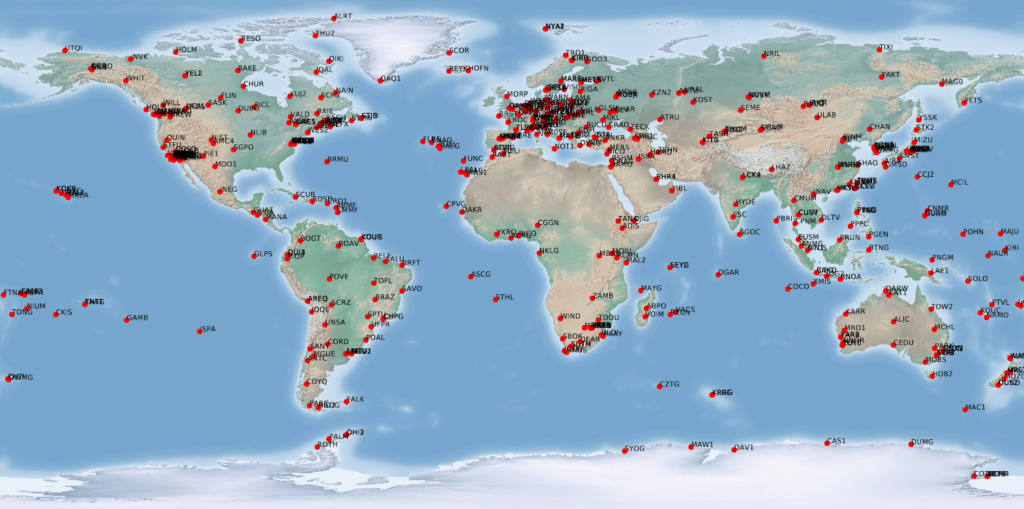
The foundation of the IGS is a global network of over 500 permanent and continuously operating stations of geodetic quality. These stations track signals from GPS, and increasingly also track signals from GLONASS, Galileo, BeiDou, QZSS, NavIC (IRNSS) as well as space-based augmentation systems (SBAS). As of late 2019, the IGS has 506 Stations, of which 308 are Multi-GNSS stations, and 259 Real-time stations. The percentage of multi-GNSS capable IGS network is expected to grow in the coming years.
IGS map
© IGS Info Info

Role in the International Association of Geodesy

It is a service of the International Association of Geodesy (IAG) and is a collaborative effort involving dozens of scientific, academic and government organizations. The IGS is a critical component of the IAG’s Global Geodetic Observing System (GGOS), where it facilitates cost-effective geometrical linkages with and among other precise geodetic observing techniques, including: Satellite Laser Ranging (SLR), Very Long Baseline Interferometry (VLBI), and Doppler Orbitography and Radio Positioning Integrated by Satellite (DORIS). These linkages are fundamental to generating and accessing the International Terrestrial Reference Frame (ITRF).

Alignment with the ITRF

The IGS provides the GPS coordinates, velocities and ERPs that contribute to the International Terrestrial Reference Frame (ITRF). GNSS has an important role providing connections between the other space geodesy techniques (VLBI, SLR and DORIS). It also helps maintain the orientation of the ITRF.

Utilizing the data and products of the IGS enables high-precision positioning to be carried out over large areas by utilizing the International Terrestrial Reference Frame (ITRF).

Structure

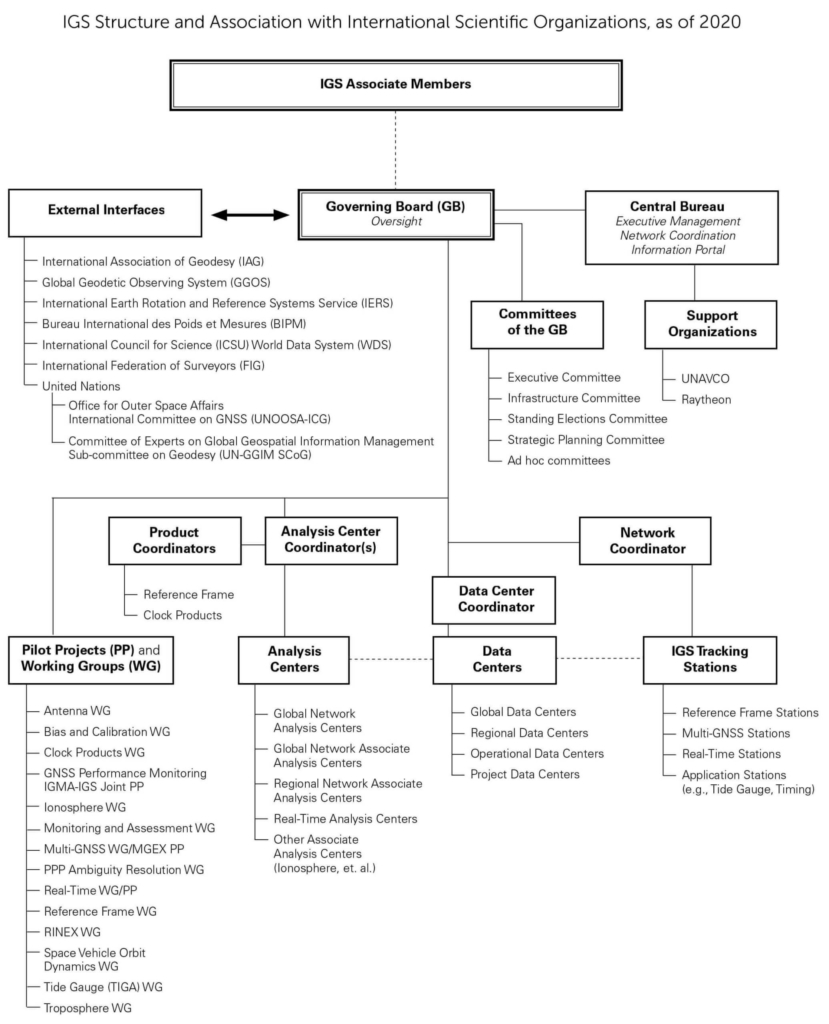
There are five main operational components to the IGS: data providers, data centers,  analysis centers, working groups and the central bureau. These are described in further detail in the chart below:
igs-structure-2020
© IGS Info Info

Data and Analysis Products

The primary data provided by the IGS is GPS and GLONASS (where available) code and phase measurements in the form of RINEX files for each of the stations forming the IGS network. Other data includes broadcast ephemerides (orbits) for GPS and GLONASS  and station meteorological information. Updated station data is available on a daily basis.

The IGS products are derived from this data. These include precise ephemerides, satellite/receiver clock corrections, Earth Rotation Parameters (ERPs), atmospheric param-eters, station coordinates and station velocities. Products are available at various latencies to reflect the requirements of different applications. Ultra-rapid products are available in near real-time, but are the least precise. Rapid products are provided within one to two days and have greater precision. The final products provide the best precision and are available within ten days to four weeks (depending on the product).The IGS also provides antenna calibration data for antennas in its network and site logs containing station metadata.

Geoscience Australia and the Massachusetts Institute of Technology jointly manage the IGS Analysis Center Coordination (ACC), with operations based at Geoscience Australia in Canberra, Australia. The ACC combination software is housed on cloud-based servers located in Australia and Europe, and coordination of the IGS product generation continues to be carried out by personnel distributed between GA and MIT. Under this joint management, the IGS continues to maintain a very high level of product availability.

Further Information

For additional information, including information about joining Working Groups or attending IGS meetings and events, please visit the IGS website, www.igs.org, and follow us on twitter @IGSorg.

(last update 2020)

IAG SERVICES

Geometric & General Services

  • IERS iag service earth rotation reference system frame© IERS
    IERS – Int. Earth Rotation and Reference Systems Service
  • IGS iag service gnss global navigation satellite system© IGS
    IGS – International GNSS Service
  • ILRS laser ranging service iag© ILRS
    ILRS – International Laser Ranging Service
  • IVS VLBI Service IAG© IVS
    IVS – International VLBI Service for Geodesy and Astrometry
  • IDS iag service DORIS© IDS
    IDS – International Doris Service
  • PSMSL Permanent Service for Mean Sea Level IAG© PSMSL
    PSMSL – Permanent Service for Mean Sea Level

Gravity Services

  • IGFS iag service gravity field© IGFS
    IGFS – International Gravity Field Service
  • ICGEM iag service© ICGEM
    ICGEM – International Centre for Global Earth Models
  • IDEMS iag service DEM digital elevation model© IDEMS
    IDEMS – International Digital Elevation Model Service
  • IGETS iag service© IGETS
    IGETS – International Geodynamics and Earth Tide Service
  • ISG service geoid IAG© ISG
    ISG – International Service for the Geoid
  • BGI gravimetric service IAG© BGI
    BGI – International Gravimetric Bureau

IAG as part of the IUGG

  
The International Association of Geodesy (IAG)  is a constituent association of the International Union of Geodesy and Geophysics (IUGG).

IAG Related Organisations

IAG collaborates closely with numerous organizations within geodesy and beyond. See the list for details.

Sitemap

  • Home | geodesy.science
  • ⠀└─ 📰News
  • ⠀└─ 📅 Events
  • ⠀└─ 💼 Jobs
  • ⠀└─ 👥 Membership
  • ⭐ About Geodesy
  • 🏛️ IAG | Int. Association of Geodesy
  • ⠀└─ ➡️ Commissions:
  • ⠀⠀◻️ 1 – Reference Frames
  • ⠀⠀◻️ 2 – Gravity Field
  • ⠀⠀◻️ 3 – Earth Rotation & Geodynamics
  • ⠀⠀◻️ 4 – Positioning and Applications
  • ⠀└─ 🔀 Inter Commission Committees:
  • ⠀⠀◻️ ICCT – Theory
  • ⠀⠀◻️ ICCM – Marine Research
  • ⠀⠀◻️ ICCC – Climate Research
  • ⠀└─ ⏰ Project QuGe
  • ⠀└─ ⚙️ IAG Services
  •  🌎 GGOS | Observing System
  • ⠀└─ About GGOS
  • ⠀└─ Structure
  • ⠀└─ Observations
  • ⠀└─ Products
  • ⠀└─ Services

References

Geodesy Glossary

Media Library

IAG Cloud | Public Documents

Terms of Use / Privacy Policy

IAG Statutes

IAG By-laws

Contact Us

Contact

Follow Us

LinkedIn

BlueSky

X (Twitter)

Facebook

Instagram

YouTube

Telegram

RSS Feed

Mailing List

This website is provided by the IAG Secretariat and the GGOS Coordinating Office, which are hosted by the BEV – Federal Office of Metrology and Surveying (Bundesamt für Eich- und Vermessungswesen) in Vienna, Austria.

Website Language Translation

The primary language of this website is English – however, the integrated GTranslate tool enables automatic translation into several languages:

Please note that translations into other languages may not be accurate. For reliable information, refer to the English version of the website.

2026 © Copyright | IAG - International Association of Geodesy
  • Link to LinkedIn
  • Link to Youtube
  • Link to Facebook
  • Link to Instagram
  • Link to X
  • Link to Telegram
  • Link to Behance
  • Link to Rss this site
  • Link to Mail
Scroll to top Scroll to top Scroll to top
Accessibility Adjustments

Powered by OneTap

How long do you want to hide the toolbar?
Hide Toolbar Duration
Select your accessibility profile
Vision Impaired Mode
Enhances website's visuals
Seizure Safe Profile
Clear flashes & reduces color
ADHD Friendly Mode
Focused browsing, distraction-free
Blindness Mode
Reduces distractions, improves focus
Epilepsy Safe Mode
Dims colors and stops blinking
Content Modules
Font Size

Default

Line Height

Default

Color Modules
Orientation Modules