GEODETIC TRAINING COURSE | SAN JUAN OBSERVATORY IN ARGENTINA | 27TH TO 31ST OCTOBER 2025
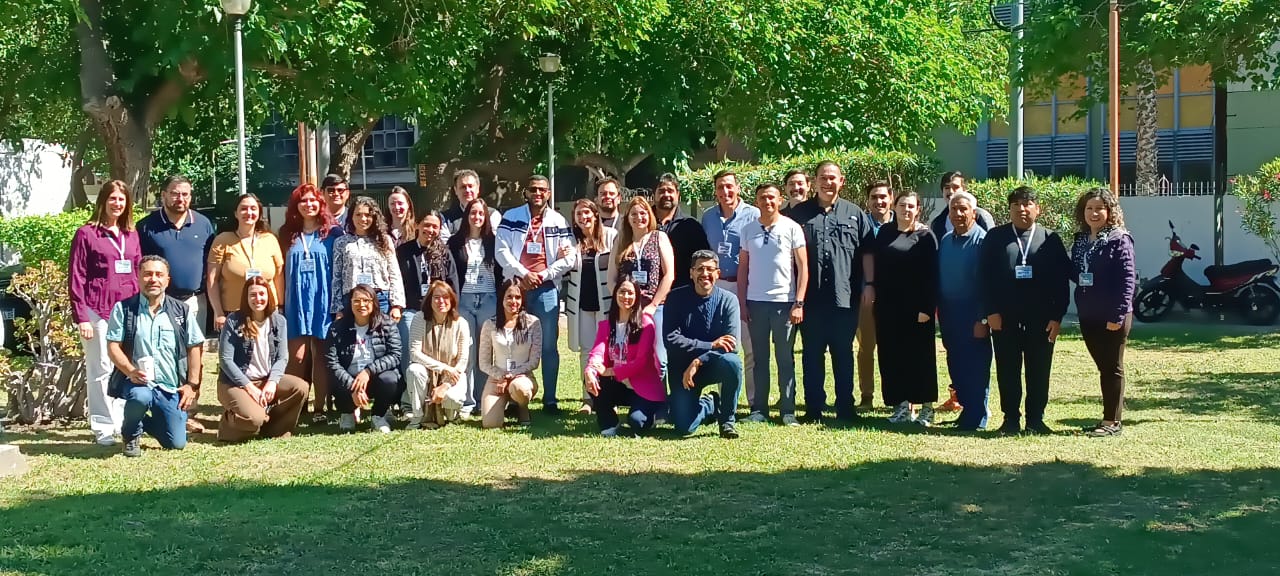
During the week of October 27–31, the XVI SIRGAS School (Geodetic Reference System for the Americas) was held at the Faculty of Engineering of the National University of San Juan (UNSJ), organized by the Félix Aguilar Astronomical Observatory (OAFA) and the Department of Surveying.
The event brought together experts in astronomy and geodesy from Latin America with the aim of deepening knowledge of space geodesy techniques VLBI and SLR. It was attended by 23 students from 8 countries across the Americas. Guest instructors included Esther Azcue Infanzón (GGOS IberAtlantic President) and Cristina García Miró (IGN Spain), who covered the fundamentals, instrumentation, analysis, and advances in VLBI (Very Long Baseline Interferometry), and Manuel Ángel Sánchez Piedra (Royal Observatory of the Spanish Army and GGOS IberAtlantic member of the Governing Board), who presented the principles and applications of SLR (Satellite Laser Ranging).
This collaboration was made possible thanks to the GGOS IberAtlantic group, the regional initiative of the Global Geodetic Observing System (GGOS) promoted by the National Geographic Institute of Spain in cooperation with other Spanish and Portuguese entities, and its partnership with SIRGAS.
GGOS IberAtlantic is committed to training young scientists and promoting geodesy outreach in the group’s official languages (Spanish, Portuguese, and English). This opportunity to offer a training course in Spanish encouraged students from different countries to participate and explore two techniques that are still scarcely developed in the region.
One of the highlights was the visit to the CART Radio Telescope (China-Argentina), located in Barreal (San Juan), which is emerging as a key element for integrating a global network of astronomical and geodetic observation in the Southern Hemisphere.
The presence of VLBI and SLR stations in the Southern Hemisphere is essential to ensure balanced global coverage in international geodetic and astronomical observation networks. These stations improve the determination of the International Terrestrial Reference Frame (ITRF) and increase accuracy in estimating Earth orientation parameters and the geocenter—crucial for satellite navigation, climate change monitoring, and interpreting tectonic movements. Without this homogeneous distribution, global solutions suffer from biases and limitations, making the incorporation of infrastructures such as the CART Radio Telescope in San Juan a strategic advancement for international science.