• Link to LinkedIn
  • Link to Youtube
  • Link to Facebook
  • Link to Instagram
  • Link to X
  • Link to Telegram
  • Link to Behance
  • Link to Rss this site
  • Link to Mail
  • NEWS
  • EVENTS
  • JOBS
  • MEMBER
  • Sitemap
    • Home
      • NEWS
      • EVENTS
      • JOBS
      • MEMBERSHIP
    • ⭐ About Geodesy
    • 🏛️ IAG | International Association of Geodesy
      • About IAG
      • Structure
      • 🎓 ECS – Early Career Scientists
      • 🌈 IDEA – Inclusion, Diversity, Equity, Accessibility
    •   └─ Comissions
      • 1️⃣ Reference Frames
      • 2️⃣ Gravity Field
      • 3️⃣ Earth Rotation & Geodynamics
      • 4️⃣ Positioning & Applications
    •   └─ Inter Commission Committees
      • 📚 ICCT – Theory
      • 🌊 ICCM – Marine Research
      • 🌥️ ICCC – Climate Research
    •   └─ Project QuGe
    •   └─ Services
    • 🌍 GGOS | Global Geodetic Observing System
      • About GGOS
      • Structure
      • 🛰️ Observations
      • 📦 Products
      • ⚙️ Services
  • Shopping Cart Shopping Cart
    0Shopping Cart
geodesy.science - IAG website
  • GGOS
    • Home
      • NEWS
      • EVENTS
      • JOBS
      • MEMBERSHIP
    • ⭐ About Geodesy
    • 🏛️ IAG | International Association of Geodesy
      • About IAG
      • Structure
      • 🎓 ECS – Early Career Scientists
      • 🌈 IDEA – Inclusion, Diversity, Equity, Accessibility
    •   └─ Comissions
      • 1️⃣ Reference Frames
      • 2️⃣ Gravity Field
      • 3️⃣ Earth Rotation & Geodynamics
      • 4️⃣ Positioning & Applications
    •   └─ Inter Commission Committees
      • 📚 ICCT – Theory
      • 🌊 ICCM – Marine Research
      • 🌥️ ICCC – Climate Research
    •   └─ Project QuGe
    •   └─ Services
    • 🌍 GGOS | Global Geodetic Observing System
      • About GGOS
      • Structure
      • 🛰️ Observations
      • 📦 Products
      • ⚙️ Services
  • About
    • About GGOS
      • What is GGOS?
      • Why GGOS?
      • Dual Roles of GGOS
      • Vision and Mission
      • GGOS History
  • Structure
    • Governance & Leadership
      • Governing Board GB
      • Executive Committee EC
    • Coordinating Office CO
    • Science Panel
    • Bureaus
      • BNO – Networks and Observations
      • BPS – Products and Standards
    • Focus Areas
      • Geohazards Monitoring
      • Geodetic Space Weather Research
      • Artificial Intelligence for Geodesy (AI4G)
    • GGOS Affiliates
      • GGOS Japan
      • GGOS D-A-CH
      • GGOS IberAtlantic
    • GGOS Committees & Working Groups
  • Observations
  • Services
  • Products
  • Resources
    • Resources Overview
    • Outreach Materials
    • Logos & Organisation Chart
    • Reports and Articles
    • Presentations and Videos
    • GGOS Meeting Reports
    • Terms of Reference and Strategy
  • Click to open the search input field Click to open the search input field Search
You are here: Home1 / IAG GGOS2 / GGOS Observations3 / Terrestrial Gravimetry
Follow a manual added link
Icon GGOS Observation Technique

Terrestrial Gravimetry

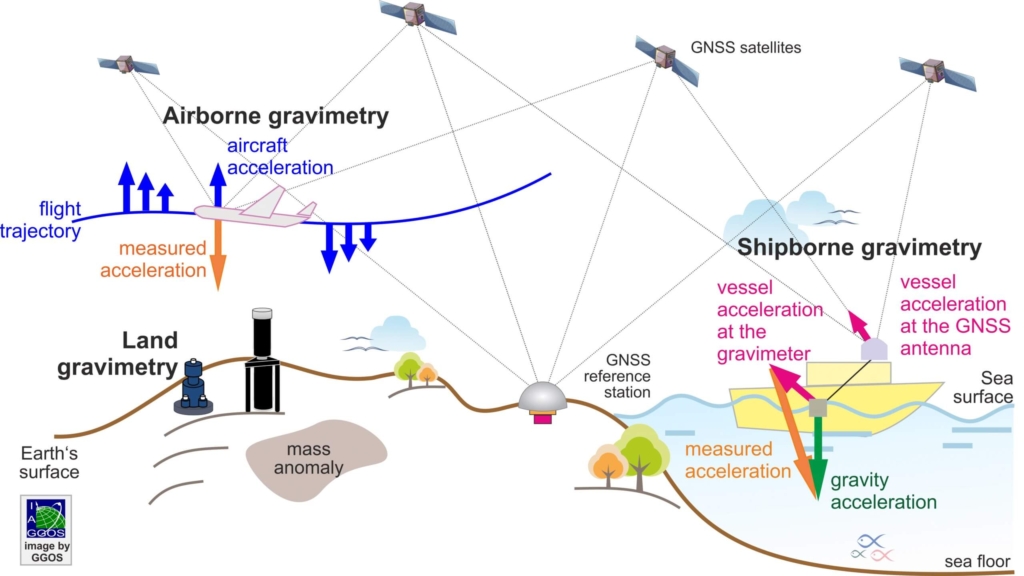
Gravimetry is the measurement of gravity, and gravity (also referred to as gravitation) is the universal force of attraction acting between all masses. On the Earth’s surface, gravity is a superposition of the gravitational attraction of masses and the centrifugal acceleration due to the rotation of the Earth. Gravity measurements can be based on the analysis of satellite orbits, using sensors on dedicated gravity satellite missions, or using terrestrial techniques, specifically, airborne gravimetry, shipborne gravimetry and land-based gravimetry. The acceleration of an object under the influence of Earth’s gravity, g, ranges from approximately 9.78 ms−2 (at the equator) to about 9.83 ms−2 (at the poles).
© GGOS (created by Laura Sanchez) Info Info
Read More ...

Absolute Gravity Observations

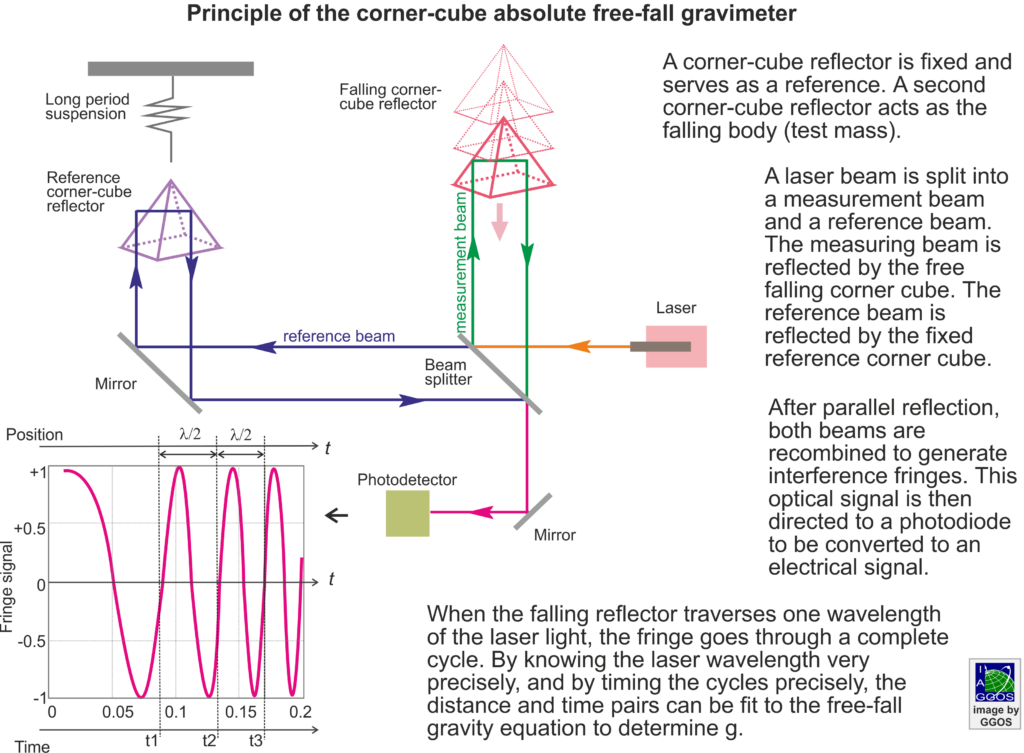
A gravity measurement can be either absolute or relative. Absolute gravity observations are performed with instruments that directly measure the magnitude of the acceleration of gravity. Because their length and time measurements can be tied to traceable, metrological standards, absolute gravity meters provide the full field gravity value at a given location and time, e.g. 9.8xx xxx xx ms-2. Modern instruments can measure g with an accuracy of about 1 x 10⁻⁸ ms-2 (i.e. nine digits, or about 1 part per billion). Absolute gravimeters can be further classified as either classical or quantum gravimeters, but both rely on precisely tracking the trajectory of a freely falling test mass. Classical instruments track the trajectory of a reflector in a vacuum chamber using laser interferometry, while quantum gravimeters measure the acceleration of free falling cold atoms (as test masses).  [Link to quantum gravimetry]
© GGOS (created by Laura Sanchez) Info Info

Relative gravity measurements

Relative gravity measurements provide either the difference in gravity between two locations or the change in gravity over time at a fixed location. While they do not provide the full field (“9.8”) gravity, modern relative instruments can still provide differences with the same parts-per-billion precision as absolute gravimeters.  Relative gravimeters use a counterforce to keep a test mass in equilibrium with gravity. Gravity changes (in space or time) are inferred from the corresponding changes of the counterforce. In classical relative gravimeters, the test mass is suspended by using an elastic spring (usually made of metal of quartz). The gravity difference between two points (or at two different times) results in an elongation or contraction of the spring. In modern relative gravimeters, the test mass is held fixed by electric plates, and the electric force necessary to do this is a measure of the change in gravity.  Another type of relative gravimeter is the superconducting relative gravity meter. Here, the elastic spring is realized by the magnetic levitation of a superconducting sphere in the super-stable magnetic field of a superconducting electromagnet. The magnetic levitation is designed to provide independent adjustment of the total levitating force and the force gradient so that it can support the full weight of the sphere and still yield a large displacement for a small change in gravity. Gravity changes are then inferred from the current adjustments needed to keep the sphere position constant.
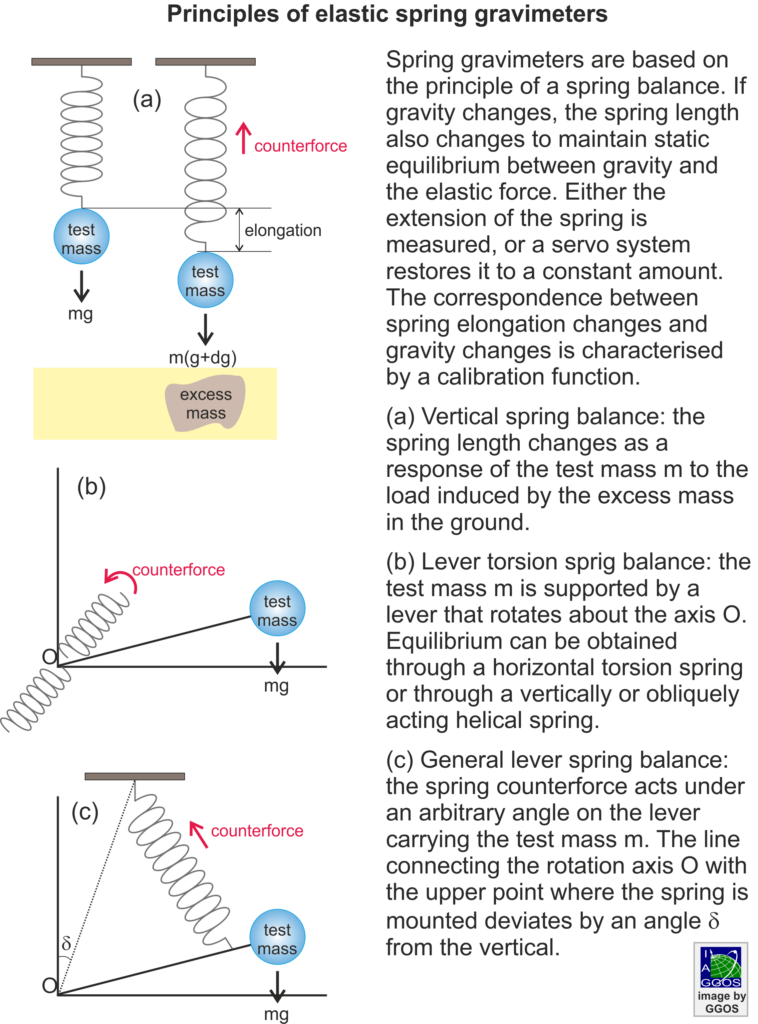
© GGOS (created by Laura Sanchez) Info Info

Due to the high sensitivity of current gravimetry technologies and the many factors influencing absolute and relative gravity measurements, a conventional gravity reference system is required to provide a global standard of high metrological quality, serving as basis for global, regional and local gravity measurements. Presently, this standard is to be embodied by the International Gravity Reference System (IGRS) and it is realized by the establishment of absolute gravity reference stations.
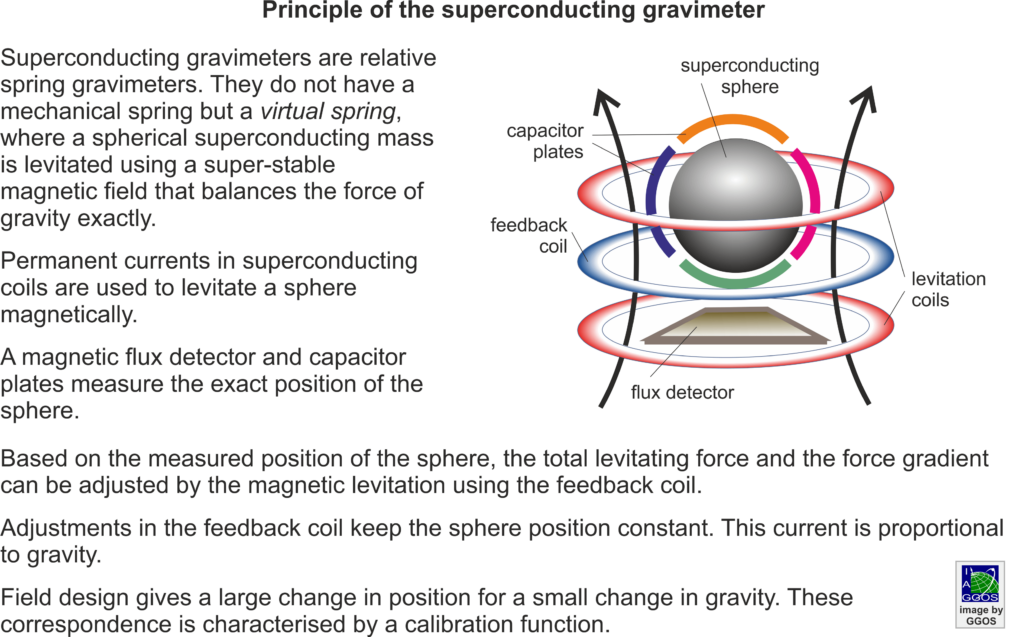
© GGOS (created by Laura Sanchez) Info Info

Applications

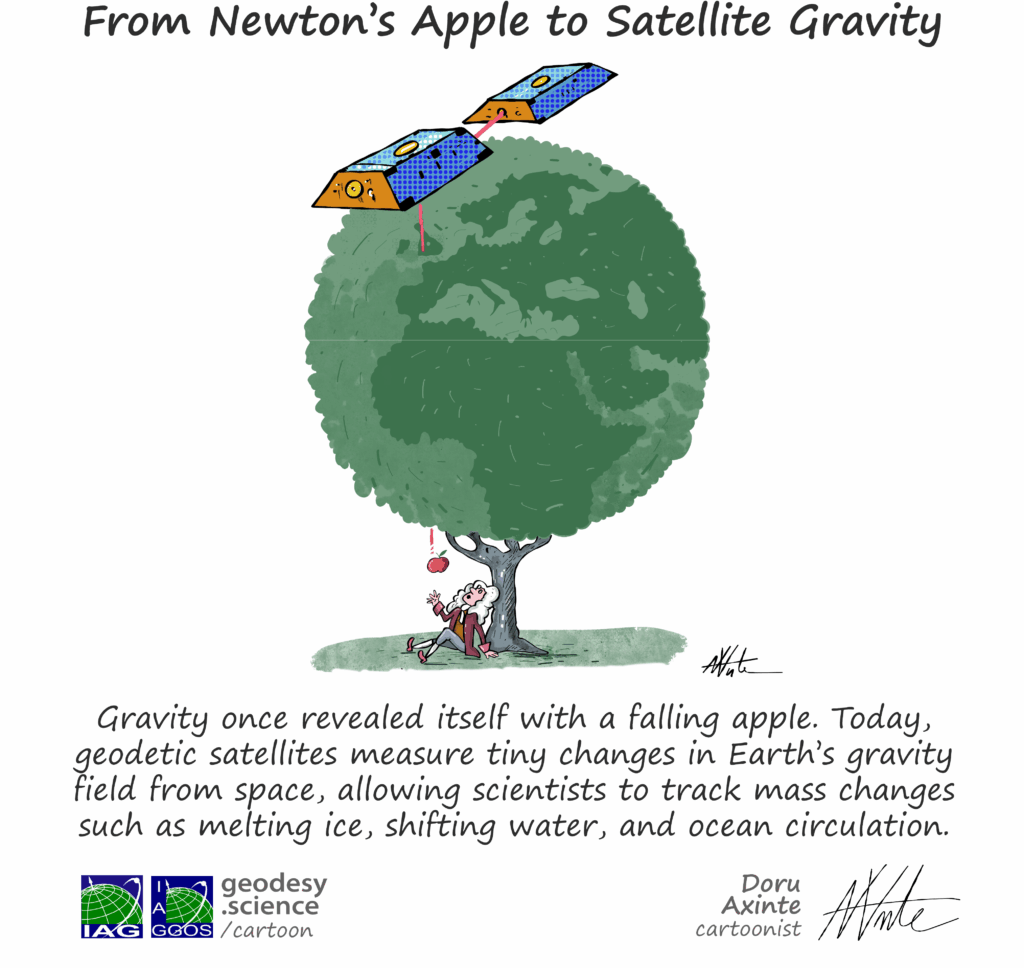
Time and space-dependent changes of gravity yield information on the distribution and movement of Earth’s masses. Time series of gravity measurements play a central role in modelling and monitoring geodynamic and geophysical processes. Satellite gravimetry provides a unique, global, and homogeneous data set of mass anomalies within Earth or at its surface. However, current satellite gravimetry is unable to resolve structures smaller than a few hundred kilometers. To increase the spatio-temporal resolution of the satellite gravimetry and to be able to detect short-term and small-scale mass changes, terrestrial gravimetry is essential. Terrestrial gravimeters are able to detect mass distribution changes nearby, in a radius of a few hundred meters from the instrument. Thus, terrestrial gravimetry is an important tool to monitor low-frequency seismicity, volcanic systems, geothermal reservoirs, effects of irrigation or withdrawal of water, impacts of large building projects, etc. (see gravity field and temporal variations). Terrestrial gravimetry is also essential for geophysical prospection and it is widely used in the exploration of natural resources like oil and gas, as well as in mining and in geotechnical, archeological, metrological and geomatics studies.

In Physical Geodesy, terrestrial gravimetry is necessary for
– The establishment and maintenance of the International Height Reference Frame (IHRF)
– The establishment and maintenance of the International Gravity Reference Frame (IGRF)
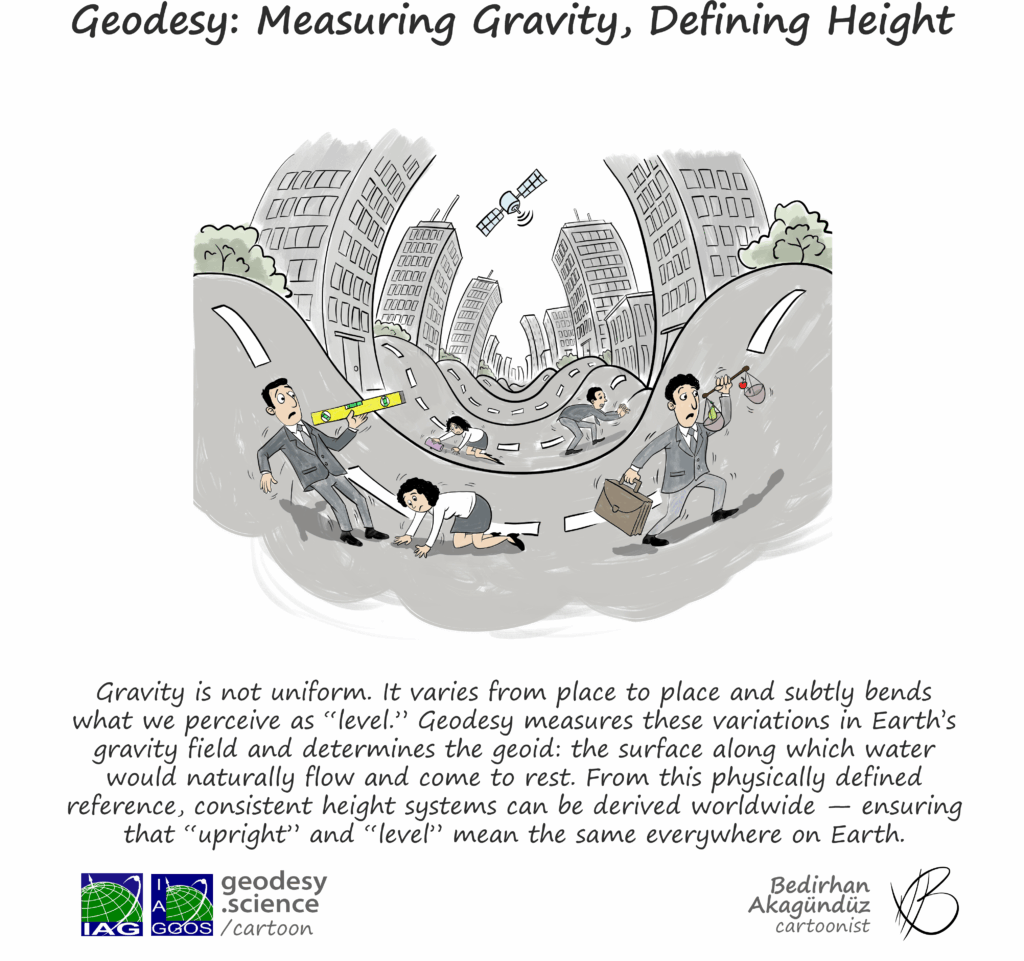
– The high-resolution regional gravity field modeling resulted in the determination of a high-accuracy and high-precision geoid or quasi-geoid models

Service

  • The Bureau Gravimétrique International (BGI)

    collects, validates, and archives, through all types of gravity measurements (relative or absolute) acquired from land, marine, or airborne surveys. For research purposes, BGI also provides derived gravity data products such as gravity anomalies to a wide range of users.

  • The International Geodynamics and Earth Tide Service (IGETS)

    monitor temporal variations of the Earth gravity field through long‐term records from ground gravimeters, tiltmeters, strainmeters and other geodynamic sensors.

  • The International Service for the Geoid (ISG)

    collects and distributes geoid models and software for geoid computations, as well as organizes technical schools on the geoid determination.

  • International Centre for Global Earth Models (ICGEM)

    Gravity observables inferred from satellite gravimetry are provided by the International Centre for Global Earth Models (ICGEM)

  • International Gravity Field Service (IGFS)

    The inter-action between these different services is coordinated by the International Gravity Field Service (IGFS).

Additionally, in the frame of the International Association of Geodesy (IAG), the Commission 2 “Gravity Field”, the Inter-Commission Committees “on Theory” and “on Geodesy for Climate Research”, as well as the recent established project “Novel Sensors and Quantum Technology for Geodesy (QuGe)” lead current research on advancing science and analysis to improve the observation and modelling of Earth’s gravity field.
© GGOS (Prepared by: Claudia Tocho, Laura Sánchez, Derek van Westrum)

Share

  • Facebook Facebook Share on Facebook
  • X-twitter X-twitter Share on X
  • Whatsapp Whatsapp Share on WhatsApp
  • Pinterest Pinterest Share on Pinterest
  • Linkedin Linkedin Share on LinkedIn
  • Mail Mail Share by Mail

Geodetic Observations - Geodesy

Observation Types

  • GNSS Radio Occultation
  • Icon GGOS Observation Technique© TheNounProject
    VLBI
  • Icon GGOS Observation Technique© TheNounProject
    SLR / LLR – Laser Ranging
  • Icon GGOS Observation Technique© TheNounProject
    DORIS
  • Icon GGOS Observation Technique© TheNounProject
    GNSS
  • Icon GGOS Observation Technique© TheNounProject
    Satellite Altimetry
  • Icon GGOS Observation Technique© TheNounProject
    Satellite Gravimetry
  • Icon GGOS Observation Technique© TheNounProject
    Terrestrial Gravimetry
  • Icon GGOS Observation Technique© TheNounProject
    Tide Gauge Measurements
  • Icon GGOS Observation Technique© TheNounProject
    GNSS Reflectometry
  • Icon GGOS Observation Technique© TheNounProject
    Quantum Gravimetry
  • Icon GGOS Observation Technique© TheNounProject
    Optical Atomic Clocks
  • Icon GGOS Observation Technique
    GGOS Core Sites
Search Search

IAG as part of the IUGG

  
The International Association of Geodesy (IAG)  is a constituent association of the International Union of Geodesy and Geophysics (IUGG).

IAG Related Organisations

IAG collaborates closely with numerous organizations within geodesy and beyond. See the list for details.

Sitemap

  • Home | geodesy.science
  • ⠀└─ 📰News
  • ⠀└─ 📅 Events
  • ⠀└─ 💼 Jobs
  • ⠀└─ 👥 Membership
  • ⭐ About Geodesy
  • 🏛️ IAG | Int. Association of Geodesy
  • ⠀└─ ➡️ Commissions:
  • ⠀⠀◻️ 1 – Reference Frames
  • ⠀⠀◻️ 2 – Gravity Field
  • ⠀⠀◻️ 3 – Earth Rotation & Geodynamics
  • ⠀⠀◻️ 4 – Positioning and Applications
  • ⠀└─ 🔀 Inter Commission Committees:
  • ⠀⠀◻️ ICCT – Theory
  • ⠀⠀◻️ ICCM – Marine Research
  • ⠀⠀◻️ ICCC – Climate Research
  • ⠀└─ ⏰ Project QuGe
  • ⠀└─ ⚙️ IAG Services
  •  🌎 GGOS | Observing System
  • ⠀└─ About GGOS
  • ⠀└─ Structure
  • ⠀└─ Observations
  • ⠀└─ Products
  • ⠀└─ Services

References

Geodesy Glossary

Media Library

IAG Cloud | Public Documents

Terms of Use / Privacy Policy

IAG Statutes

IAG By-laws

Contact Us

Contact

Follow Us

LinkedIn

BlueSky

X (Twitter)

Facebook

Instagram

YouTube

Telegram

RSS Feed

Mailing List

This website is provided by the IAG Secretariat and the GGOS Coordinating Office, which are hosted by the BEV – Federal Office of Metrology and Surveying (Bundesamt für Eich- und Vermessungswesen) in Vienna, Austria.

Website Language Translation

The primary language of this website is English – however, the integrated GTranslate tool enables automatic translation into several languages:

Please note that translations into other languages may not be accurate. For reliable information, refer to the English version of the website.

2026 © Copyright | IAG - International Association of Geodesy
  • Link to LinkedIn
  • Link to Youtube
  • Link to Facebook
  • Link to Instagram
  • Link to X
  • Link to Telegram
  • Link to Behance
  • Link to Rss this site
  • Link to Mail
Scroll to top Scroll to top Scroll to top
Accessibility Adjustments

Powered by OneTap

How long do you want to hide the toolbar?
Hide Toolbar Duration
Select your accessibility profile
Vision Impaired Mode
Enhances website's visuals
Seizure Safe Profile
Clear flashes & reduces color
ADHD Friendly Mode
Focused browsing, distraction-free
Blindness Mode
Reduces distractions, improves focus
Epilepsy Safe Mode
Dims colors and stops blinking
Content Modules
Font Size

Default

Line Height

Default

Color Modules
Orientation Modules