
• Link to LinkedIn
  • Link to Youtube
  • Link to Facebook
  • Link to Instagram
  • Link to X
  • Link to Telegram
  • Link to Behance
  • Link to Rss this site
  • Link to Mail
  • NEWS
  • EVENTS
  • JOBS
  • MEMBER
  • Sitemap
    • Home
      • NEWS
      • EVENTS
      • JOBS
      • MEMBERSHIP
    • ⭐ About Geodesy
    • 🏛️ IAG | International Association of Geodesy
      • About IAG
      • Structure
      • 🎓 ECS – Early Career Scientists
      • 🌈 IDEA – Inclusion, Diversity, Equity, Accessibility
    •   └─ Comissions
      • 1️⃣ Reference Frames
      • 2️⃣ Gravity Field
      • 3️⃣ Earth Rotation & Geodynamics
      • 4️⃣ Positioning & Applications
    •   └─ Inter Commission Committees
      • 📚 ICCT – Theory
      • 🌊 ICCM – Marine Research
      • 🌥️ ICCC – Climate Research
    •   └─ Project QuGe
    •   └─ Services
    • 🌍 GGOS | Global Geodetic Observing System
      • About GGOS
      • Structure
      • 🛰️ Observations
      • 📦 Products
      • ⚙️ Services
  • Shopping Cart Shopping Cart
    0Shopping Cart
geodesy.science - IAG website
  • GGOS
    • Home
      • NEWS
      • EVENTS
      • JOBS
      • MEMBERSHIP
    • ⭐ About Geodesy
    • 🏛️ IAG | International Association of Geodesy
      • About IAG
      • Structure
      • 🎓 ECS – Early Career Scientists
      • 🌈 IDEA – Inclusion, Diversity, Equity, Accessibility
    •   └─ Comissions
      • 1️⃣ Reference Frames
      • 2️⃣ Gravity Field
      • 3️⃣ Earth Rotation & Geodynamics
      • 4️⃣ Positioning & Applications
    •   └─ Inter Commission Committees
      • 📚 ICCT – Theory
      • 🌊 ICCM – Marine Research
      • 🌥️ ICCC – Climate Research
    •   └─ Project QuGe
    •   └─ Services
    • 🌍 GGOS | Global Geodetic Observing System
      • About GGOS
      • Structure
      • 🛰️ Observations
      • 📦 Products
      • ⚙️ Services
  • About
    • About GGOS
      • What is GGOS?
      • Why GGOS?
      • Dual Roles of GGOS
      • Vision and Mission
      • GGOS History
  • Structure
    • Governance & Leadership
      • Governing Board GB
      • Executive Committee EC
    • Coordinating Office CO
    • Science Panel
    • Bureaus
      • BNO – Networks and Observations
      • BPS – Products and Standards
    • Focus Areas
      • Geohazards Monitoring
      • Geodetic Space Weather Research
      • Artificial Intelligence for Geodesy (AI4G)
    • GGOS Affiliates
      • GGOS Japan
      • GGOS D-A-CH
      • GGOS IberAtlantic
    • GGOS Committees & Working Groups
  • Observations
  • Services
  • Products
  • Resources
    • Resources Overview
    • Outreach Materials
    • Logos & Organisation Chart
    • Reports and Articles
    • Presentations and Videos
    • GGOS Meeting Reports
    • Terms of Reference and Strategy
  • Click to open the search input field Click to open the search input field Search
Follow a manual added link

Gravity

Reference Frame

How to refer gravity measurements at the Earth surface to a uniform reference?

So far, the valid gravity reference system of the IAG is still the International Gravity Standardization Net 1971 (IGSN71) (Morelli et al. 1974). Although it is widely used, at an uncertainty level of 10^{\text{-}6} \frac{m}{s^{2}} it fulfils neither the requirements nor the accuracy for the understanding of the Earth’s System and applications in metrology.

Following IAG Resolution No. 2 “Establishment of a Global Absolute Gravity Reference System” adopted at the XXVI, General Assembly of the International Union of Geodesy and Geophysics (IUGG) in Prague 2015, the IAG Joint Working Group 2.1.1 “Establishment of a global absolute gravity reference system” has developed the basis of a new system and frame to achieve accurate, homogeneous, long-term global recording of Earth’s gravity, while taking advantage of the potential of today’s absolute gravity measurements. (Wilmes et al. 2016, Wziontek et al. 2021)
gravity IGRF

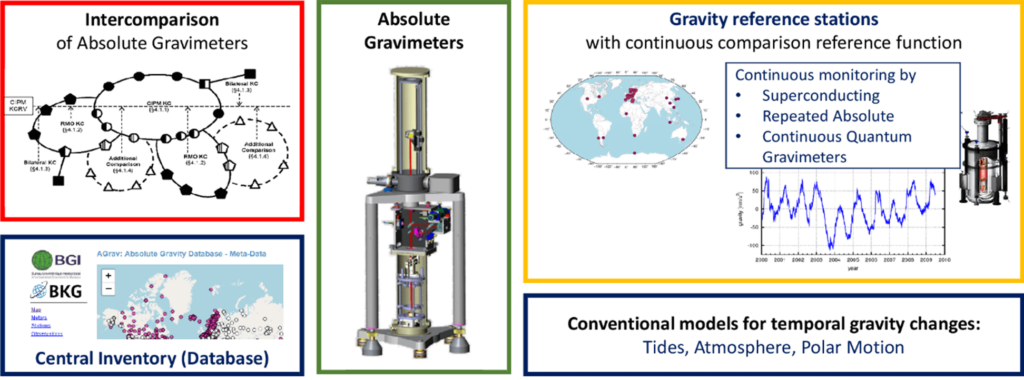
Fig. 1: Concept for the International Gravity Reference Frame.

The International Gravity Reference System (IGRS) is defined by the instantaneous acceleration of free-fall, expressed in the International System of Units (SI). It is completed by a set of conventional models for the time-dependent corrections of this quantity comprising constant components which define the conventional quantity “acceleration of gravity”.

The International Gravity Reference Frame (IGRF) as the realization of the IGRS is represented by absolute gravity measurements traceable to the SI that contain conventional temporal gravity corrections (Fig. 1). Due to its principle, absolute gravity observations at individual stations are not linked to each other avoiding the need to build up classical observation networks. All absolute gravimeters (AG) have to be checked at comparisons, where the gravity reference is realized based on a set of measurements by a group of AGs and the functional model for their processing. The comparisons follow the “CCM – IAG Strategy for Metrology in Absolute Gravimetry”, which also describes the traceability chain in gravimetry. The reliability of all AGs used for the realization of the IGRF has to be ensured further by regular monitoring at reference stations.

Read More ...

The IGRS Conventions 2020 (Wziontek et al. 2021) update the Processing Standards for the International Absolute Gravity Basestation Network (IAGBN) (Boedecker 1988) which are already applied for decades. Minor updates reflect the current state of the art but provide the compatibility with existing processing results.

The IGRF contains a global set of stations where reliable absolute gravity values with an accuracy of 10^{\text{-}7} \frac{m}{s^{2}} and better are provided to the users. The main infrastructure of the IGRF is formed by gravity stations of three different types:

  • Reference stations, which are providing an empirical gravity reference function as time series based on absolute monitoring of the gravity field derived from continuous recording by superconducting gravimeter (SG) in combination with repeated absolute gravity observations or from a continuously operated absolute quantum gravimeter. At minimum, repeated absolute gravity observations to capture annual variations are recommended.
  • Comparison stations, which are reference stations with extended facilities to check the compatibility of instruments.
  • Core stations, which are providing the link to main space geodetic techniques (GNSS, SLR; VLBI), preferably collocated with GGOS core stations.

All measurements at these stations should be documented and archived in the IAG absolute gravity database (AGrav) operated by BGI (Bureau Gravimétrique International) and IGETS (International Geodynamics and Earth Tide Service) for static and time variable measurements, respectively. Both IAG Services BGI and IGETS are also services within the IGFS (International Gravity Field Service).

To make the IGRF accessible to users and to finally replace the previous IGSN71 network, an adequate infrastructure based on absolute gravity measurements needs to be built up. This requires the support of international and national institutions, agencies and governmental bodies in charge of geodetic infrastructure which are encouraged to establish compatible first order gravity networks and to provide information about existing absolute gravity observations. This was acknowledged by IAG with Resolution No. 4 of 2019 and provides the frame for activities IAG Joint Working Group 2.1.1. to establish the IGRF.
Further Information

  • Boedecker G (1988) The International Absolute Gravity Basestation Network (IAGBN). Absolute gravity observations data processing standards and station documentation. BGI Bull d’Inf 63:51–57

  • Morelli C, Gantar C, Honkasalo T, McConnell R, Tanner J, Szabo B, U U, Whalen C (1974) The International Gravity Standardization Net 1971 (I.G.S.N.71). International Association of Geodesy, Special Publication 4 https://apps.dtic.mil/dtic/tr/fulltext/u2/a006203.pdf.

  • Wilmes H, Vitushkin L, Pálinkáš V, Falk R, Wziontek H, Bonvalot S (2016). Towards the definition and realization of a global absolute gravity reference system. In: Freymueller JT, Sánchez L (eds). International Symposium on Earth and Environmental Sciences for Future Generations, vol 147. Springer, Cham, pp 25–29. https://doi.org/10.1007/1345_2016_245

  • Wziontek, H., Bonvalot, S., Falk, R., Gabalda, G., Mäkinen, J, Pálinkáš, V., Rülke, A., Vitushkin, L.:  Status of the International Gravity Reference System and Frame. J Geod 95, 7 (2021), https://doi.org/10.1007/s00190-020-01438-9

© GGOS (Prepared by: L. Sánchez, H. Wziontek, T. Gruber, Y. Tanaka)

Share this Product

  • Gravity%20Reference%20Frame' data-av_svg_icon='facebook' data-av_iconset='svg_entypo-fontello' title='' data-avia-related-tooltip='Share on Facebook'> Facebook Facebook Share on Facebook
  • Gravity%20Reference%20Frame&url=https://geodesy.science/?p=8237' data-av_svg_icon='x-twitter' data-av_iconset='svg_entypo-fontello' title='' data-avia-related-tooltip='Share on X'> X-twitter X-twitter Share on X
  • Whatsapp Whatsapp Share on WhatsApp
  • Gravity%20Reference%20Frame&media=https%3A%2F%2Fgeodesy.science%2Fwp-content%2Fuploads%2Fggos-product-ICON_IGRF.svg' data-av_svg_icon='pinterest' data-av_iconset='svg_entypo-fontello' title='' data-avia-related-tooltip='Share on Pinterest'> Pinterest Pinterest Share on Pinterest
  • Gravity%20Reference%20Frame&url=https://geodesy.science/item/gravity-reference-frame/' data-av_svg_icon='linkedin' data-av_iconset='svg_entypo-fontello' title='' data-avia-related-tooltip='Share on LinkedIn'> Linkedin Linkedin Share on LinkedIn
  • Gravity%20Reference%20Frame&body=https://geodesy.science/item/gravity-reference-frame/' data-av_svg_icon='mail' data-av_iconset='svg_entypo-fontello' title='' data-avia-related-tooltip='Share by Mail'> Mail Mail Share by Mail

PRODUCTS

Reference Frames

  • © TheNounProject (edited by GGOS)
    Height Reference Frame
  • ICRF celestial© TheNounProject (edited by GGOS)
    Celestial Reference Frame
  • © TheNounProject (edited by GGOS)
    Gravity Reference Frame
  • © TheNounProject (edited by GGOS)
    Terrestrial Reference Frame

Earth Orientation

  • EOP Earth orientation parameter© TheNounProject (edited by GGOS)
    Earth Orientation Parameters

Geometry

  • © TheNounProject (edited by GGOS)
    Surface Deformation Models
  • © TheNounProject (edited by GGOS)
    Ocean Topography Models
  • © TheNounProject (edited by GGOS)
    Sea Level Change
  • © TheNounProject (edited by GGOS)
    Digital Elevation Model
  • © TheNounProject (edited by GGOS)
    Ice Sheets & Glaciers – Variations
  • © TheNounProject (edited by GGOS)
    Station Positions & Variations
  • © TheNounProject (edited by GGOS)
    Tide Gauge Records
  • © TheNounProject (edited by GGOS)
    Sea Surface Heights

Gravity Field

  • © TheNounProject (edited by GGOS)
    Global Gravity Field – Models
  • © TheNounProject (edited by GGOS)
    Gravity Field – Temporal Variations
  • © TheNounProject (edited by GGOS)
    Terrestrial Gravity Data
  • © TheNounProject (edited by GGOS)
    Regional / Local Geoid Models
  • © TheNounProject (edited by GGOS)
    Ice Sheets & Glaciers – Variations
  • © TheNounProject (edited by GGOS)
    Height Systems

Positioning & Applications

  • ICON Atmosphere© TheNounProject (edited by GGOS)
    Thermosphere
  • ICON Atmosphere© TheNounProject (edited by GGOS)
    Ionosphere
  • ICON Atmosphere© TheNounProject (edited by GGOS)
    Lower Neutral Atmosphere
  • ICON Atmosphere© TheNounProject (edited by GGOS)
    Atmospheric Products
  • GNSS Orbits satellites GPS GLONASS Galileo BeiDou QZSS IRNSS© TheNounProject (edited by GGOS)
    GNSS Satellite Orbits and Clocks

IAG as part of the IUGG

  
The International Association of Geodesy (IAG)  is a constituent association of the International Union of Geodesy and Geophysics (IUGG).

IAG Related Organisations

IAG collaborates closely with numerous organizations within geodesy and beyond. See the list for details.

Sitemap

  • Home | geodesy.science
  • ⠀└─ 📰News
  • ⠀└─ 📅 Events
  • ⠀└─ 💼 Jobs
  • ⠀└─ 👥 Membership
  • ⭐ About Geodesy
  • 🏛️ IAG | Int. Association of Geodesy
  • ⠀└─ ➡️ Commissions:
  • ⠀⠀◻️ 1 – Reference Frames
  • ⠀⠀◻️ 2 – Gravity Field
  • ⠀⠀◻️ 3 – Earth Rotation & Geodynamics
  • ⠀⠀◻️ 4 – Positioning and Applications
  • ⠀└─ 🔀 Inter Commission Committees:
  • ⠀⠀◻️ ICCT – Theory
  • ⠀⠀◻️ ICCM – Marine Research
  • ⠀⠀◻️ ICCC – Climate Research
  • ⠀└─ ⏰ Project QuGe
  • ⠀└─ ⚙️ IAG Services
  •  🌎 GGOS | Observing System
  • ⠀└─ About GGOS
  • ⠀└─ Structure
  • ⠀└─ Observations
  • ⠀└─ Products
  • ⠀└─ Services

References

Geodesy Glossary

Media Library

IAG Cloud | Public Documents

Terms of Use / Privacy Policy

IAG Statutes

IAG By-laws

Contact Us

Contact

Follow Us

LinkedIn

BlueSky

X (Twitter)

Facebook

Instagram

YouTube

Telegram

RSS Feed

Mailing List

This website is provided by the IAG Secretariat and the GGOS Coordinating Office, which are hosted by the BEV – Federal Office of Metrology and Surveying (Bundesamt für Eich- und Vermessungswesen) in Vienna, Austria.

Website Language Translation

The primary language of this website is English – however, the integrated GTranslate tool enables automatic translation into several languages:

Please note that translations into other languages may not be accurate. For reliable information, refer to the English version of the website.

2026 © Copyright | IAG - International Association of Geodesy
  • Link to LinkedIn
  • Link to Youtube
  • Link to Facebook
  • Link to Instagram
  • Link to X
  • Link to Telegram
  • Link to Behance
  • Link to Rss this site
  • Link to Mail
Scroll to top Scroll to top Scroll to top
Accessibility Adjustments

Powered by OneTap

How long do you want to hide the toolbar?
Hide Toolbar Duration
Select your accessibility profile
Vision Impaired Mode
Enhances website's visuals
Seizure Safe Profile
Clear flashes & reduces color
ADHD Friendly Mode
Focused browsing, distraction-free
Blindness Mode
Reduces distractions, improves focus
Epilepsy Safe Mode
Dims colors and stops blinking
Content Modules
Font Size

Default

Line Height

Default

Color Modules
Orientation Modules