• Link to LinkedIn
  • Link to Youtube
  • Link to Facebook
  • Link to Instagram
  • Link to X
  • Link to Telegram
  • Link to Behance
  • Link to Rss this site
  • Link to Mail
  • NEWS
  • EVENTS
  • JOBS
  • MEMBER
  • Sitemap
    • Home
      • NEWS
      • EVENTS
      • JOBS
      • MEMBERSHIP
    • ⭐ About Geodesy
    • 🏛️ IAG | International Association of Geodesy
      • About IAG
      • Structure
      • 🎓 ECS – Early Career Scientists
      • 🌈 IDEA – Inclusion, Diversity, Equity, Accessibility
    •   └─ Comissions
      • 1️⃣ Reference Frames
      • 2️⃣ Gravity Field
      • 3️⃣ Earth Rotation & Geodynamics
      • 4️⃣ Positioning & Applications
    •   └─ Inter Commission Committees
      • 📚 ICCT – Theory
      • 🌊 ICCM – Marine Research
      • 🌥️ ICCC – Climate Research
    •   └─ Project QuGe
    •   └─ Services
    • 🌍 GGOS | Global Geodetic Observing System
      • About GGOS
      • Structure
      • 🛰️ Observations
      • 📦 Products
      • ⚙️ Services
  • Shopping Cart Shopping Cart
    0Shopping Cart
geodesy.science - IAG website
  • GGOS
    • Home
      • NEWS
      • EVENTS
      • JOBS
      • MEMBERSHIP
    • ⭐ About Geodesy
    • 🏛️ IAG | International Association of Geodesy
      • About IAG
      • Structure
      • 🎓 ECS – Early Career Scientists
      • 🌈 IDEA – Inclusion, Diversity, Equity, Accessibility
    •   └─ Comissions
      • 1️⃣ Reference Frames
      • 2️⃣ Gravity Field
      • 3️⃣ Earth Rotation & Geodynamics
      • 4️⃣ Positioning & Applications
    •   └─ Inter Commission Committees
      • 📚 ICCT – Theory
      • 🌊 ICCM – Marine Research
      • 🌥️ ICCC – Climate Research
    •   └─ Project QuGe
    •   └─ Services
    • 🌍 GGOS | Global Geodetic Observing System
      • About GGOS
      • Structure
      • 🛰️ Observations
      • 📦 Products
      • ⚙️ Services
  • About
    • About GGOS
      • What is GGOS?
      • Why GGOS?
      • Dual Roles of GGOS
      • Vision and Mission
      • GGOS History
  • Structure
    • Governance & Leadership
      • Governing Board GB
      • Executive Committee EC
    • Coordinating Office CO
    • Science Panel
    • Bureaus
      • BNO – Networks and Observations
      • BPS – Products and Standards
    • Focus Areas
      • Geohazards Monitoring
      • Geodetic Space Weather Research
      • Artificial Intelligence for Geodesy (AI4G)
    • GGOS Affiliates
      • GGOS Japan
      • GGOS D-A-CH
      • GGOS IberAtlantic
    • GGOS Committees & Working Groups
  • Observations
  • Services
  • Products
  • Resources
    • Resources Overview
    • Outreach Materials
    • Logos & Organisation Chart
    • Reports and Articles
    • Presentations and Videos
    • GGOS Meeting Reports
    • Terms of Reference and Strategy
  • Click to open the search input field Click to open the search input field Search
You are here: Home1 / IAG GGOS2 / GGOS Observations3 / Satellite Gravimetry
Follow a manual added link
Icon GGOS Observation Technique

Satellite-based

gravity field observations

According to Newton’s law of gravitation, the attraction between two bodies is proportional to the product of their mases and inversely proportional to the square of the distance between them. If a satellite passes above an Earth’s mass inhomogeneity (or anomaly), its trajectory (orbit) has a perturbation, i.e., the satellite position gets closer or further away from the Earth. The lower the satellite, the higher its sensitivity to the gravitational effect caused by the mass inhomogeneity. The satellite motion and the parameters describing the orbit are observed to draw conclusions about the forces acting on the satellite. Of particular interest is the relation between the features of the terrestrial gravity field and the resulting deviations of the true satellite orbit from an undisturbed, ideal satellite motion.

The traditional tracking techniques used for satellite positioning (GNSS, SLR and DORIS) allow the precise orbit determination for satellites with altitudes between 800 km and 20,000 km, which in turn allow the determination of the Earth’s gravity field with a resolution of about 500 to 1000 km (half wavelength). To increase this resolution, dedicated high-resolution gravity-field missions have been developed. The essence of these is the use of satellites as gravity probes or sensors moving within the Earth’s gravity field. The main characteristics of these satellite missions are:

– Orbit altitude as low as possible (200 to 500 km)
– Uninterrupted tracking over large orbital arcs in three spatial dimensions, and
– Separation between gravitational and non-gravitational forces (e.g. atmospheric drag, solar radiation pressure, albedo, thrust, etc.) acting on the satellite.

The main observation principles are:

– Satellite-to-satellite tracking in the high-low mode (SST-HL): a low Earth orbiting (LEO) satellite is tracked by high orbiting GNSS satellites, relative to a network of ground stations. The satellite is a probe within the Earth’s gravity field, which can be precisely tracked without interruption. The observed 3-D accelerations correspond to the gravity accelerations. The non-gravitational forces acting on the satellite are measured by accelerometers. An example of this measuring principle is given by the mission CHAMP (CHAllenging Minisatellite Payload)

– Satellite-to-satellite tracking in the low-low mode (SST-LL): Two LEO satellites are placed in the same orbit, separated by several hundred kilometres, and the range (distance) between them is measured with the highest possible accuracy. Basically, the acceleration difference between the two satellites is measured. The two satellites can be considered as one instrument in which

(1) Variations in the gravity field cause variations in the range between the two satellites: areas of stronger gravity affect the lead satellite first and accelerate it away from the second satellite,
(2) Range variations are measured by a high-accuracy microwave link or laser-ranging interferometry,
(3) The observed range variations are corrected for non-gravitational effects by precise accelerometers.
This method provides a very much higher sensitivity than SSL-HL. Examples of this measuring principle are the GRACE (Gravity Recovery and Climate Experiment) [Link1, Link2] and GRACE Follow-On (GRACE-FO) missions [Link1, Link2, Link3]

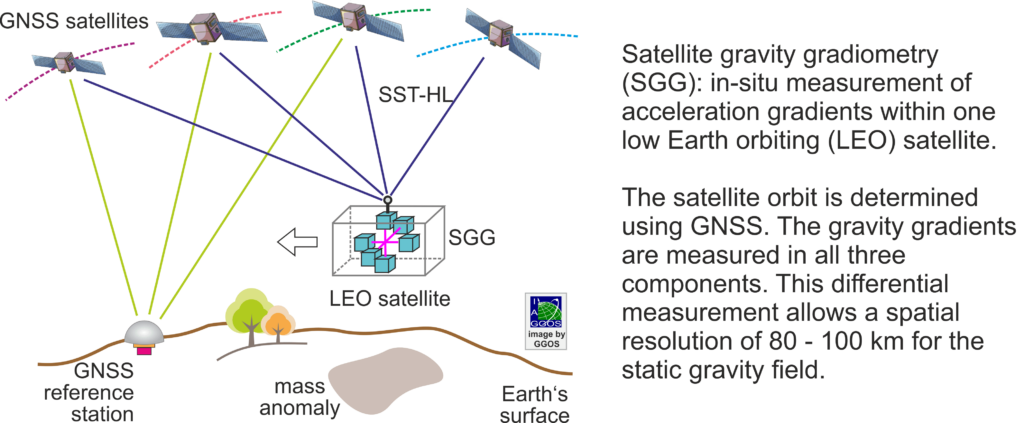
– Satellite gravity gradiometry (SGG): Acceleration differences in all three dimensions are measured directly within a LEO satellite. One important advantage, compared to SST-HL and SST-LL, is that non-gravitational accelerations are the same for all measurements inside the satellite and hence vanish by differentiation. An example of this measuring principle is the mission GOCE (Gravity field and steady-state Ocean Circulation Explorer)
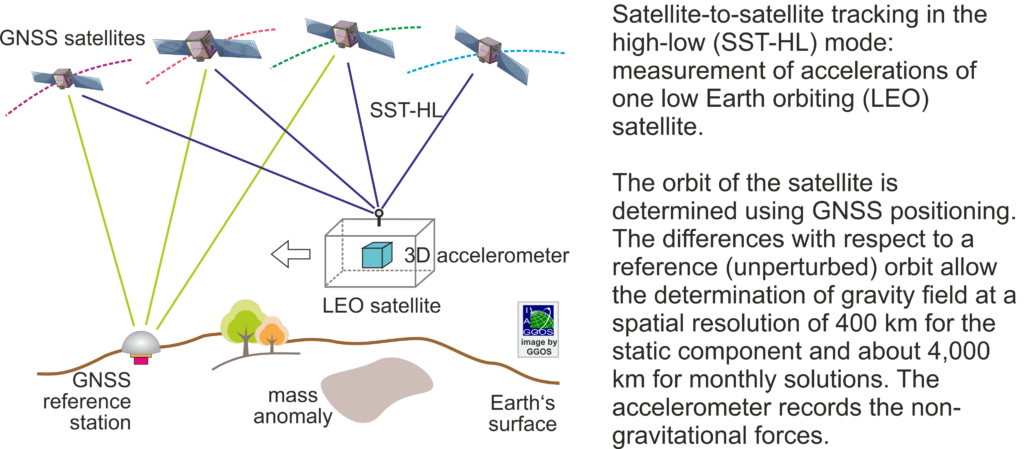
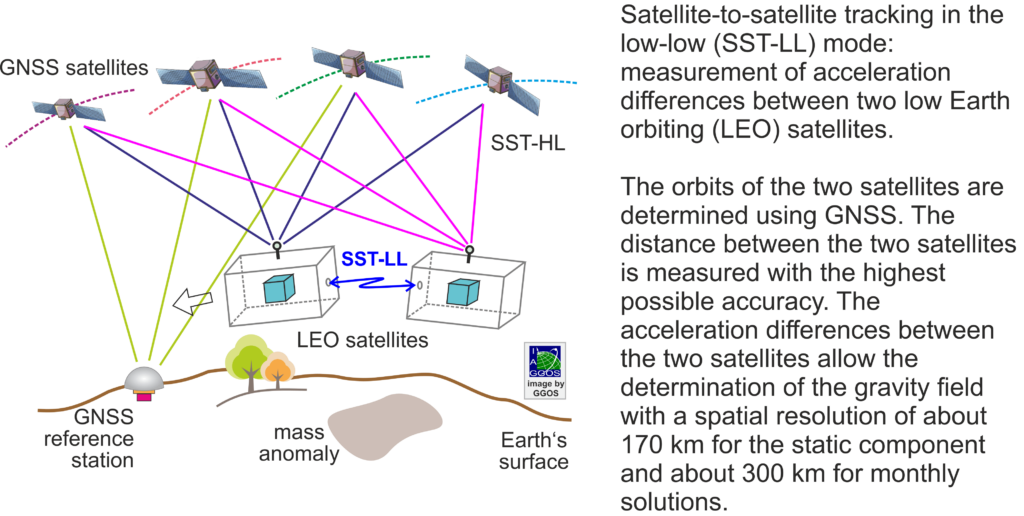
© GGOS (created by Laura Sanchez)

Satellite-to-satellite tracking in the high-low (SST-HL) mode

GNSS LEO satellites
© GGOS (created by Laura Sanchez)

Satellite-to-satellite tracking in the low-low (SST-LL) mode

© GGOS (created by Laura Sanchez)

Satellite gravity gradiometry (SGG)

Read More ...

Applications

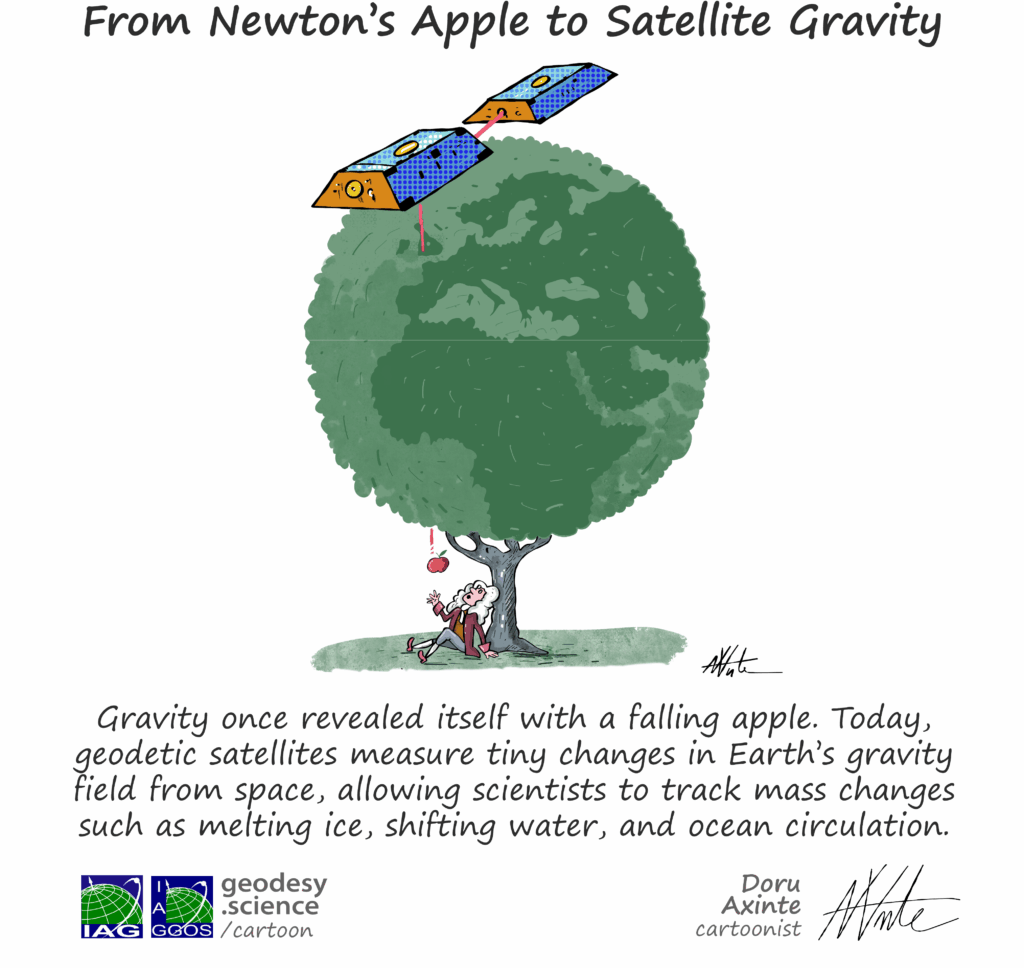
Data provided by satellite gravity field missions are essential for the determination of the Earth’s gravity field, the computation of geoid, the vertical datum unification, and for the establishment of a global unified height system such as the International Height Reference System (IHRS). The dedicated gravity field missions CHAMP, GRACE (and GRACE Follow-On) and GOCE have made to a huge improvement to our knowledge of the Earth’s static and time-variable gravity field. These missions have considerably increased the accuracy of the static gravity field by a factor of at least 100 in terms of resolvable spatial scales compared to pre-CHAMP gravity models, which were mainly determined from satellite laser ranging data. Global gravity models based on GOCE data offer accuracies at the 2 cm level in terms of geoid height at a resolution of 80 to 100 km. Based on monthly gravity fields determined from CHAMP and in particular, GRACE data, seasonal variations and trends in the Earth’s gravity field can be monitored, providing unique information about relevant mass transport phenomena like water cycle in larger river basins, the melting of ice sheets in Antarctica and Greenland and the associated sea level change, as well as in the ocean current systems.

Services

Static global gravity models and time-variable gravity models are available at ICGEM.

Service

  • ICGEM

    Static global gravity models and time-variable gravity models are available at ICGEM

Further Information

  • CHAMP

    CHAllenging Minisatellite Payload

  • GRACE

    Gravity Recovery and Climate Experiment

  • GRACE-FO

    Gravity Recovery and Climate Experiment Follow-on

  • GOCE

    Gravity field and steady-state Ocean Circulation Explorer

© GGOS (Prepared by: Laura Sánchez, Riccardo Barzaghi, Michael Pearlman, Kosuke Heki)

Share

  • Facebook Facebook Share on Facebook
  • X-twitter X-twitter Share on X
  • Whatsapp Whatsapp Share on WhatsApp
  • Pinterest Pinterest Share on Pinterest
  • Linkedin Linkedin Share on LinkedIn
  • Mail Mail Share by Mail

Geodetic Observations - Geodesy

Observation Types

  • GNSS Radio Occultation
  • Icon GGOS Observation Technique© TheNounProject
    VLBI
  • Icon GGOS Observation Technique© TheNounProject
    SLR / LLR – Laser Ranging
  • Icon GGOS Observation Technique© TheNounProject
    DORIS
  • Icon GGOS Observation Technique© TheNounProject
    GNSS
  • Icon GGOS Observation Technique© TheNounProject
    Satellite Altimetry
  • Icon GGOS Observation Technique© TheNounProject
    Satellite Gravimetry
  • Icon GGOS Observation Technique© TheNounProject
    Terrestrial Gravimetry
  • Icon GGOS Observation Technique© TheNounProject
    Tide Gauge Measurements
  • Icon GGOS Observation Technique© TheNounProject
    GNSS Reflectometry
  • Icon GGOS Observation Technique© TheNounProject
    Quantum Gravimetry
  • Icon GGOS Observation Technique© TheNounProject
    Optical Atomic Clocks
  • Icon GGOS Observation Technique
    GGOS Core Sites
Search Search

IAG as part of the IUGG

  
The International Association of Geodesy (IAG)  is a constituent association of the International Union of Geodesy and Geophysics (IUGG).

IAG Related Organisations

IAG collaborates closely with numerous organizations within geodesy and beyond. See the list for details.

Sitemap

  • Home | geodesy.science
  • ⠀└─ 📰News
  • ⠀└─ 📅 Events
  • ⠀└─ 💼 Jobs
  • ⠀└─ 👥 Membership
  • ⭐ About Geodesy
  • 🏛️ IAG | Int. Association of Geodesy
  • ⠀└─ ➡️ Commissions:
  • ⠀⠀◻️ 1 – Reference Frames
  • ⠀⠀◻️ 2 – Gravity Field
  • ⠀⠀◻️ 3 – Earth Rotation & Geodynamics
  • ⠀⠀◻️ 4 – Positioning and Applications
  • ⠀└─ 🔀 Inter Commission Committees:
  • ⠀⠀◻️ ICCT – Theory
  • ⠀⠀◻️ ICCM – Marine Research
  • ⠀⠀◻️ ICCC – Climate Research
  • ⠀└─ ⏰ Project QuGe
  • ⠀└─ ⚙️ IAG Services
  •  🌎 GGOS | Observing System
  • ⠀└─ About GGOS
  • ⠀└─ Structure
  • ⠀└─ Observations
  • ⠀└─ Products
  • ⠀└─ Services

References

Geodesy Glossary

Media Library

IAG Cloud | Public Documents

Terms of Use / Privacy Policy

IAG Statutes

IAG By-laws

Contact Us

Contact

Follow Us

LinkedIn

BlueSky

X (Twitter)

Facebook

Instagram

YouTube

Telegram

RSS Feed

Mailing List

This website is provided by the IAG Secretariat and the GGOS Coordinating Office, which are hosted by the BEV – Federal Office of Metrology and Surveying (Bundesamt für Eich- und Vermessungswesen) in Vienna, Austria.

Website Language Translation

The primary language of this website is English – however, the integrated GTranslate tool enables automatic translation into several languages:

Please note that translations into other languages may not be accurate. For reliable information, refer to the English version of the website.

2026 © Copyright | IAG - International Association of Geodesy
  • Link to LinkedIn
  • Link to Youtube
  • Link to Facebook
  • Link to Instagram
  • Link to X
  • Link to Telegram
  • Link to Behance
  • Link to Rss this site
  • Link to Mail
Scroll to top Scroll to top Scroll to top
Accessibility Adjustments

Powered by OneTap

How long do you want to hide the toolbar?
Hide Toolbar Duration
Select your accessibility profile
Vision Impaired Mode
Enhances website's visuals
Seizure Safe Profile
Clear flashes & reduces color
ADHD Friendly Mode
Focused browsing, distraction-free
Blindness Mode
Reduces distractions, improves focus
Epilepsy Safe Mode
Dims colors and stops blinking
Content Modules
Font Size

Default

Line Height

Default

Color Modules
Orientation Modules