Joint Study Group
Understanding Ionospheric and Plasmaspheric Processes
Led by GGOS; joint with IAG Commission 4, Sub-Commissions 4.1 and 4.3
Chair: Fabricio dos Santos Prol (Finland)
Vice-Chair: David R. Themens (United Kingdom)
Summary
The need for improved global-scale electron density models has been widely acknowledged in the past years, particularly with the rise in space activity. Over decades, numerous studies have been conducted with particular interest on ionospheric and plasmaspheric models for geodetic positioning, space weather monitoring, aeronomy, and telecommunications. The JSG1 group aims to advance three-dimensional (3D) ionospheric and plasmaspheric models that are specifically developed for geodetic applications. The reason for this initiative arises from the demand for highly precise electron density models of the ionosphere and plasmasphere, essential for satellite-based navigation and precise orbit determination of artificial satellites. We are targeting both empirical- and physics-based models; however, accomplishing this task presents inherent challenges, including the need for comprehensive data coverage, accurate measurement inversions, reliable measurements on a global scale, and an accurate initial guess of the modelling system. Figure 1.1 shows the geometry involved in 3D models used to cover data gaps by GNSS measurements.
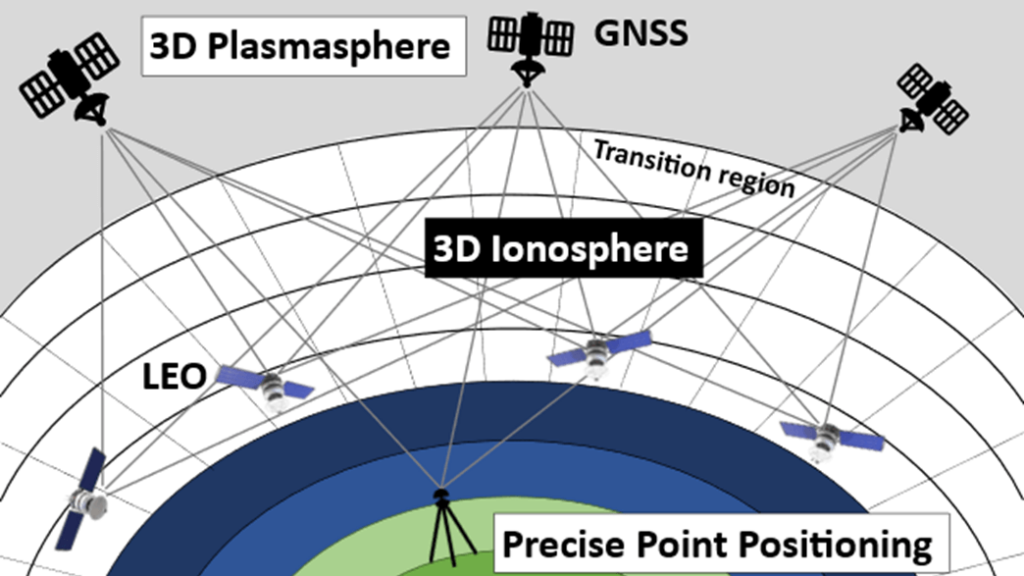
Figure 1.1: Diagram illustrating the geometry involved in 3D inversion algorithms used to obtain ionospheric and plasmaspheric representations for geodetic applications. Note: the illustration is not to scale.
Objectives
To promote solutions to overcome the challenges facing highly accurate ionospheric and plasmaspheric modelling, the group has outlined the following objectives:
- Promote the development of instruments to observe the ionosphere and plasmasphere.
- Evaluation and development of 3D imaging techniques of the ionosphere and plasmasphere. The parameters of interest include vertical electron density profiles, electron density peak and peak height, scale height, and vertical total electron content (VTEC), i.e. the column-integrated electron density.
- Improve our capacity to model the coupling and interaction between the ionosphere and plasmasphere.
- Enhance the feasibility of using 3D ionospheric maps for Precise Point Positioning (PPP) and RTK-PPP.
- Propose perspectives and recommendations for future developments in 3D electron density estimation, with particular interest in geodetic positioning.
Activities
Activities already done:
- Promote the development of new instruments for measuring the ionosphere.
- Development of an initial database of measurements for validation and testing.
- Development of several models of the ionosphere and plasmasphere.
Current activities:
- Improving 3D ionospheric models.
- Development of tools for using 3D models in PPP.
- Enhancing the integration of ionospheric models with the plasmasphere.
Planned for the near future:
- Assessment of 3D models in PPP.
List of publications
Pignalberi A., Bilitza D., Coïsson P., Haralambous H., Nava B., Pezzopane M., Prol F., Smirnov A., Themens D. R., Xiong C. (2024) Validation of the IRI-2020 topside ionosphere options through in-situ electron density observations by low-Earth-orbit satellites. Advances in Space Research, In Press. https://doi.org/10.1016/j.asr.2024.05.056
Pezzopane M., et al. (2024) An Update of the NeQuick-Corr Topside Ionosphere Modeling Based on New Datasets. Atmosphere, 15, 498. https://doi.org/10.3390/atmos15040498
Calabia A., et al. (2024) Uncovering the drivers of responsive ionospheric dynamics to severe space weather conditions: A coordinated multi-instrumental approach. Journal of Geophysical Research: Space Physics, 129, e2023JA031862. https://doi.org/10.1029/2023JA031862
Prol F. S., Smirnov A., Kaasalainen S., Hoque M. M., Bhuiyan M. Z. H., Menzione F. (2023) The Potential of LEO-PNT Mega-Constellations for Ionospheric 3-D Imaging: A Simulation Study. IEEE Journal of Selected Topics in Applied Earth Observations and Remote Sensing, 16, 7559-7571. https://doi.org/10.1109/JSTARS.2023.3299415
Christovam A. L., Prol F. S., Hernández-Pajares M., Camargo P. O. (2023) Plasma bubble imaging by single-frequency GNSS measurements. GPS Solut., 27, 124. https://doi.org/10.1007/s10291-023-01463-z
Olivares-Pulido G., Hernández-Pajares M., Monte-Moreno E., Lyu H., Graffigna V., Cardellach E, Hoque M., Prol F. S., Notarpietro R., Garcia-Fernandez M. (2023) Real-Time Tomographic Inversion of Truncated Ionospheric GNSS Radio Occultations. Remote Sensing, 15, 3176. https://doi.org/10.3390/rs15123176
Hoque M. M., Prol F. S., Hernandez-Pajares M., Notarpietro R., Yuan L., Olivares-Pulido G., Graffigna V., Von Engeln A., Marquardt C. (2023) Assessment of GRAS Ionospheric Measurements for Ionospheric Model Assimilation. Remote Sensing, 15, 3129. https://doi.org/10.3390/rs15123129
Prol F. S., Hoque M. M., Hernández-Pajares M., Yuan L., Olivares-Pulido G., von Engeln A., Marquardt C., Notarpietro R. (2023) Study of Ionospheric Bending Angle and Scintillation Profiles Derived by GNSS Radio-Occultation with MetOp-A Satellite. Remote Sensing, 15, 1663. https://doi.org/10.3390/rs15061663
Hoque M. M., Yuan L., Prol F. S., Hernández-Pajares M., Notarpietro R., Jakowski N., Olivares Pulido G., Von Engeln A., Marquardt C. (2023) A New Method of Electron Density Retrieval from MetOp-A’s Truncated Radio Occultation Measurements. Remote Sensing, 15, 1424. https://doi.org/10.3390/rs15051424
Jerez G. O., Hernández-Pajares M., Goss A., Prol F. S., Alves D. B. M., Monico J. F. G., Schmidt M. (2023) Two-way assessment of ionospheric maps performance over the Brazilian region: Global versus regional products. Space Weather, 21, e2022SW003252. https://doi.org/10.1029/2022SW003252
Smirnov A., Shprits Y., Prol F., Lühr H., Berrendorf M., Zhelavskaya I., Xiong C. A novel neural network model of Earth’s topside ionosphere. Sci Rep 13, 1303. https://doi.org/10.1038/s41598-023-28034-z
Hernández-Pajares M., Olivares-Pulido G., Hoque M. M., Prol F. S., Yuan L., Notarpietro R., Graffigna, V. (2023) Topside Ionospheric Tomography Exclusively Based on LEO POD GPS Carrier Phases: Application to Autonomous LEO DCB Estimation. Remote Sensing, 15, 390. https://doi.org/10.3390/rs15020390
Prol F.S., Smirnov A. G., Hoque M. M., Shprits Y. Y. (2022) Combined model of topside ionosphere and plasmasphere derived from radio-occultation and Van Allen Probes data. Sci Rep 12, 9732 (2022). https://doi.org/10.1038/s41598-022-13302-1
Prol F. S., Hoque M. M. (2022) A Tomographic Method for the Reconstruction of the Plasmasphere Based on COSMIC/ FORMOSAT-3 Data. IEEE Journal of Selected Topics in Applied Earth Observations and Remote Sensing, 15, 2197-2208, 2022. https://doi.org/10.1109/JSTARS.2022.3155926
Monico J. F. G., et al. (2022). The GNSS NavAer INCT project overview and main results. Journal of Aerospace Technology and Management, 14, e0722. https://doi.org/10.1590/jatm.v14.1249
Hoque M. M., Jakowski N., Prol F. S. (2022) A new climatological electron density model for supporting space weather services. J. Space Weather Space Clim., 12. https://doi.org/10.1051/swsc/2021044
Prol F. S., Kodikara T., Hoque M. M., Borries C. (2021) Global-scale ionospheric tomography during the March 17, 2015 geomagnetic storm. Space Weather, 19, e2021SW002889. https://doi.org/10.1029/2021SW002889
Smirnov A., Shprits Y., Zhelavskaya I., Lühr H., Xiong C., Goss, A., Prol F. S., Schmidt M., Hoque M., Pedatella N., Szabó-Roberts M. (2021). Intercalibration of the plasma density measurements in Earth’s topside ionosphere. Journal of Geophysical Research: Space Physics, 126, e2021JA029334. https://doi.org/10.1029/2021JA029334
Prol F. S., Hoque M. M. (2021) Topside Ionosphere and Plasmasphere Modelling Using GNSS Radio Occultation and POD Data. Remote Sensing, 2021, 13, 1559. https://doi.org/10.3390/rs13081559
Prol F. S., Hoque M. M., Ferreira A. A. (2021) Plasmasphere and topside ionosphere reconstruction using METOP satellite data during geomagnetic storms. J. Space Weather Space Clim., 11, 5. https://doi.org/10.1051/swsc/2020076
Jerez G.O., Hernández-Pajares M., Prol F. S., Alves D. B. M., Monico J. F. G. (2020) Assessment of Global Ionospheric Maps Performance by Means of Ionosonde Data. Remote Sens. 2020, 12, 3452. https://doi.org/10.3390/rs12203452