
Joint Study Group
Thermosphere Modelling and Applications
Led by GGOS; joint with IAG Commission 4, Sub-Commission 4.3
Chair: Guenther March (Netherlands)
Vice-Chair: Armin Corbin (Germany)
Summary
Neutral mass density, temperature, composition and winds are important state parameters of the thermosphere (see Fig. 2.1) that affect aerodynamic forces on satellites, especially drag force. Since these significantly influence the orbits of space objects flying at altitudes below 700 km, accurate knowledge of the state of the thermosphere is important for applications such as orbit prediction, collision avoidance, evolution of space debris, and mission lifetime predictions. Drag and lift forces can be inferred from space geodetic observations of accelerometers, which complement other positioning techniques such as GNSS, satellite laser ranging or radar tracking of space objects. Recent models and accelerometer derived observations of the neutral mass density have significant discrepancies (see time series in Fig. 2.2, and Siemes et al., 2023 for an example for density and wind models, and Hładczuk et al., 2024 for neutral winds).
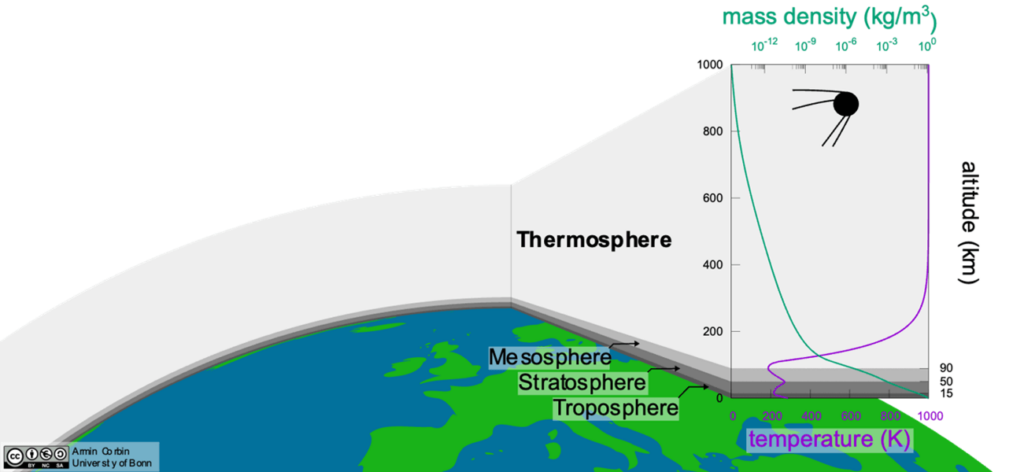
Figure 3.1: Representation of the thermosphere region its mass density and temperature variations.
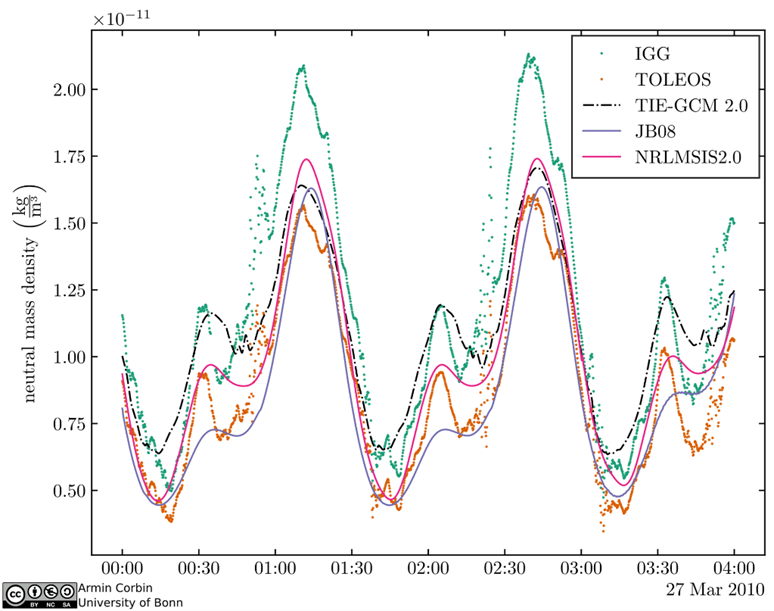
Figure 2.2: Comparison between different neutral mass densities estimated from different algorithms and models.
Objectives
The objectives of the JSG2 are related to the improve thermosphere models. We aim for a better consistency between datasets and investigate new applications from a modelling perspective including novel data exploitations. Our objectives are:
- Update review on space geodetic observations and state-of-the-art processing methods including an overview of novel thermosphere datasets and model applications.
- Advance thermosphere modelling to increase consistency between observational datasets and enable new applications.
- Assess accuracy level of available space geodetic observations.
- Investigate the impact of improved observational data sets and advanced processing methods, including data assimilation, on orbit determination and prediction.
- Use of improved thermosphere models and observational data sets to advance the study of thermospheric variations in the context of climate change and space weather monitoring.
Activities
Planned activities:
- Virtually meet on a regular base & during conferences to monitor and share advances in thermosphere modelling
- Update the list of state-of-the-art processing methods and currently available thermosphere data sets
- Step-by-step comparison of the processing and estimations of neutral mass density from different measurements and models to advance thermosphere modelling capabilities
- Initiate cooperations & synergies with other study groups (including other GGOS study groups and groups from the International Association of Geodesy, IAG)
List of publications
Corbin and J. Kusche, “Improving the estimation of thermospheric neutral density via two-step assimilation of in situ neutral density into a numerical model,” Earth, Planets and Space, vol. 74, no. 1, p. 183, Dec. 2022, doi: 10.1186/s40623-022-01733-z.
Forootan, E., Kosary, M., Farzaneh, S., Kodikara, T., Vielberg, K., Fernandez-Gomez, I., Borries, C., & Schumacher, M. (2022). Forecasting global and multi-level thermospheric neutral density and ionospheric electron content by tuning models against satellite-based accelerometer measurements. Scientific Reports, 12(1). https://doi.org/10.1038/s41598-022-05952-y.
March, “Consistent thermosphere density and wind data from satellite observations: A study of satellite aerodynamics and thermospheric products,” 2020, doi: 10.4233/uuid:862e11b6-4018-4f63-8332-8f88066b0c5c.
Vielberg, “Thermosphere and radiation effects in forward and inverse non-gravitational force modelling,” phdthesis, Rheinische Friedrich-Wilhelms-Universität, Bonn, 2024. doi: 10.48565/bonndoc-213.
Zeitler et al., “Scale Factors of the Thermospheric Density: A Comparison of Satellite Laser Ranging and Accelerometer Solutions,” Journal of Geophysical Research: Space Physics, vol. 126, no. 12, p. e2021JA029708, 2021, doi: 10.1029/2021JA029708.
Siemes, C., Borries, C., Bruinsma, S., Fernandez-Gomez, I., Hładczuk, N., den IJssel, J., Kodikara, T., Vielberg, K., & Visser, P. (2023). New thermosphere neutral mass density and crosswind datasets from CHAMP, GRACE, and GRACE-FO. Journal of Space Weather and Space Climate, 13, 16. https://doi.org/10.1051/swsc/2023014.
Kodikara, T., Carter, B., Norman, R., & Zhang, K. (2019). Density-temperature synchrony in the hydrostatic thermosphere. Journal of Geophysical Research: Space Physics, 124, 674–699. https://doi.org/10.1029/2018JA025973.
Hładczuk, N. A., van den IJssel, J., Kodikara, T., Siemes, C., & Visser, P. (2024). GRACE-FO radiation pressure modelling for accurate density and crosswind retrieval. Advances in Space Research: The Official Journal of the Committee on Space Research (COSPAR), 73(5), 2355–2373. https://doi.org/10.1016/j.asr.2023.12.059.
Kodikara, T., Carter, B., & Zhang, K. (2018). The first comparison between Swarm-C accelerometer-derived thermospheric densities and physical and empirical model estimates. Journal of Geophysical Research: Space Physics, 123, 5068–5086. https://doi.org/10.1029/2017JA025118
Forootan, E., Farzaneh, S., Kosary, M., Borries, C., Kodikara, T., & Schumacher, M. (2023). Predicting global thermospheric neutral density during periods with high geomagnetic activity. Scientific Reports, 13(1). https://doi.org/10.1038/s41598-023-47440-x.
Bruinsma, S., Boniface, C., Sutton, E. K., & Fedrizzi, M. (2021). Thermosphere modeling capabilities assessment: geomagnetic storms. In Journal of Space Weather and Space Climate (Vol. 11, p. 12). EDP Sciences. https://doi.org/10.1051/swsc/2021002.
Shim, J. S., Kuznetsova, M., Rastätter, L., Bilitza, D., Butala, M., Codrescu, M., Emery, B. A., Foster, B., Fuller‐Rowell, T. J., Huba, J., Mannucci, A. J., Pi, X., Ridley, A., Scherliess, L., Schunk, R. W., Sojka, J. J., Stephens, P., Thompson, D. C., Weimer, D., … Sutton, E. (2012). CEDAR Electrodynamics Thermosphere Ionosphere (ETI) Challenge for systematic assessment of ionosphere/thermosphere models: Electron density, neutral density, NmF2, and hmF2 using space based observations. In Space Weather (Vol. 10, Issue 10). American Geophysical Union (AGU). https://doi.org/10.1029/2012sw000851.