
• Link to LinkedIn
  • Link to Youtube
  • Link to Facebook
  • Link to Instagram
  • Link to X
  • Link to Telegram
  • Link to Behance
  • Link to Rss this site
  • Link to Mail
  • NEWS
  • EVENTS
  • JOBS
  • MEMBER
  • Sitemap
    • Home
      • NEWS
      • EVENTS
      • JOBS
      • MEMBERSHIP
    • ⭐ About Geodesy
    • 🏛️ IAG | International Association of Geodesy
      • About IAG
      • Structure
      • 🎓 ECS – Early Career Scientists
      • 🌈 IDEA – Inclusion, Diversity, Equity, Accessibility
    •   └─ Comissions
      • 1️⃣ Reference Frames
      • 2️⃣ Gravity Field
      • 3️⃣ Earth Rotation & Geodynamics
      • 4️⃣ Positioning & Applications
    •   └─ Inter Commission Committees
      • 📚 ICCT – Theory
      • 🌊 ICCM – Marine Research
      • 🌥️ ICCC – Climate Research
    •   └─ Project QuGe
    •   └─ Services
    • 🌍 GGOS | Global Geodetic Observing System
      • About GGOS
      • Structure
      • 🛰️ Observations
      • 📦 Products
      • ⚙️ Services
  • Shopping Cart Shopping Cart
    0Shopping Cart
geodesy.science - IAG website
  • GGOS
    • Home
      • NEWS
      • EVENTS
      • JOBS
      • MEMBERSHIP
    • ⭐ About Geodesy
    • 🏛️ IAG | International Association of Geodesy
      • About IAG
      • Structure
      • 🎓 ECS – Early Career Scientists
      • 🌈 IDEA – Inclusion, Diversity, Equity, Accessibility
    •   └─ Comissions
      • 1️⃣ Reference Frames
      • 2️⃣ Gravity Field
      • 3️⃣ Earth Rotation & Geodynamics
      • 4️⃣ Positioning & Applications
    •   └─ Inter Commission Committees
      • 📚 ICCT – Theory
      • 🌊 ICCM – Marine Research
      • 🌥️ ICCC – Climate Research
    •   └─ Project QuGe
    •   └─ Services
    • 🌍 GGOS | Global Geodetic Observing System
      • About GGOS
      • Structure
      • 🛰️ Observations
      • 📦 Products
      • ⚙️ Services
  • About
    • About GGOS
      • What is GGOS?
      • Why GGOS?
      • Dual Roles of GGOS
      • Vision and Mission
      • GGOS History
  • Structure
    • Governance & Leadership
      • Governing Board GB
      • Executive Committee EC
    • Coordinating Office CO
    • Science Panel
    • Bureaus
      • BNO – Networks and Observations
      • BPS – Products and Standards
    • Focus Areas
      • Geohazards Monitoring
      • Geodetic Space Weather Research
      • Artificial Intelligence for Geodesy (AI4G)
    • GGOS Affiliates
      • GGOS Japan
      • GGOS D-A-CH
      • GGOS IberAtlantic
    • GGOS Committees & Working Groups
  • Observations
  • Services
  • Products
  • Resources
    • Resources Overview
    • Outreach Materials
    • Logos & Organisation Chart
    • Reports and Articles
    • Presentations and Videos
    • GGOS Meeting Reports
    • Terms of Reference and Strategy
  • Click to open the search input field Click to open the search input field Search
Follow a manual added link
ICON Atmosphere

Ionosphere

Official IAG-GGOS Product icon
How does electron density affect positioning and navigation?

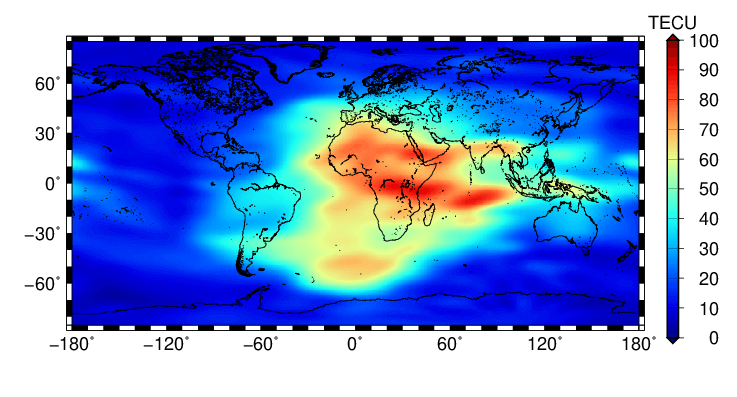
The Earth’s ionosphere as part of the upper atmosphere is the most important atmospheric layer for radio wave propagation in space between the satellites and the Earth. It has, for example, a large impact on the accuracy of positioning and navigation, but also on up-to-date GNSS applications such as autonomous driving and precision farming. Under usual circumstances, the ionosphere is the largest error source in point positioning with single frequency GNSS receivers. As an example, the Figure below shows a global map of the Vertical Total Electron Content (VTEC) on March 17, 2015, the St. Patrick’s day, at 13:00 UT. These large VTEC variations are mostly caused by a strong geomagnetic storm (Erdogan et al., 2020).

TECU
© Michael Schmidt - generated with GMT Info Info

Global distribution of the Vertical Total Electron Content (VTEC) on March 17, 2015, the St. Patrick’s day, at 13:00 UT

The ionospheric influence on radio waves is twofold: the signal travel times are changed and the signal paths are bent. The latter can be neglected for most applications. The ionospheric delay depends directly on the integral of the electron density along the signal path between the transmitter and the receiver, the so-called slant total electron content (STEC). In other words, if the STEC along the ray path is known from ionosphere models, the delay for a single-frequency GNSS measurement can be computed and to some extent corrected. High-precision ionosphere models are required, for instance, if precise navigation applications have to be performed with single-frequency receivers.

Read More ...

Detailed Description

Since the STEC is defined as a quantity along the ray path between transmitter and receiver, i.e. usually between a satellite and a terrestrial receiver, it is not related to a uniquely defined fixed reference point. For that purpose a projection of STEC into the VTEC is performed by means of a mapping function depending on the zenith angle of the ray path. This conversion is realized by the idealized assumption that the vertical electron distribution can be neglected and all electrons are concentrated in a thin spherical layer at a constant height, i.e., a single layer ionosphere model. The intersection point of the signal ray path and the sphere of the single layer is the reference point of VTEC and called the ionospheric pierce point (IPP). Following this concept, ionosphere models describe typically the global variations of VTEC on regular grids with a spatial resolution of 5° x 2.5° with respect to longitude and latitude and a temporal resolution of 1 or 2 hours.

Global Ionospheric Map Products

The International GNSS Service (IGS) and their Ionosphere Associated Analysis Centers (IAAC) routinely provide VTEC maps of the ionosphere to the users in IONEX format to correct their GNSS code and phase measurements for ionospheric influences. The following IAACs of the IGS routinely provide the Global Ionosphere Maps (GIM) products:

  • Center for Orbit Determination in Europe (CODE, Berne, Switzerland)
  • Universitat Politècnica de Catalunya (UPC, Barcelona, Spain)
  • European Space Operations Center of the European Space Agency (ESOC/ESA, Darmstadt, Germany)
  • Jet Propulsion Laboratory (JPL, Pasadena, USA)
  • Chinese Academy of Sciences (CAS, Beijing, China)
  • Canadian Geodetic Survey of Natural Resources Canada (NRCan, Ottawa, Canada)
  • Wuhan University (WHU, China)

Since GIM are based on post-processed observations and so-called final orbits, they are typically provided to the user with latencies of days to weeks. However, high-precise modern GNSS applications such as autonomous driving and precision farming, require high-resolution and high-precision ionosphere products in near real-time (2 to 3 minutes) or real-time (less than 30 seconds).

Other Products

Other products such as Regional Ionosphere Maps (RIM), global or regional near real-time (NRT) and real-time (RT) models are still under development or only partly available for scientific studies, but not routinely provided on a regular basis. The same statements are valid for electron density models for both the ionosphere and the plasmasphere. Today, these models still suffer from the lack of input observations.

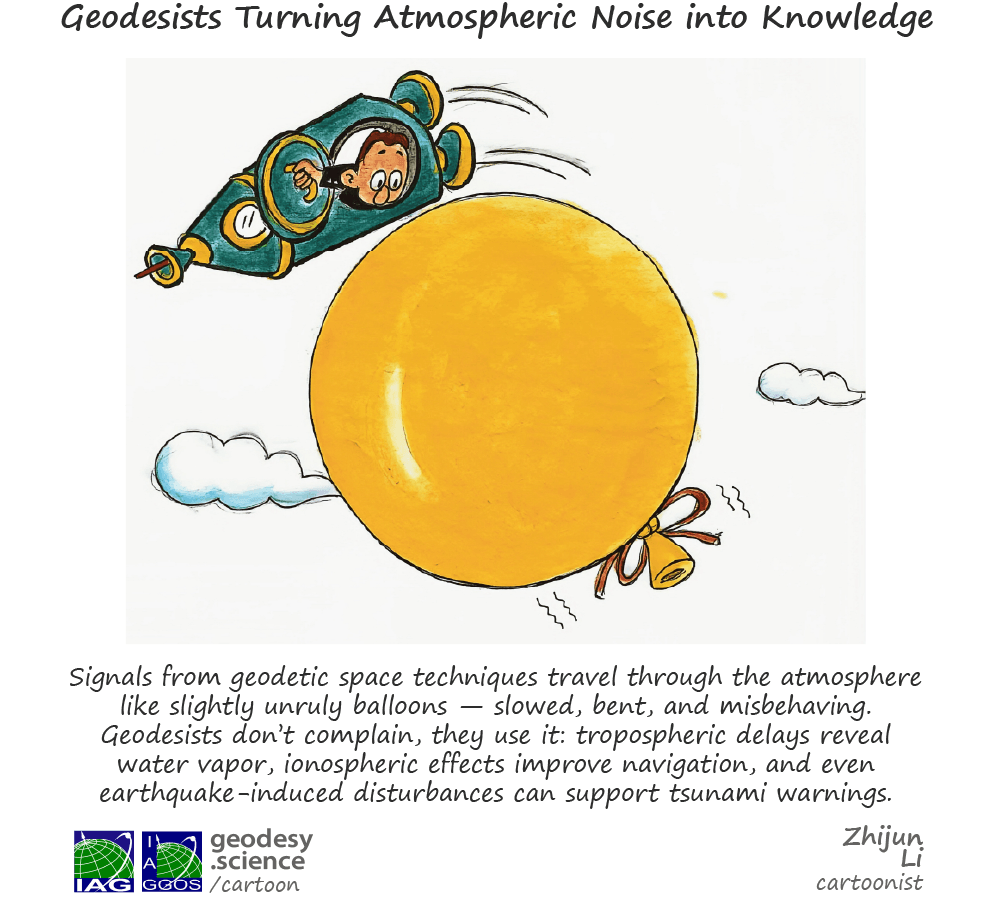
Atmospheric disturbances caused by earthquakes and tsunamis can be detected by GNSS measurements. This can be used for tsunami verification and over the horizon tsunami tracking. The GNSS for Tsunami Early Warning System (GTEWS) is a part of the GGOS Focus Area Geohazards.

Data Sources

  • IGS - IAAC

    Ionosphere Associated Analysis Centers (IAAC) of the IGS

  • IGS - Global Ionospheric maps

    the IGS provides as official IGS Global Ionosphere Maps (GIM) a weighted combination of the GIMs from a subset of the above mentioned first four IAACs.

  • CDDIS

    NASA’s Crustal Dynamics Data Information System (CDDIS) – current ionospheric solution files is

All products are GPS and GLONASS only solutions. They are post-processed, i.e. available with a latency of up to 2 or 3 weeks.

Further Information

  • Erdogan E., Schmidt M., Goss A., Görres B., Seitz F.: Adaptive Modeling of the Global Ionosphere Vertical Total Electron Content. Remote Sensing, 12(11), 1822, 10.3390/rs12111822, 2020

© GGOS (Prepared by: M. Schmidt, R. Heinkelmann, D. Angermann, J. Wickert, P. Wielgosz, E. Forootan)
 

Share this Product

  • Facebook Facebook Share on Facebook
  • X-twitter X-twitter Share on X
  • Whatsapp Whatsapp Share on WhatsApp
  • Pinterest Pinterest Share on Pinterest
  • Linkedin Linkedin Share on LinkedIn
  • Mail Mail Share by Mail

PRODUCTS

Reference Frames

  • © TheNounProject (edited by GGOS)
    Height Reference Frame
  • ICRF celestial© TheNounProject (edited by GGOS)
    Celestial Reference Frame
  • © TheNounProject (edited by GGOS)
    Gravity Reference Frame
  • © TheNounProject (edited by GGOS)
    Terrestrial Reference Frame

Earth Orientation

  • EOP Earth orientation parameter© TheNounProject (edited by GGOS)
    Earth Orientation Parameters

Geometry

  • © TheNounProject (edited by GGOS)
    Surface Deformation Models
  • © TheNounProject (edited by GGOS)
    Ocean Topography Models
  • © TheNounProject (edited by GGOS)
    Sea Level Change
  • © TheNounProject (edited by GGOS)
    Digital Elevation Model
  • © TheNounProject (edited by GGOS)
    Ice Sheets & Glaciers – Variations
  • © TheNounProject (edited by GGOS)
    Station Positions & Variations
  • © TheNounProject (edited by GGOS)
    Tide Gauge Records
  • © TheNounProject (edited by GGOS)
    Sea Surface Heights

Gravity Field

  • © TheNounProject (edited by GGOS)
    Global Gravity Field – Models
  • © TheNounProject (edited by GGOS)
    Gravity Field – Temporal Variations
  • © TheNounProject (edited by GGOS)
    Terrestrial Gravity Data
  • © TheNounProject (edited by GGOS)
    Regional / Local Geoid Models
  • © TheNounProject (edited by GGOS)
    Ice Sheets & Glaciers – Variations
  • © TheNounProject (edited by GGOS)
    Height Systems

Positioning & Applications

  • ICON Atmosphere© TheNounProject (edited by GGOS)
    Thermosphere
  • ICON Atmosphere© TheNounProject (edited by GGOS)
    Ionosphere
  • ICON Atmosphere© TheNounProject (edited by GGOS)
    Lower Neutral Atmosphere
  • ICON Atmosphere© TheNounProject (edited by GGOS)
    Atmospheric Products
  • GNSS Orbits satellites GPS GLONASS Galileo BeiDou QZSS IRNSS© TheNounProject (edited by GGOS)
    GNSS Satellite Orbits and Clocks

IAG as part of the IUGG

  
The International Association of Geodesy (IAG)  is a constituent association of the International Union of Geodesy and Geophysics (IUGG).

IAG Related Organisations

IAG collaborates closely with numerous organizations within geodesy and beyond. See the list for details.

Sitemap

  • Home | geodesy.science
  • ⠀└─ 📰News
  • ⠀└─ 📅 Events
  • ⠀└─ 💼 Jobs
  • ⠀└─ 👥 Membership
  • ⭐ About Geodesy
  • 🏛️ IAG | Int. Association of Geodesy
  • ⠀└─ ➡️ Commissions:
  • ⠀⠀◻️ 1 – Reference Frames
  • ⠀⠀◻️ 2 – Gravity Field
  • ⠀⠀◻️ 3 – Earth Rotation & Geodynamics
  • ⠀⠀◻️ 4 – Positioning and Applications
  • ⠀└─ 🔀 Inter Commission Committees:
  • ⠀⠀◻️ ICCT – Theory
  • ⠀⠀◻️ ICCM – Marine Research
  • ⠀⠀◻️ ICCC – Climate Research
  • ⠀└─ ⏰ Project QuGe
  • ⠀└─ ⚙️ IAG Services
  •  🌎 GGOS | Observing System
  • ⠀└─ About GGOS
  • ⠀└─ Structure
  • ⠀└─ Observations
  • ⠀└─ Products
  • ⠀└─ Services

References

Geodesy Glossary

Media Library

IAG Cloud | Public Documents

Terms of Use / Privacy Policy

IAG Statutes

IAG By-laws

Contact Us

Contact

Follow Us

LinkedIn

BlueSky

X (Twitter)

Facebook

Instagram

YouTube

Telegram

RSS Feed

Mailing List

This website is provided by the IAG Secretariat and the GGOS Coordinating Office, which are hosted by the BEV – Federal Office of Metrology and Surveying (Bundesamt für Eich- und Vermessungswesen) in Vienna, Austria.

Website Language Translation

The primary language of this website is English – however, the integrated GTranslate tool enables automatic translation into several languages:

Please note that translations into other languages may not be accurate. For reliable information, refer to the English version of the website.

2026 © Copyright | IAG - International Association of Geodesy
  • Link to LinkedIn
  • Link to Youtube
  • Link to Facebook
  • Link to Instagram
  • Link to X
  • Link to Telegram
  • Link to Behance
  • Link to Rss this site
  • Link to Mail
Scroll to top Scroll to top Scroll to top
Accessibility Adjustments

Powered by OneTap

How long do you want to hide the toolbar?
Hide Toolbar Duration
Select your accessibility profile
Vision Impaired Mode
Enhances website's visuals
Seizure Safe Profile
Clear flashes & reduces color
ADHD Friendly Mode
Focused browsing, distraction-free
Blindness Mode
Reduces distractions, improves focus
Epilepsy Safe Mode
Dims colors and stops blinking
Content Modules
Font Size

Default

Line Height

Default

Color Modules
Orientation Modules