• Link to LinkedIn
  • Link to Youtube
  • Link to Facebook
  • Link to Instagram
  • Link to X
  • Link to Telegram
  • Link to Behance
  • Link to Rss this site
  • Link to Mail
  • NEWS
  • EVENTS
  • JOBS
  • MEMBER
  • Sitemap
    • Home
      • NEWS
      • EVENTS
      • JOBS
      • MEMBERSHIP
    • ⭐ About Geodesy
    • 🏛️ IAG | International Association of Geodesy
      • About IAG
      • Structure
      • 🎓 ECS – Early Career Scientists
      • 🌈 IDEA – Inclusion, Diversity, Equity, Accessibility
    •   └─ Comissions
      • 1️⃣ Reference Frames
      • 2️⃣ Gravity Field
      • 3️⃣ Earth Rotation & Geodynamics
      • 4️⃣ Positioning & Applications
    •   └─ Inter Commission Committees
      • 📚 ICCT – Theory
      • 🌊 ICCM – Marine Research
      • 🌥️ ICCC – Climate Research
    •   └─ Project QuGe
    •   └─ Services
    • 🌍 GGOS | Global Geodetic Observing System
      • About GGOS
      • Structure
      • 🛰️ Observations
      • 📦 Products
      • ⚙️ Services
  • Shopping Cart Shopping Cart
    0Shopping Cart
geodesy.science - IAG website
  • GGOS
    • Home
      • NEWS
      • EVENTS
      • JOBS
      • MEMBERSHIP
    • ⭐ About Geodesy
    • 🏛️ IAG | International Association of Geodesy
      • About IAG
      • Structure
      • 🎓 ECS – Early Career Scientists
      • 🌈 IDEA – Inclusion, Diversity, Equity, Accessibility
    •   └─ Comissions
      • 1️⃣ Reference Frames
      • 2️⃣ Gravity Field
      • 3️⃣ Earth Rotation & Geodynamics
      • 4️⃣ Positioning & Applications
    •   └─ Inter Commission Committees
      • 📚 ICCT – Theory
      • 🌊 ICCM – Marine Research
      • 🌥️ ICCC – Climate Research
    •   └─ Project QuGe
    •   └─ Services
    • 🌍 GGOS | Global Geodetic Observing System
      • About GGOS
      • Structure
      • 🛰️ Observations
      • 📦 Products
      • ⚙️ Services
  • About
    • About GGOS
      • What is GGOS?
      • Why GGOS?
      • Dual Roles of GGOS
      • Vision and Mission
      • GGOS History
  • Structure
    • Governance & Leadership
      • Governing Board GB
      • Executive Committee EC
    • Coordinating Office CO
    • Science Panel
    • Bureaus
      • BNO – Networks and Observations
      • BPS – Products and Standards
    • Focus Areas
      • Geohazards Monitoring
      • Geodetic Space Weather Research
      • Artificial Intelligence for Geodesy (AI4G)
    • GGOS Affiliates
      • GGOS Japan
      • GGOS D-A-CH
      • GGOS IberAtlantic
    • GGOS Committees & Working Groups
  • Observations
  • Services
  • Products
  • Resources
    • Resources Overview
    • Outreach Materials
    • Logos & Organisation Chart
    • Reports and Articles
    • Presentations and Videos
    • GGOS Meeting Reports
    • Terms of Reference and Strategy
  • Click to open the search input field Click to open the search input field Search
You are here: Home1 / IAG GGOS2 / Structure3 / Bureaus4 / BPS – Products & Standards5 / Committees & JWG6 / Earth System Modelling

BPS – GGOS Committee on

Contribution to Earth System Modelling

Chair: Maik Thomas (GFZ, Germany)

Role

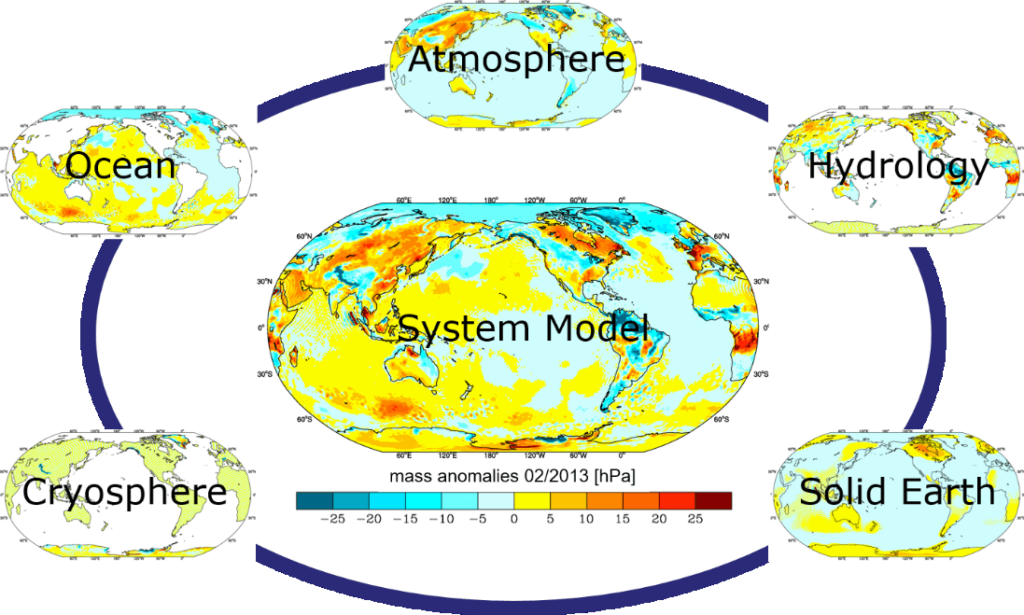
The GGOS Committee on “Earth System Modeling” tends to promote the development of physically consistent modular Earth system modeling tools that are simultaneously applicable to all geodetic parameter types (i.e., Earth rotation, gravity field and surface geometry) and observation techniques. Hereby, the committee contributes to:

  • The interpretation of geodetic monitoring data and, thus, to a deeper understanding of processes responsible for the observed variations;
  • The establishment of a link between the geodetic products delivered by GGOS and numerical process models;
  • A consistent combination and integration of observed geodetic parameters derived from various monitoring systems and techniques;
  • The utilization of geodetic products for the interdisciplinary scientific community.
BPS_massAnomalies Earth System Models GGOS Committee
© GGOS BPS Info Info

Simulated mass anomalies in a modular system model approach.

Objectives

The overall long-term goal is the development of a physically consistent modular numerical Earth system model for homogeneous processing, interpretation and prediction of geodetic parameters with interfaces allowing the introduction of constraints provided by geodetic time series of global surface processes, rotation parameters and gravity variations. This ultimate goal implicates the following objectives:

  • development of Earth system model components considering interactions and relationships between surface deformation, Earth rotation and gravity field variations as well as interactions and physical fluxes between relevant compartments of the Earth system;
  • promotion of homogeneous processing of geodetic monitoring data (de-aliasing, reduction) by process modeling to improve analyses of geodetic parameter sets;
  • contributions to the interpretation of geodetic parameters derived from different observation techniques by developing strategies to separate underlying physical processes;
  • contributions to the integration of geodetic observations based on different techniques in order to promote validation and consistency tests of various geodetic products.

Activities

Current activities focus on:

  • the consideration of three-dimensional structures of the Earth’s crust and mantle as well as of anelastic effects in surface mass loading models;
  • implementation of interfaces to geodetic monitoring data based on Kalman and particle filter approaches in order to constrain and improve stand-alone model approaches and to prove consistency of various geodetic monitoring products;
  • feasibility studies regarding the coupling of neural networks with traditional data assimilation techniques and application of the combined approach in stand-alone models.

Important in-progress activities and future efforts focus on:

  • estimation of consequences of upcoming hardware developments for CPU intensive model simulations (high-performance computing vs. exascale modeling);
  • application of forward modeling and inversion methods in order to improve model-based predictions of geodetic quantities and to invert geodetic observations for the underlying causative processes.

Selected Publications

  • Dill, R., Dobslaw, H., Thomas, M.: ESMGFZ EAM Products for EOP Prediction: Toward the Quantification of Time Variable EAM Forecast Errors. Artificial Satellites, 58, 4, 330-340, 2023.
  • Shihora, L., Balidakis, K., Dill, R., Dobslaw, H.: Assessing the stability of AOD1B atmosphere-ocean non-tidal background modelling for climate applications of satellite gravity data: long-term trends and 3-hourly tendencies. Geophysical Journal International, 243, 2, 1063-1072, 2023.
  • Dill, R., Dobslaw, H., Thomas, M.: ESMGFZ Products for Earth Rotation Prediction. Artificial Satellites, 57, 254-261, 2022.
  • Huang, P., Sulzbach, R., Klemann, V., Tanaka, Y., Dobslaw, H., Martinec, Z., Thomas, M.: The Influence of Sediments, Lithosphere and Upper Mantle (Anelastic) With Lateral Heterogeneity on Ocean Tide Loading and Ocean Tide Dynamics. Journal of Geophysical Research: Solid Earth, 127, 11, e2022JB025200, 2022.
  • Schachtschneider, R., Saynisch-Wagner, J., Klemann, V., Bagge, M., Thomas, M.: An approach for constraining mantle viscosities through assimilation of palaeo sea level data into a glacial isostatic adjustment model. Nonlinear Processes in Geophysics, 29, 1, 53-75, 2022.
  • Shihora, L., Sulzbach, R., Dobslaw, H., Thomas, M.: Self-attraction and loading feedback on ocean dynamics in both shallow water equations and primitive equations. Ocean Modelling, 169, 101914, 2022.
  • Dill, R., Saynisch-Wagner, J., Irrgang, C., Thomas, M.: Improving atmospheric angular momentum forecasts by machine learning. Earth and Space Science, 8, 12, e2021EA002070, 2021.
  • Huang, P., Sulzbach, R., Tanaka, Y., Klemann, V., Dobslaw, H., Martinec, Z., Thomas, M.: Anelasticity and lateral heterogeneities in Earth’s upper mantle: impact on surface displacements, self‐attraction and loading and ocean tide dynamics. Journal of Geophysical Research: Solid Earth, 126, 9, e2021JB022332, 2021.
  • Sulzbach, R., Thomas, M., Dobslaw, H.: High-Resolution Numerical Modelling of Barotropic Global Ocean Tides for Satellite Gravimetry. Journal of Geophysical Research: Oceans, 126, 5, e2020JC017097, 2021.
  • Irrgang, C., Dill, R., Boergens, E., Saynisch-Wagner, J., Thomas, M.: Self-validating deep learning for recovering terrestrial water storage from gravity and altimetry measurements. Geophysical Research Letters, 47, 17, e2020GL089258, 2020.


Page Navigation

  • IAG GGOS
  •   ─ Structure
  •     ─ Bureaus
  •       ─ BPS - Products & Standa...
  •         ─ Committees & JWG
  •            ★ Earth System Modelling
    •            ☆ Essential Geodetic Var...
    •            ☆ Definition of a new GR...

News

  • Honorary colloquium for Prof. Torge and Prof. Seeber at Leibniz University Hannover
  • Webinar: A Synergy between EUREF and EPOS: GNSS Data Quality Monitoring Service (DQMS)
  • Geodesy Day – International Webinar on Geodesy
  • Geodetic Data: Applying FAIR, TRUST and CARE Principles

Join Us!

Join Mailing Lists

Become IAG Member

IAG as part of the IUGG

  
The International Association of Geodesy (IAG)  is a constituent association of the International Union of Geodesy and Geophysics (IUGG).

IAG Related Organisations

IAG collaborates closely with numerous organizations within geodesy and beyond. See the list for details.

Sitemap

  • Home | geodesy.science
  • ⠀└─ 📰News
  • ⠀└─ 📅 Events
  • ⠀└─ 💼 Jobs
  • ⠀└─ 👥 Membership
  • ⭐ About Geodesy
  • 🏛️ IAG | Int. Association of Geodesy
  • ⠀└─ ➡️ Commissions:
  • ⠀⠀◻️ 1 – Reference Frames
  • ⠀⠀◻️ 2 – Gravity Field
  • ⠀⠀◻️ 3 – Earth Rotation & Geodynamics
  • ⠀⠀◻️ 4 – Positioning and Applications
  • ⠀└─ 🔀 Inter Commission Committees:
  • ⠀⠀◻️ ICCT – Theory
  • ⠀⠀◻️ ICCM – Marine Research
  • ⠀⠀◻️ ICCC – Climate Research
  • ⠀└─ ⏰ Project QuGe
  • ⠀└─ ⚙️ IAG Services
  •  🌎 GGOS | Observing System
  • ⠀└─ About GGOS
  • ⠀└─ Structure
  • ⠀└─ Observations
  • ⠀└─ Products
  • ⠀└─ Services

References

Geodesy Glossary

Media Library

IAG Cloud | Public Documents

Terms of Use / Privacy Policy

IAG Statutes

IAG By-laws

Contact Us

Contact

Follow Us

LinkedIn

BlueSky

X (Twitter)

Facebook

Instagram

YouTube

Telegram

RSS Feed

Mailing List

This website is provided by the IAG Secretariat and the GGOS Coordinating Office, which are hosted by the BEV – Federal Office of Metrology and Surveying (Bundesamt für Eich- und Vermessungswesen) in Vienna, Austria.

Website Language Translation

The primary language of this website is English – however, the integrated GTranslate tool enables automatic translation into several languages:

Please note that translations into other languages may not be accurate. For reliable information, refer to the English version of the website.

2026 © Copyright | IAG - International Association of Geodesy
  • Link to LinkedIn
  • Link to Youtube
  • Link to Facebook
  • Link to Instagram
  • Link to X
  • Link to Telegram
  • Link to Behance
  • Link to Rss this site
  • Link to Mail
Scroll to top Scroll to top Scroll to top
Accessibility Adjustments

Powered by OneTap

How long do you want to hide the toolbar?
Hide Toolbar Duration
Select your accessibility profile
Vision Impaired Mode
Enhances website's visuals
Seizure Safe Profile
Clear flashes & reduces color
ADHD Friendly Mode
Focused browsing, distraction-free
Blindness Mode
Reduces distractions, improves focus
Epilepsy Safe Mode
Dims colors and stops blinking
Content Modules
Font Size

Default

Line Height

Default

Color Modules
Orientation Modules