
IERS – Int. Earth Rotation and Reference Systems Service

Development
The IERS was established as the International Earth Rotation Service in 1987 by the International Astronomical Union and the International Union of Geodesy and Geophysics, and it began operation on 1 January 1988. Since 2001, the IERS works in a new organizational structure; in 2003, the new name of the Service, without changing its abbreviation, was adopted. The IERS is a member of the International Committee on Global Navigation Satellite Systems (ICG) and of the World Data System (WDS).
see also: https://www.iers.org/iers/en/organization/about/history/history
Objectives
The primary objectives of the IERS are to serve the astronomical, geodetic and geophysical communities by providing the following:
- The International Celestial Reference System (ICRS) and its realization, the International Celestial Reference Frame (ICRF)
- The International Terrestrial Reference System (ITRS) and its realization, the International Terrestrial Reference Frame (ITRF)
- Earth orientation parameters required to study earth orientation variations and to transform between the ICRF and the ITRF
- Geophysical data to interpret time/space variations in the ICRF, ITRF or earth orientation parameters, and model such variations
- Standards, constants and models (i.e., conventions) encouraging international adherence
Products
IERS collects, archives and distributes products to satisfy the objectives of a wide range of applications, research and experimentation. These products include the following:
- International Celestial Reference Frame
- International Terrestrial Reference Frame
- Long-term earth orientation information
- Monthly earth orientation data
- Daily rapid service estimates of near real-time earth orientation data and their predictions
- Announcements of the differences between astronomical and civil time for time distribution by radio stations
- Leap second announcements
- Products related to global geophysical fluids such as mass and angular momentum distribution
- Annual report and technical notes on conventions and other topics
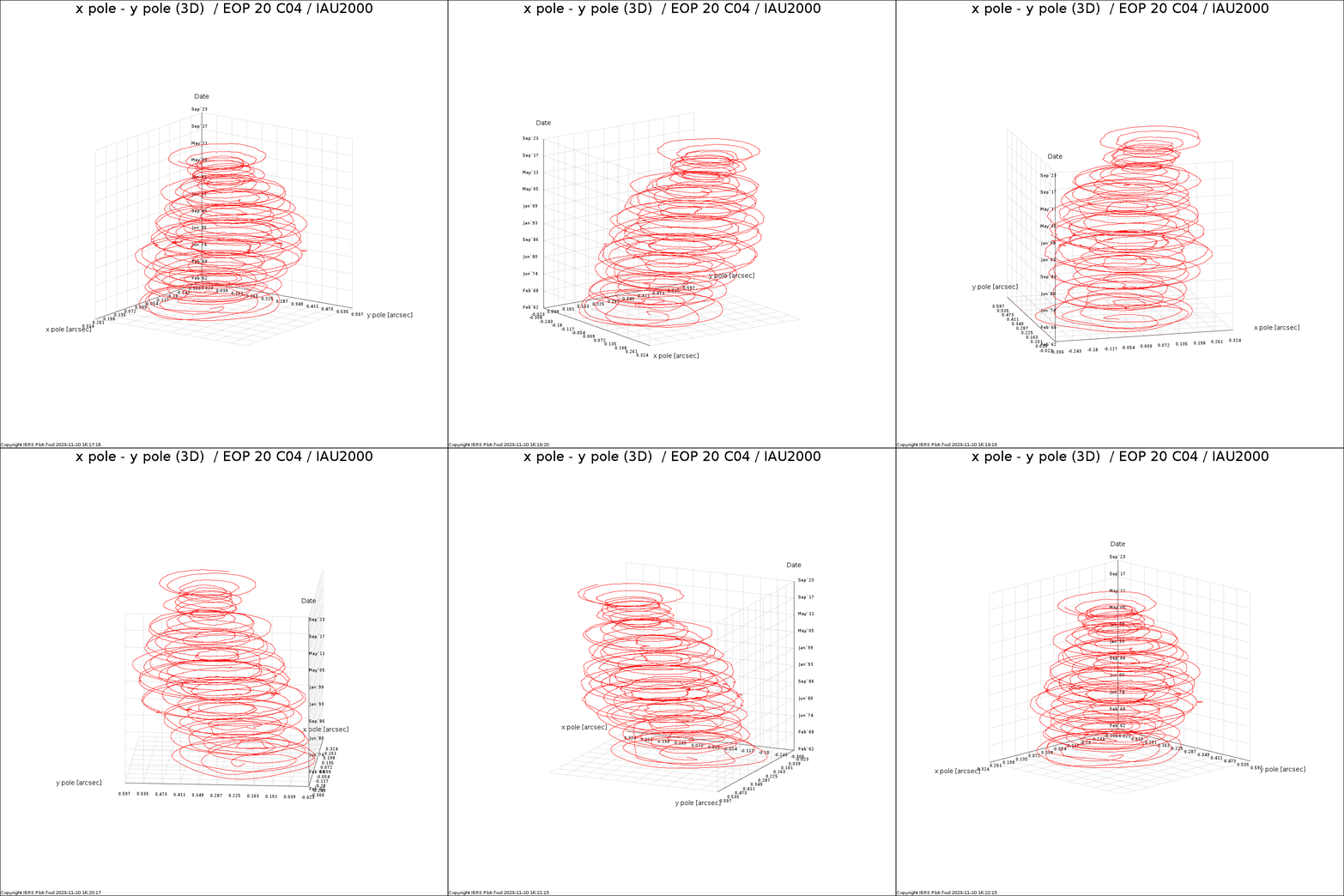
Polar motion, 1962 to 2023, from IERS EOP series 14 C04 (IAU2000A). The latest version of this figure is available at https://datacenter.iers.org/data/gif/EOPC04_20_62-NOW-X_Y.gif.
The accuracies of these products are sufficient to support current scientific and technical objectives including the following:
- Fundamental astronomical and geodetic reference systems
- Monitoring and modelling earth rotation/orientation
- Monitoring and modelling deformations of the solid earth
- Monitoring mass variations in the geophysical fluids, including the atmosphere and the hydrosphere
- Artificial satellite orbit determination
- Geophysical and atmospheric research, studies of dynamical interactions between geophysical fluids and the solid earth
- Space navigation.
see also: https://www.iers.org/iers/en/dataproducts/data
Structure
The IERS accomplishes its mission through the following components:
- Technique Centers: International DORIS Service, International GNSS Service, International Laser Ranging Service, and International VLBI Service
- Product Centers: Earth Orientation Center, Rapid Service/Prediction Center, Conventions Center, ICRS Center, ITRS Center, and Global Geophysical Fluids Center with Special Bureaus for the Atmosphere, for the Oceans, for Hydrology, and for Combination
- ITRS Combination Centers at Deutsches Geodätisches Forschungsinstitut (DGFI), Institut Géographique National (IGN), and Jet Propulsion Laboratory (JPL)
- Analysis Coordinator
- Central Bureau
- Directing Board
- Working Groups: WG on Site Survey and Co-location, WG on SINEX Format, IAG/IAU/IERS Joint WG on the Consistent Realization of TRF, CRF, and EOP, and WG on the 2nd Earth Orientation Parameter Prediction Comparison Campaign.
Some of these components (e.g., Technique Centers) may be autonomous operations, structurally independent from IERS, but which cooperate with the IERS. A participating organization may also function as one or several of these components (except as a Directing Board).
see also: https://www.iers.org/iers/en/organization/organization
IERS Directing Board
visit the IERS homepage for a list of current members
Content of this contribution provided by Wolfgang Dick and Bernd Richter.