• Link to LinkedIn
  • Link to Youtube
  • Link to Facebook
  • Link to Instagram
  • Link to X
  • Link to Telegram
  • Link to Behance
  • Link to Rss this site
  • Link to Mail
  • NEWS
  • EVENTS
  • JOBS
  • MEMBER
  • Sitemap
    • Home
      • NEWS
      • EVENTS
      • JOBS
      • MEMBERSHIP
    • ⭐ About Geodesy
    • 🏛️ IAG | International Association of Geodesy
      • About IAG
      • Structure
      • 🎓 ECS – Early Career Scientists
      • 🌈 IDEA – Inclusion, Diversity, Equity, Accessibility
    •   └─ Comissions
      • 1️⃣ Reference Frames
      • 2️⃣ Gravity Field
      • 3️⃣ Earth Rotation & Geodynamics
      • 4️⃣ Positioning & Applications
    •   └─ Inter Commission Committees
      • 📚 ICCT – Theory
      • 🌊 ICCM – Marine Research
      • 🌥️ ICCC – Climate Research
    •   └─ Project QuGe
    •   └─ Services
    • 🌍 GGOS | Global Geodetic Observing System
      • About GGOS
      • Structure
      • 🛰️ Observations
      • 📦 Products
      • ⚙️ Services
  • Shopping Cart Shopping Cart
    0Shopping Cart
geodesy.science - IAG website
  • GGOS
    • Home
      • NEWS
      • EVENTS
      • JOBS
      • MEMBERSHIP
    • ⭐ About Geodesy
    • 🏛️ IAG | International Association of Geodesy
      • About IAG
      • Structure
      • 🎓 ECS – Early Career Scientists
      • 🌈 IDEA – Inclusion, Diversity, Equity, Accessibility
    •   └─ Comissions
      • 1️⃣ Reference Frames
      • 2️⃣ Gravity Field
      • 3️⃣ Earth Rotation & Geodynamics
      • 4️⃣ Positioning & Applications
    •   └─ Inter Commission Committees
      • 📚 ICCT – Theory
      • 🌊 ICCM – Marine Research
      • 🌥️ ICCC – Climate Research
    •   └─ Project QuGe
    •   └─ Services
    • 🌍 GGOS | Global Geodetic Observing System
      • About GGOS
      • Structure
      • 🛰️ Observations
      • 📦 Products
      • ⚙️ Services
  • About
    • About GGOS
      • What is GGOS?
      • Why GGOS?
      • Dual Roles of GGOS
      • Vision and Mission
      • GGOS History
  • Structure
    • Governance & Leadership
      • Governing Board GB
      • Executive Committee EC
    • Coordinating Office CO
    • Science Panel
    • Bureaus
      • BNO – Networks and Observations
      • BPS – Products and Standards
    • Focus Areas
      • Geohazards Monitoring
      • Geodetic Space Weather Research
      • Artificial Intelligence for Geodesy (AI4G)
    • GGOS Affiliates
      • GGOS Japan
      • GGOS D-A-CH
      • GGOS IberAtlantic
    • GGOS Committees & Working Groups
  • Observations
  • Services
  • Products
  • Resources
    • Resources Overview
    • Outreach Materials
    • Logos & Organisation Chart
    • Reports and Articles
    • Presentations and Videos
    • GGOS Meeting Reports
    • Terms of Reference and Strategy
  • Click to open the search input field Click to open the search input field Search
Follow a manual added link

Height Systems

Why are height systems so important?

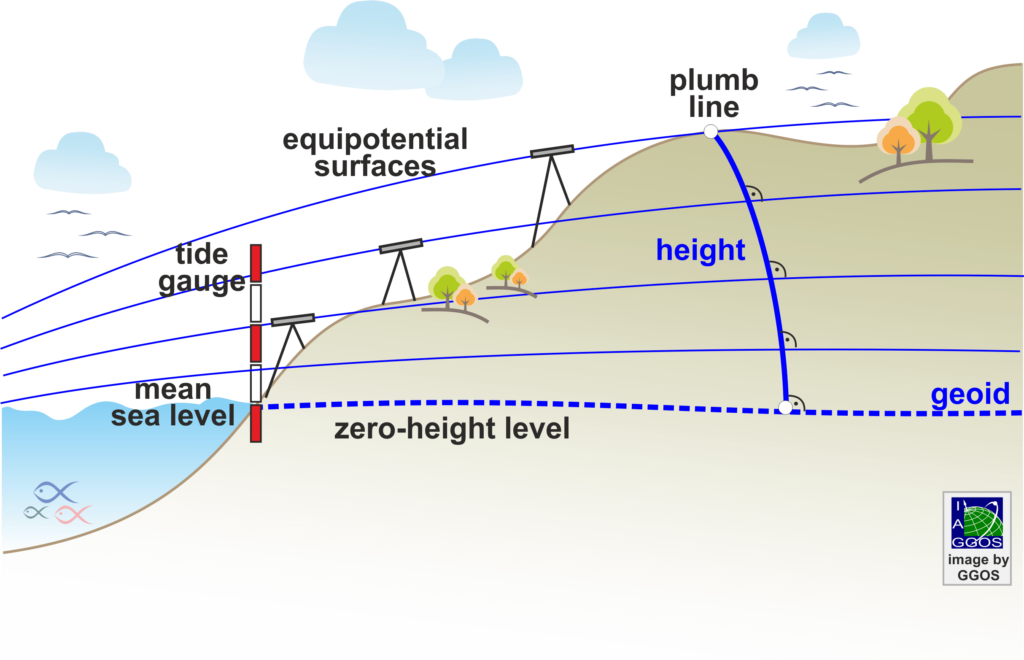
A height system is a one-dimensional coordinate system used to express the metric distance (height) of a point above a reference surface (i.e., the zero-height level) along a well-defined path. Particularly, the physical heights are determined using geodetic levelling techniques that measure the distance between two equipotential or level surfaces of the Earth’s gravity field and provide the height along the curved plumb line. As the height determination depends on the level surfaces and the plumb line of Earth’s gravity field, these coordinate systems are called physical height systems. These coordinate systems are called physical height systems as the height determination depends on the level surfaces and the plumb line of Earth’s gravity field. The physical heights are referred to the geoid, a particular equipotential surface of the Earth’s gravity field that is close to the mean sea level. From the practical point of view, the mean sea level has been assumed as the zero-height level and inferred from averaged tide gauge records over certain time intervals. Since the mean sea level differs from the geoid (up to 2 m at global scale) and from point to point, the heights determined along the so-called vertical or levelling networks referred to a given tide gauge define a local height system. Presently, more than 100 local physical height systems are in use.

height systems tide gauge mean sea level geoid orthometric ellipsoid
© GGOS (created by Laura Sanchez) Info Info

Determination of physical heights with geodetic levelling

Read More ...

Detailed Description

A height system is a one-dimensional coordinate system used to express the metric distance (height) of a point above a reference surface (i.e., the zero-height level). If the reference surface and the height are linked to equipotential surfaces and the plumb line of the Earth’s gravity field, the height system is called physical height system. If the reference surface and the height do not depend on the Earth’s gravity field, the height system is called geometric height system. In the latter, the reference surface is a reference ellipsoid and the vertical coordinate is the ellipsoidal height, which is usually derived from satellite positioning techniques (i.e., GNSS: Global and Navigation Satellite Systems). The reference surface of most of the existing physical height systems is linked to the mean sea level determined at a tide gauge. As the mean sea level varies geographically and with time, mean sea level values used for the definition of the zero-height level in different countries may present discrepancies up to some decimetres. The traditional way to obtain physical heights is geodetic levelling in combination with gravity reductions along the so-called vertical or levelling networks. The gravity reductions are necessary to take into account the non-constant separation between equipotential surfaces due to variations of the Earth’s gravity field. Depending on the gravity correction applied to levelling, different types of physical heights are distinguished: orthometric heights, normal heights, or dynamic heights. Thus, the height of a point can be determined in many slightly different ways, each of which gives a different height coordinate for the same point.

Orthometric and normal heights are widely used in the definition and realisation of physical height systems, while dynamic heights are mainly employed to define the height coordinate in water bodies (e.g., large lakes). Physical height systems based on orthometric heights use the geoid as reference surface. The geoid is the equipotential surface that best fits the mean sea level. Physical height systems based on normal heights use the quasi-geoid as reference surface. The quasigeoid is close to the geoid but not an equipotential surface as the geoid is. The quasi-geoid deviates from the geoid in the same way as the normal heights deviate from the orthometric heights. They present differences on the millimetre to centimetre order at low elevations and may reach 1 m deviation in high mountains. On the oceans, geoid and quasi-geoid as well as orthometric and normal heights practically coincide. The transformation between geometric and physical height systems is given by h = H + N \approx H^N + \zeta, where h is the ellipsoidal height, H and H^N are the orthometric and normal heights, respectively, N is the geoid undulation, and \zeta is the height anomaly. The geoid (N) and the quasi-geoid (\zeta) are to be determined by precise gravity field modelling approaches and may be combined with GNSS positioning to obtain physical heights, without the necessity of performing levelling surveys.

height systems tide gauge mean sea level geoid orthometric ellipsoid
© GGOS (created by Laura Sanchez) Info Info

Physical and geometric heights with their respective reference surfaces

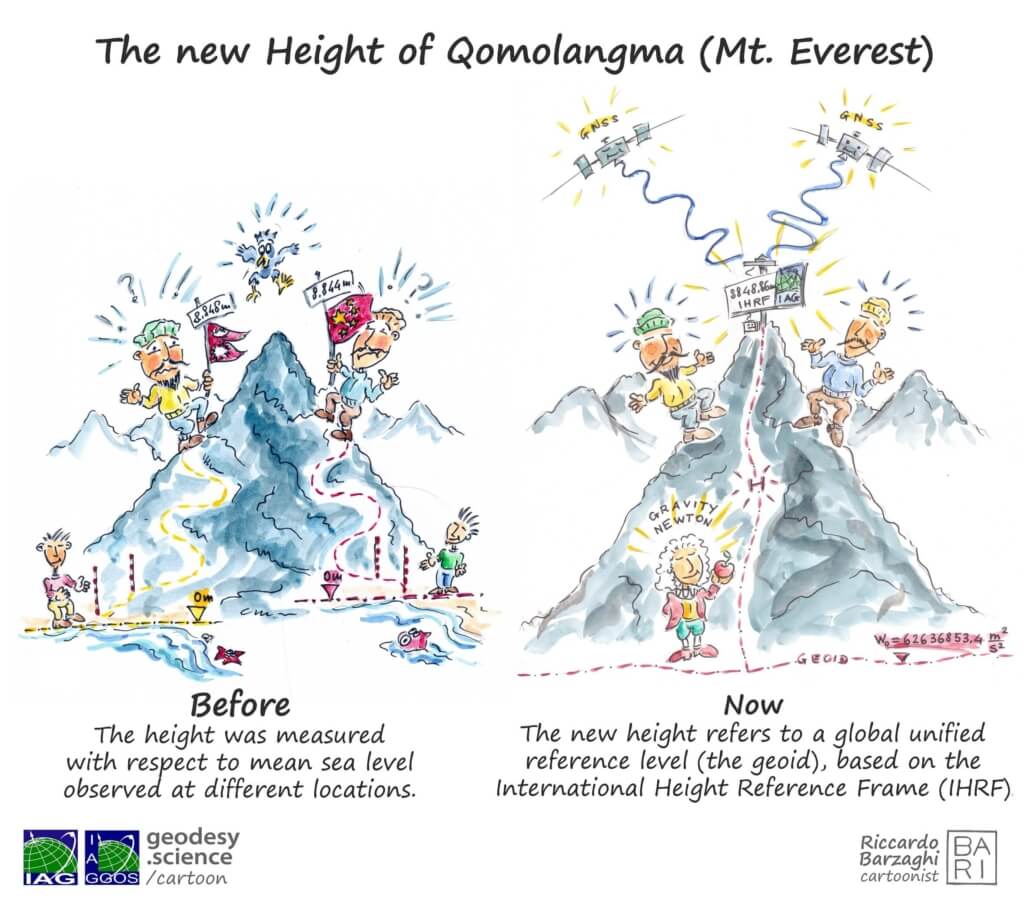
As most of the existing height systems refer to local mean sea level values (and consequently to local geoids) and are realised by national or regional levelling networks covering specific regions, they are utilisable over limited geographical areas only. Thus, they are local height systems. At present, there are about 100 local height systems in use. Current efforts concentrate on the realisation of a global unified height system based on a common reference level for all the regions over the world and a unique, coherent vertical coordinate (see GGOS Focus Area – Unified Height System). This system is called the International Height Reference System (IHRS) and its realisation is given by the International Height Reference Frame (IHRF).

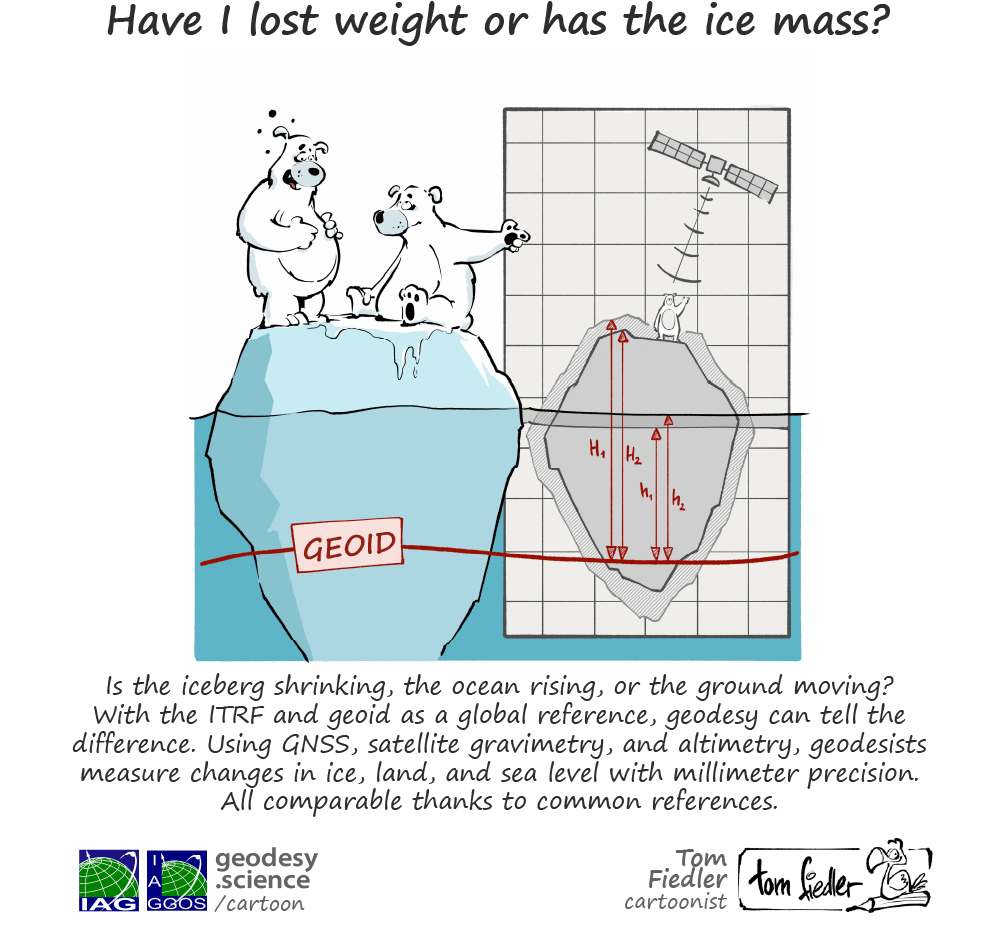
Geodesy Cartoon

Visual explanation of why height values depend on the chosen reference – geodesy cartoons

Data Sources

  • regional physical height systems

    Local height systems are established, maintained and provided by the national agencies responsible for the geodetic reference systems. An inventory of regional physical height systems (covering large continental extensions or many countries) is available at the ISO Geodetic Registry

  • IHRF CC - Coordination Centre

    The International Height Reference Frame Coordination Centre (IHRF CC) is a central coordinating body responsible for managing and maintaining the International Height Reference System (IHRS) & the International Height Reference Frame (IHRF). It is established as a central coordinating body under the responsibility of the International Gravity Field Service (IGFS) with direct adherence to the IGFS Central Bureau (IGFS CB).

  • Geoid & Quasi-Geoid Models

    Geoid or quasi-geoid models serving as reference surface for some local physical height systems are available at the Geoid Repository of the International Service for the Geoid (ISG)

© GGOS (Prepared by: Laura Sánchez, M. Crespi, Y. Tanaka)

Share this Product

  • Facebook Facebook Share on Facebook
  • X-twitter X-twitter Share on X
  • Whatsapp Whatsapp Share on WhatsApp
  • Pinterest Pinterest Share on Pinterest
  • Linkedin Linkedin Share on LinkedIn
  • Mail Mail Share by Mail

PRODUCTS

Reference Frames

  • © TheNounProject (edited by GGOS)
    Height Reference Frame
  • ICRF celestial© TheNounProject (edited by GGOS)
    Celestial Reference Frame
  • © TheNounProject (edited by GGOS)
    Gravity Reference Frame
  • © TheNounProject (edited by GGOS)
    Terrestrial Reference Frame

Earth Orientation

  • EOP Earth orientation parameter© TheNounProject (edited by GGOS)
    Earth Orientation Parameters

Geometry

  • © TheNounProject (edited by GGOS)
    Surface Deformation Models
  • © TheNounProject (edited by GGOS)
    Ocean Topography Models
  • © TheNounProject (edited by GGOS)
    Sea Level Change
  • © TheNounProject (edited by GGOS)
    Digital Elevation Model
  • © TheNounProject (edited by GGOS)
    Ice Sheets & Glaciers – Variations
  • © TheNounProject (edited by GGOS)
    Station Positions & Variations
  • © TheNounProject (edited by GGOS)
    Tide Gauge Records
  • © TheNounProject (edited by GGOS)
    Sea Surface Heights

Gravity Field

  • © TheNounProject (edited by GGOS)
    Global Gravity Field – Models
  • © TheNounProject (edited by GGOS)
    Gravity Field – Temporal Variations
  • © TheNounProject (edited by GGOS)
    Terrestrial Gravity Data
  • © TheNounProject (edited by GGOS)
    Regional / Local Geoid Models
  • © TheNounProject (edited by GGOS)
    Ice Sheets & Glaciers – Variations
  • © TheNounProject (edited by GGOS)
    Height Systems

Positioning & Applications

  • ICON Atmosphere© TheNounProject (edited by GGOS)
    Thermosphere
  • ICON Atmosphere© TheNounProject (edited by GGOS)
    Ionosphere
  • ICON Atmosphere© TheNounProject (edited by GGOS)
    Lower Neutral Atmosphere
  • ICON Atmosphere© TheNounProject (edited by GGOS)
    Atmospheric Products
  • GNSS Orbits satellites GPS GLONASS Galileo BeiDou QZSS IRNSS© TheNounProject (edited by GGOS)
    GNSS Satellite Orbits and Clocks

IAG as part of the IUGG

  
The International Association of Geodesy (IAG)  is a constituent association of the International Union of Geodesy and Geophysics (IUGG).

IAG Related Organisations

IAG collaborates closely with numerous organizations within geodesy and beyond. See the list for details.

Sitemap

  • Home | geodesy.science
  • ⠀└─ 📰News
  • ⠀└─ 📅 Events
  • ⠀└─ 💼 Jobs
  • ⠀└─ 👥 Membership
  • ⭐ About Geodesy
  • 🏛️ IAG | Int. Association of Geodesy
  • ⠀└─ ➡️ Commissions:
  • ⠀⠀◻️ 1 – Reference Frames
  • ⠀⠀◻️ 2 – Gravity Field
  • ⠀⠀◻️ 3 – Earth Rotation & Geodynamics
  • ⠀⠀◻️ 4 – Positioning and Applications
  • ⠀└─ 🔀 Inter Commission Committees:
  • ⠀⠀◻️ ICCT – Theory
  • ⠀⠀◻️ ICCM – Marine Research
  • ⠀⠀◻️ ICCC – Climate Research
  • ⠀└─ ⏰ Project QuGe
  • ⠀└─ ⚙️ IAG Services
  •  🌎 GGOS | Observing System
  • ⠀└─ About GGOS
  • ⠀└─ Structure
  • ⠀└─ Observations
  • ⠀└─ Products
  • ⠀└─ Services

References

Geodesy Glossary

Media Library

IAG Cloud | Public Documents

Terms of Use / Privacy Policy

IAG Statutes

IAG By-laws

Contact Us

Contact

Follow Us

LinkedIn

BlueSky

X (Twitter)

Facebook

Instagram

YouTube

Telegram

RSS Feed

Mailing List

This website is provided by the IAG Secretariat and the GGOS Coordinating Office, which are hosted by the BEV – Federal Office of Metrology and Surveying (Bundesamt für Eich- und Vermessungswesen) in Vienna, Austria.

Website Language Translation

The primary language of this website is English – however, the integrated GTranslate tool enables automatic translation into several languages:

Please note that translations into other languages may not be accurate. For reliable information, refer to the English version of the website.

2026 © Copyright | IAG - International Association of Geodesy
  • Link to LinkedIn
  • Link to Youtube
  • Link to Facebook
  • Link to Instagram
  • Link to X
  • Link to Telegram
  • Link to Behance
  • Link to Rss this site
  • Link to Mail
Scroll to top Scroll to top Scroll to top
Accessibility Adjustments

Powered by OneTap

How long do you want to hide the toolbar?
Hide Toolbar Duration
Select your accessibility profile
Vision Impaired Mode
Enhances website's visuals
Seizure Safe Profile
Clear flashes & reduces color
ADHD Friendly Mode
Focused browsing, distraction-free
Blindness Mode
Reduces distractions, improves focus
Epilepsy Safe Mode
Dims colors and stops blinking
Content Modules
Font Size

Default

Line Height

Default

Color Modules
Orientation Modules