• Link to LinkedIn
  • Link to Youtube
  • Link to Facebook
  • Link to Instagram
  • Link to X
  • Link to Telegram
  • Link to Behance
  • Link to Rss this site
  • Link to Mail
  • NEWS
  • EVENTS
  • JOBS
  • MEMBER
  • Sitemap
    • Home
      • NEWS
      • EVENTS
      • JOBS
      • MEMBERSHIP
    • ⭐ About Geodesy
    • 🏛️ IAG | International Association of Geodesy
      • About IAG
      • Structure
      • 🎓 ECS – Early Career Scientists
      • 🌈 IDEA – Inclusion, Diversity, Equity, Accessibility
    •   └─ Comissions
      • 1️⃣ Reference Frames
      • 2️⃣ Gravity Field
      • 3️⃣ Earth Rotation & Geodynamics
      • 4️⃣ Positioning & Applications
    •   └─ Inter Commission Committees
      • 📚 ICCT – Theory
      • 🌊 ICCM – Marine Research
      • 🌥️ ICCC – Climate Research
    •   └─ Project QuGe
    •   └─ Services
    • 🌍 GGOS | Global Geodetic Observing System
      • About GGOS
      • Structure
      • 🛰️ Observations
      • 📦 Products
      • ⚙️ Services
  • Shopping Cart Shopping Cart
    0Shopping Cart
geodesy.science - IAG website
  • GGOS
    • Home
      • NEWS
      • EVENTS
      • JOBS
      • MEMBERSHIP
    • ⭐ About Geodesy
    • 🏛️ IAG | International Association of Geodesy
      • About IAG
      • Structure
      • 🎓 ECS – Early Career Scientists
      • 🌈 IDEA – Inclusion, Diversity, Equity, Accessibility
    •   └─ Comissions
      • 1️⃣ Reference Frames
      • 2️⃣ Gravity Field
      • 3️⃣ Earth Rotation & Geodynamics
      • 4️⃣ Positioning & Applications
    •   └─ Inter Commission Committees
      • 📚 ICCT – Theory
      • 🌊 ICCM – Marine Research
      • 🌥️ ICCC – Climate Research
    •   └─ Project QuGe
    •   └─ Services
    • 🌍 GGOS | Global Geodetic Observing System
      • About GGOS
      • Structure
      • 🛰️ Observations
      • 📦 Products
      • ⚙️ Services
  • About
    • About GGOS
      • What is GGOS?
      • Why GGOS?
      • Dual Roles of GGOS
      • Vision and Mission
      • GGOS History
  • Structure
    • Governance & Leadership
      • Governing Board GB
      • Executive Committee EC
    • Coordinating Office CO
    • Science Panel
    • Bureaus
      • BNO – Networks and Observations
      • BPS – Products and Standards
    • Focus Areas
      • Geohazards Monitoring
      • Geodetic Space Weather Research
      • Artificial Intelligence for Geodesy (AI4G)
    • GGOS Affiliates
      • GGOS Japan
      • GGOS D-A-CH
      • GGOS IberAtlantic
    • GGOS Committees & Working Groups
  • Observations
  • Services
  • Products
  • Resources
    • Resources Overview
    • Outreach Materials
    • Logos & Organisation Chart
    • Reports and Articles
    • Presentations and Videos
    • GGOS Meeting Reports
    • Terms of Reference and Strategy
  • Click to open the search input field Click to open the search input field Search
Follow a manual added link

Station Positions

and their Time Variations

Official IAG-GGOS Product icon
Why do we need precise positioning and navigation on Earth and in space?

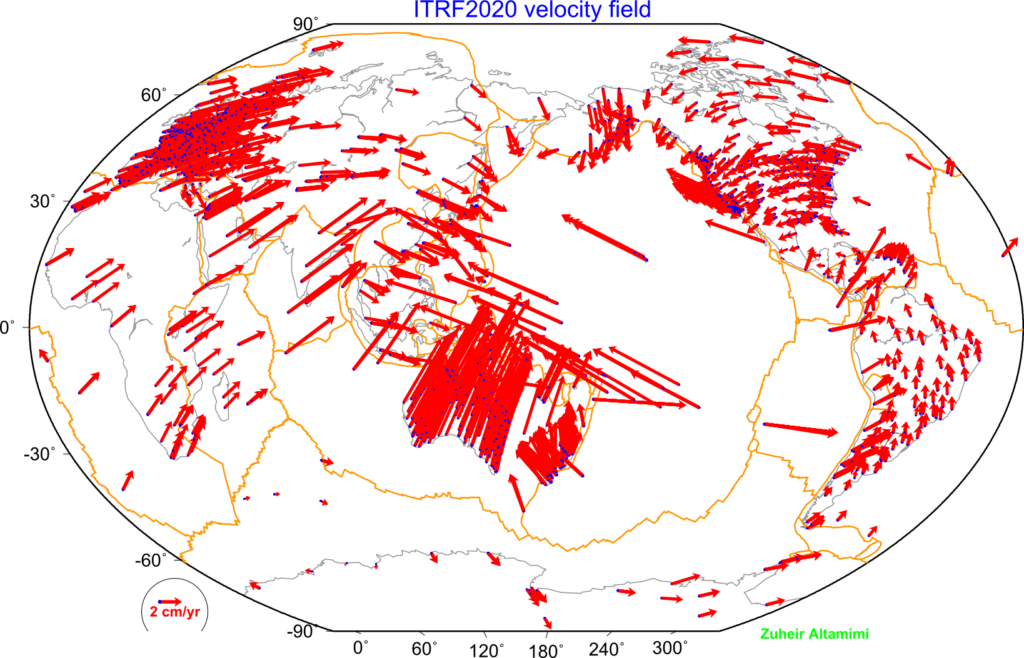
The precise knowledge of the time varying positions of stations at the Earth’s surface is essential for quantifying changes in the Earth system as a basis for an improved understanding of the underlying geodynamic processes. These products are fundamental for many activities, ranging from disaster prevention and mitigation, the understanding of climate change to the building and management of a prosperous and sustainable global society. The International Terrestrial Reference Frame (ITRF) provides the global frame for estimating station positions and their time variations. As primary products, the ITRF comprises precise 3-dimensional station positions (referred to a reference epoch) and constant velocities of the ITRF network stations observed by space geodetic techniques, such as Very Long Baseline Interferometry (VLBI), Satellite Laser Ranging (SLR), Global Navigation Satellite Systems (GNSS) and Doppler Orbitography and Radiopositioning Integrated by Satellite (DORIS) (Links). The ITRF computation makes use of the entire observation time series for each of the four observation techniques covering almost 40 years for VLBI and SLR, and more than 25 years for GNSS and DORIS.
ITRF
© Altamimi et al., 2016 Info Info

ITRF2014 horizontal site velocities with a formal error less than 0.2 mm/yr. The movements of the major tectonic plates are well reflected by the estimated velocities. [Source: Altamimi et al., 2016]

Read More ...

Time Series

The time series analysis of daily or weekly estimated station positions of the different space techniques reveals nonlinear motions of several millimeters or even more (up to a few centimeters) for some stations. These motions are induced by various geophysical phenomena (e.g., non-tidal loading deformations caused by the atmosphere, hydrology and ocean) or technique-specific effects that are not properly modelled or for which accurate models do not exist. The handling of these nonlinear motions is subject of ongoing research by the three ITRS Combination Centers at IGN (Paris, France), DGFI-TUM (Munich, Germany) and JPL (Pasadena, USA) and many other groups. The official ITRS realization, the ITRF2014, is generated with an enhanced modelling of nonlinear station motions, including seasonal (annual and semi-annual) signals of station positions and post-seismic deformation (PSD) for sites that were subject to major earthquakes (Altamimi et al., 2016). The time series of ITRF2014 station position residuals are available at the ITRF website at https://itrf.ign.fr/. In addition to the ITRF results, also the geometric IAG services (IGS, ILRS, IVS, IDS) provide positions and their time variations for their technique-specific network stations. The links to the respective IAG service websites are given below. 

The global ITRF station network is densified by regional networks, such as the European Reference Frame (EUREF), the Geocentric Reference System for the Americas (SIRGAS), the North American Reference Frame (NAREF), the African Reference Frame (AFREF), and the Asia-Pacific Reference Frame (APREF). These regional densifications also provide positions and their time variations for the network stations.
© EPN - Bruyninx et al.2019 Info Info

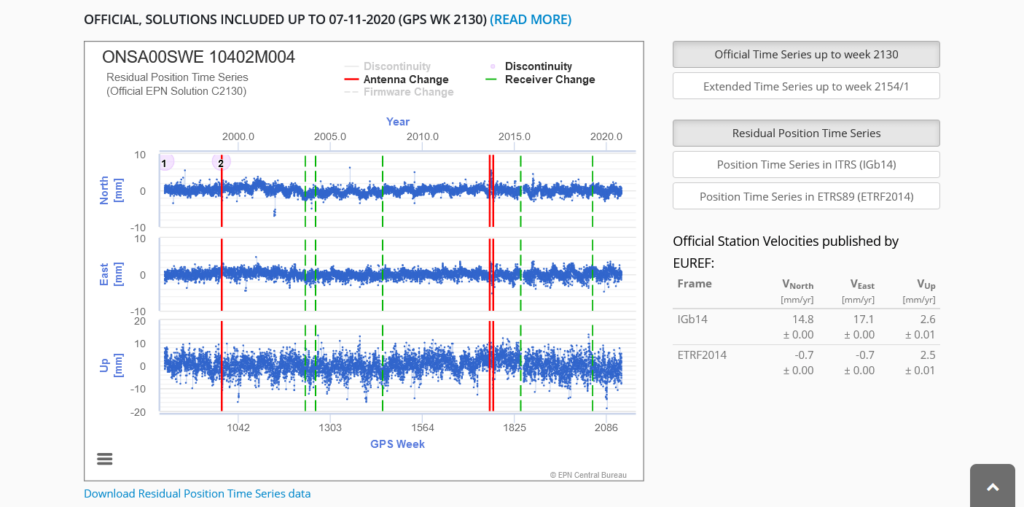
Position time series of station Onsala (Sweden) with respect to the European Terrestrial Reference System 1989 (ETRS 89). Clearly visible is the trend in the height component of about 2.5 mm/yr, caused by post-glacial rebound.
[Source: EPN Central Bureau, http://www.epncb.oma.be, citation: Bruyninx et al.2019]

Data products openly available

from Nevada Geodetic Laboratory (NGL)

The Nevada Geodetic Laboratory (NGL) makes its data products derived from more than 19,000 geodetic GPS stations around the globe openly available, including metadata, lists of stations, plots of position coordinates, discontinuity data (e.g., earthquakes and instrument changes), station velocities, atmospheric water vapor, quality assessment statistics, tables of data holdings, and descriptions of new items relating to the products (Blewitt et al., 2018). NGL scours more than 130 Internet archives to facilitate such a comprehensive GPS products portal.
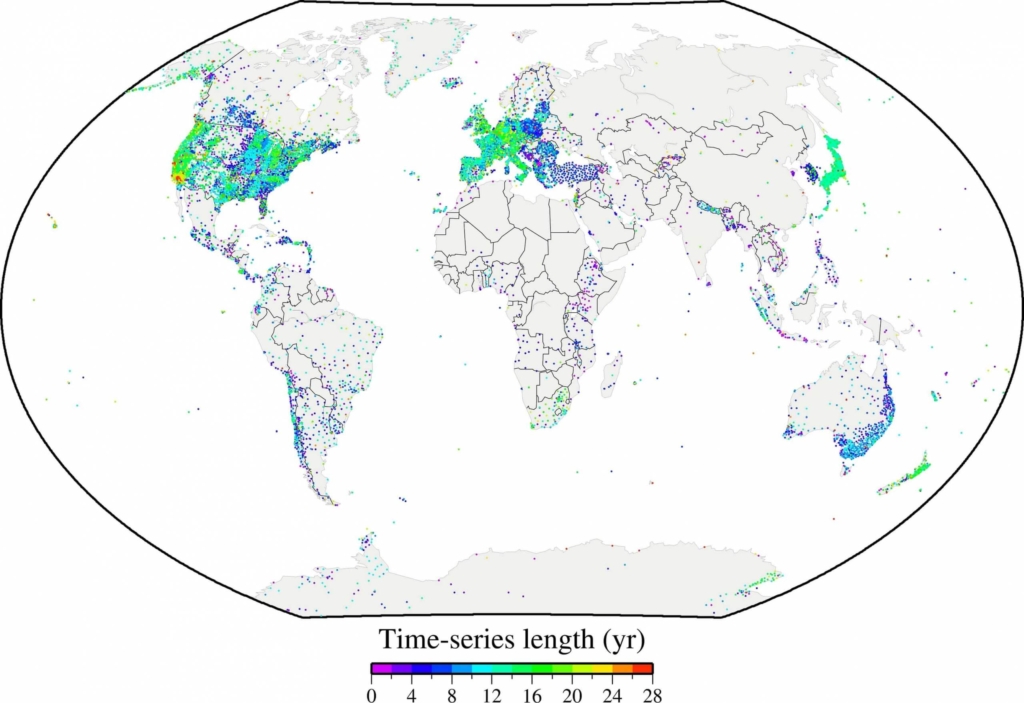
© Blewitt et al., 2018 Info Info

The Nevada Geodetic Laboratory processes data from a global network of over 19,000 geodetic GPS stations
[Source: Blewitt et al., 2018]

Every week, NGL updates the daily position coordinates of some 10,000 stations. 5-minute position coordinates are updated every day for 5,000 stations, and hourly updates are available for 2,000 stations. These products provide the basis for many applications and an abundant information for many kinds of Earth scientists. For example, the lower-latency products are useful for gaining early insight into large earthquakes by measuring coseismic and postseismic displacements as well as for the assessment of geohazards (see GGOS Focus Area Geohazards).

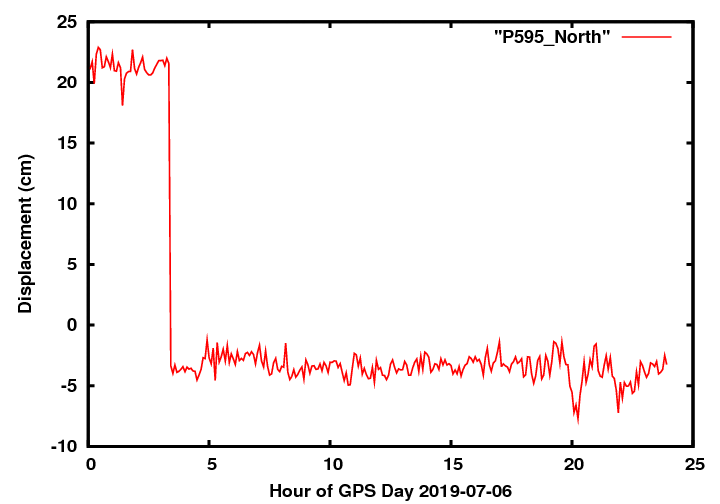
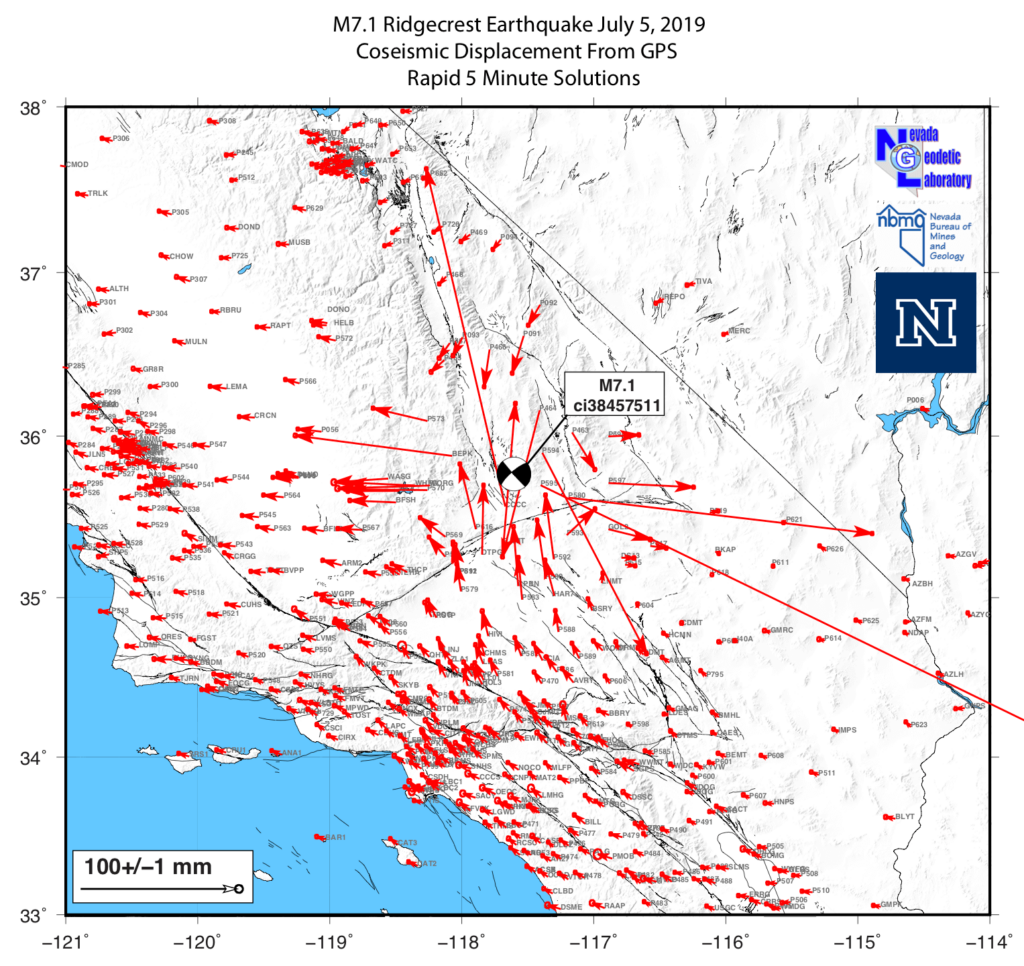
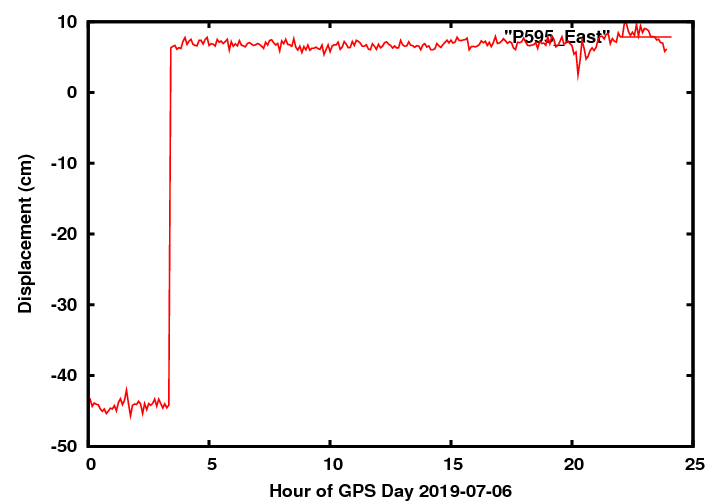
M 7.1 Ridgecrest Earthquake on July 5, 2019 (California, USA): Coseismic displacement
from GPS rapid 5-minute solutions. The position time series for station P595 reveals a displacement of about 25 cm and 50 cm in the north and east component, respectively. [http://geodesy.unr.edu/]

The principle of open availability of GPS data provided by contributing networks allows NGL to provide open, online access to the data products. As a result, network operators and data users can quickly access results without requiring advanced data processing expertise. NGL and UNAVCO jointly developed the Plug and Play GPS project, funded by NASA’s Advancing Collaborative Connections for Earth System Science (ACCESS) program. The goal of Plug and Play GPS is to encourage also less experienced investigators to participate in the geodetic community, for example, by installing new GPS stations in a region currently with sparse coverage. The idea is that any investigator can register a newly installed GPS station and deposit data at the UNAVCO archive, and in return NGL will process the data and provide the data products. This creates a win-win situation for everyone concerned.

Data Sources

ITRF station positions and their temporal variations
  • IERS

    International Earth Rotation and Reference Systems Service

  • IERS - ITRS Centre

Technique-specific station positions and their temporal variations
  • IGS

    International GNSS Service (IGS)

  • ILRS

    International Laser Ranging Service

  • IVS

    International VLBI Service for Geodesy and Astrometry (IVS)

  • IDS

    International DORIS Service

Station positions and their temporal variations for regional networks
  • EPN

    EUREF Permanent GNSS Network

  • SIRGAS

    SIRGAS: Sistema de Referencia para las Américas

  • NAREF

    Regional Reference Frames for North America

  • APREF

    Asia-Pacific Reference Frame

  • APREF

    Asia-Pacific Reference Frame

  • NGL

    Nevada Geodetic Laboratory

Further Information

  • Altamimi Z., P. Rebischung, L. Métivier, X. Collilieux. ITRF2014: A new release of the International Terrestrial Reference Frame modeling nonlinear station motions. Journal of Geophysical Research: Solid Earth 121.8, pp. 6109-6131, DOI: 10.1002/2016JB013098, 2016.

  • Bruyninx, C., Legrand, J., Fabian, A., Pottiaux E., GNSS metadata and data validation in the EUREF Permanent Network, GPS Solut (2019) 23: 106. https://doi.org/10.1007/s10291-019-0880-9.

  • Blewitt, G., W. C. Hammond, and C. Kreemer (2018), Harnessing the GPS data explosion for interdisciplinary science, Eos, 99, https://doi.org/10.1029/2018EO104623.

© GGOS (Prepared by: D. Angermann, G. Blewitt, K. Heki)

Share this Product

  • Facebook Facebook Share on Facebook
  • X-twitter X-twitter Share on X
  • Whatsapp Whatsapp Share on WhatsApp
  • Pinterest Pinterest Share on Pinterest
  • Linkedin Linkedin Share on LinkedIn
  • Mail Mail Share by Mail

PRODUCTS

Reference Frames

  • © TheNounProject (edited by GGOS)
    Height Reference Frame
  • ICRF celestial© TheNounProject (edited by GGOS)
    Celestial Reference Frame
  • © TheNounProject (edited by GGOS)
    Gravity Reference Frame
  • © TheNounProject (edited by GGOS)
    Terrestrial Reference Frame

Earth Orientation

  • EOP Earth orientation parameter© TheNounProject (edited by GGOS)
    Earth Orientation Parameters

Geometry

  • © TheNounProject (edited by GGOS)
    Surface Deformation Models
  • © TheNounProject (edited by GGOS)
    Ocean Topography Models
  • © TheNounProject (edited by GGOS)
    Sea Level Change
  • © TheNounProject (edited by GGOS)
    Digital Elevation Model
  • © TheNounProject (edited by GGOS)
    Ice Sheets & Glaciers – Variations
  • © TheNounProject (edited by GGOS)
    Station Positions & Variations
  • © TheNounProject (edited by GGOS)
    Tide Gauge Records
  • © TheNounProject (edited by GGOS)
    Sea Surface Heights

Gravity Field

  • © TheNounProject (edited by GGOS)
    Global Gravity Field – Models
  • © TheNounProject (edited by GGOS)
    Gravity Field – Temporal Variations
  • © TheNounProject (edited by GGOS)
    Terrestrial Gravity Data
  • © TheNounProject (edited by GGOS)
    Regional / Local Geoid Models
  • © TheNounProject (edited by GGOS)
    Ice Sheets & Glaciers – Variations
  • © TheNounProject (edited by GGOS)
    Height Systems

Positioning & Applications

  • ICON Atmosphere© TheNounProject (edited by GGOS)
    Thermosphere
  • ICON Atmosphere© TheNounProject (edited by GGOS)
    Ionosphere
  • ICON Atmosphere© TheNounProject (edited by GGOS)
    Lower Neutral Atmosphere
  • ICON Atmosphere© TheNounProject (edited by GGOS)
    Atmospheric Products
  • GNSS Orbits satellites GPS GLONASS Galileo BeiDou QZSS IRNSS© TheNounProject (edited by GGOS)
    GNSS Satellite Orbits and Clocks

IAG as part of the IUGG

  
The International Association of Geodesy (IAG)  is a constituent association of the International Union of Geodesy and Geophysics (IUGG).

IAG Related Organisations

IAG collaborates closely with numerous organizations within geodesy and beyond. See the list for details.

Sitemap

  • Home | geodesy.science
  • ⠀└─ 📰News
  • ⠀└─ 📅 Events
  • ⠀└─ 💼 Jobs
  • ⠀└─ 👥 Membership
  • ⭐ About Geodesy
  • 🏛️ IAG | Int. Association of Geodesy
  • ⠀└─ ➡️ Commissions:
  • ⠀⠀◻️ 1 – Reference Frames
  • ⠀⠀◻️ 2 – Gravity Field
  • ⠀⠀◻️ 3 – Earth Rotation & Geodynamics
  • ⠀⠀◻️ 4 – Positioning and Applications
  • ⠀└─ 🔀 Inter Commission Committees:
  • ⠀⠀◻️ ICCT – Theory
  • ⠀⠀◻️ ICCM – Marine Research
  • ⠀⠀◻️ ICCC – Climate Research
  • ⠀└─ ⏰ Project QuGe
  • ⠀└─ ⚙️ IAG Services
  •  🌎 GGOS | Observing System
  • ⠀└─ About GGOS
  • ⠀└─ Structure
  • ⠀└─ Observations
  • ⠀└─ Products
  • ⠀└─ Services

References

Geodesy Glossary

Media Library

IAG Cloud | Public Documents

Terms of Use / Privacy Policy

IAG Statutes

IAG By-laws

Contact Us

Contact

Follow Us

LinkedIn

BlueSky

X (Twitter)

Facebook

Instagram

YouTube

Telegram

RSS Feed

Mailing List

This website is provided by the IAG Secretariat and the GGOS Coordinating Office, which are hosted by the BEV – Federal Office of Metrology and Surveying (Bundesamt für Eich- und Vermessungswesen) in Vienna, Austria.

Website Language Translation

The primary language of this website is English – however, the integrated GTranslate tool enables automatic translation into several languages:

Please note that translations into other languages may not be accurate. For reliable information, refer to the English version of the website.

2026 © Copyright | IAG - International Association of Geodesy
  • Link to LinkedIn
  • Link to Youtube
  • Link to Facebook
  • Link to Instagram
  • Link to X
  • Link to Telegram
  • Link to Behance
  • Link to Rss this site
  • Link to Mail
Scroll to top Scroll to top Scroll to top
Accessibility Adjustments

Powered by OneTap

How long do you want to hide the toolbar?
Hide Toolbar Duration
Select your accessibility profile
Vision Impaired Mode
Enhances website's visuals
Seizure Safe Profile
Clear flashes & reduces color
ADHD Friendly Mode
Focused browsing, distraction-free
Blindness Mode
Reduces distractions, improves focus
Epilepsy Safe Mode
Dims colors and stops blinking
Content Modules
Font Size

Default

Line Height

Default

Color Modules
Orientation Modules