• Link to LinkedIn
  • Link to Youtube
  • Link to Facebook
  • Link to Instagram
  • Link to X
  • Link to Telegram
  • Link to Behance
  • Link to Rss this site
  • Link to Mail
  • NEWS
  • EVENTS
  • JOBS
  • MEMBER
  • Sitemap
    • Home
      • NEWS
      • EVENTS
      • JOBS
      • MEMBERSHIP
    • ⭐ About Geodesy
    • 🏛️ IAG | International Association of Geodesy
      • About IAG
      • Structure
      • 🎓 ECS – Early Career Scientists
      • 🌈 IDEA – Inclusion, Diversity, Equity, Accessibility
    •   └─ Comissions
      • 1️⃣ Reference Frames
      • 2️⃣ Gravity Field
      • 3️⃣ Earth Rotation & Geodynamics
      • 4️⃣ Positioning & Applications
    •   └─ Inter Commission Committees
      • 📚 ICCT – Theory
      • 🌊 ICCM – Marine Research
      • 🌥️ ICCC – Climate Research
    •   └─ Project QuGe
    •   └─ Services
    • 🌍 GGOS | Global Geodetic Observing System
      • About GGOS
      • Structure
      • 🛰️ Observations
      • 📦 Products
      • ⚙️ Services
  • Shopping Cart Shopping Cart
    0Shopping Cart
geodesy.science - IAG website
  • GGOS
    • Home
      • NEWS
      • EVENTS
      • JOBS
      • MEMBERSHIP
    • ⭐ About Geodesy
    • 🏛️ IAG | International Association of Geodesy
      • About IAG
      • Structure
      • 🎓 ECS – Early Career Scientists
      • 🌈 IDEA – Inclusion, Diversity, Equity, Accessibility
    •   └─ Comissions
      • 1️⃣ Reference Frames
      • 2️⃣ Gravity Field
      • 3️⃣ Earth Rotation & Geodynamics
      • 4️⃣ Positioning & Applications
    •   └─ Inter Commission Committees
      • 📚 ICCT – Theory
      • 🌊 ICCM – Marine Research
      • 🌥️ ICCC – Climate Research
    •   └─ Project QuGe
    •   └─ Services
    • 🌍 GGOS | Global Geodetic Observing System
      • About GGOS
      • Structure
      • 🛰️ Observations
      • 📦 Products
      • ⚙️ Services
  • About
    • About GGOS
      • What is GGOS?
      • Why GGOS?
      • Dual Roles of GGOS
      • Vision and Mission
      • GGOS History
  • Structure
    • Governance & Leadership
      • Governing Board GB
      • Executive Committee EC
    • Coordinating Office CO
    • Science Panel
    • Bureaus
      • BNO – Networks and Observations
      • BPS – Products and Standards
    • Focus Areas
      • Geohazards Monitoring
      • Geodetic Space Weather Research
      • Artificial Intelligence for Geodesy (AI4G)
    • GGOS Affiliates
      • GGOS Japan
      • GGOS D-A-CH
      • GGOS IberAtlantic
    • GGOS Committees & Working Groups
  • Observations
  • Services
  • Products
  • Resources
    • Resources Overview
    • Outreach Materials
    • Logos & Organisation Chart
    • Reports and Articles
    • Presentations and Videos
    • GGOS Meeting Reports
    • Terms of Reference and Strategy
  • Click to open the search input field Click to open the search input field Search
Follow a manual added link

Sea Surface Heights

How can the height of oceans be observed?

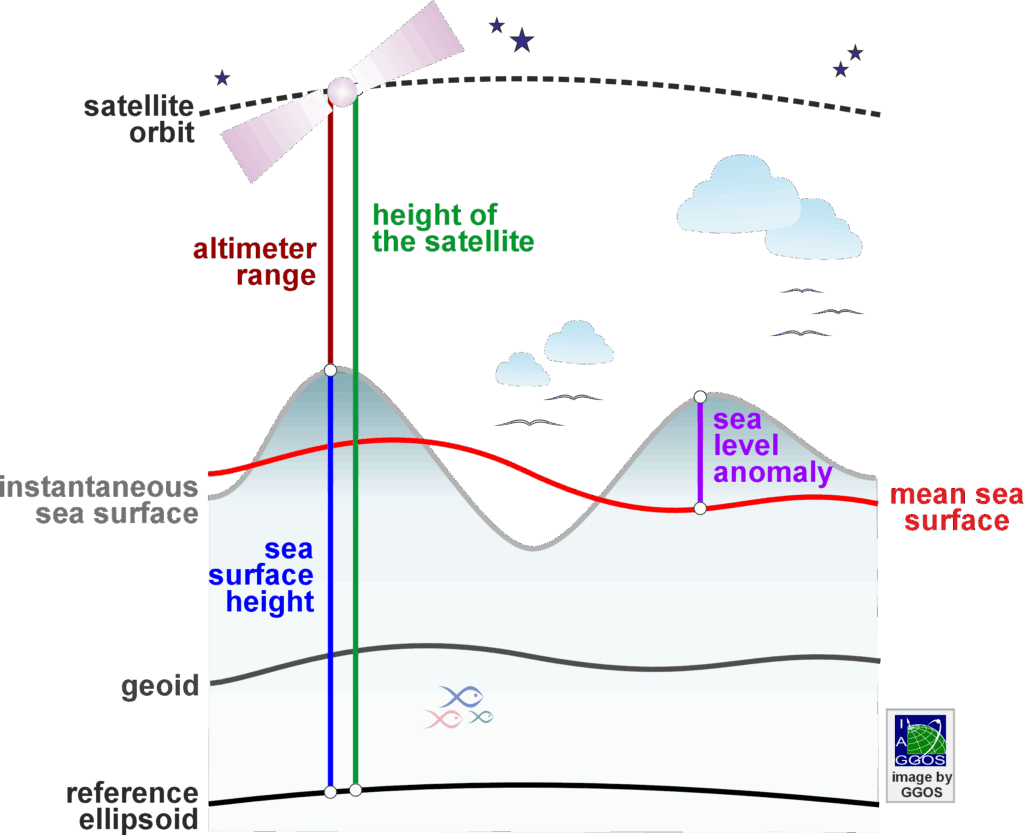
Satellite altimetry systems are designed to map the sea surface. These systems measure the satellite-to-sea surface round-trip travel time of radar or light pulses to determine the height of the satellite (altimetric range) above the instantaneous sea surface. The difference between the satellite altitude above a reference surface and the altimetric range provides the sea surface height with respect to the same reference surface. The range from the satellite to the sea surface is corrected for various components of the atmospheric refraction and to mitigate effects caused by instrumental biases and sea state induced systematics. A number of corrections due to different geophysical effects are also taken into account. Different products are distinguished:

mean sea level sea ocean surface GNSS satellite altimetry orbit ellipsoid
© GGOS (created by Laura Sanchez) Info Info

Definition of various quantities related to sea-surface-heights

Sea Surface Height (SSH)

Sea Surface Height (SSH) is the height of the sea surface above a reference ellipsoid. This is the direct product of satellite altimetry. Sea surface height values are provided along the satellites’ ground tracks or at regular grids interpolated from the values determined along the satellite tracks. Instantaneous sea surface height values contain long-term, annual, seasonal and short-term temporal variations of the ocean surface.

Mean Sea Surface (MSS)

Mean Sea Surface (MSS) is the long-term average of the sea surface height (at least over one year). Usually, ocean tides are reduced from the sea surface height values before computing the mean sea surface. Mean sea surface values are provided at regular grids for different time lengths (typically multi-year mean values).
Sea Level Anomalies (SLA)

Sea Level Anomalies (SLA) are the deviations of the sea surface from the mean sea surface; i.e., SLA = SSH – MSS.
Dynamic Ocean Topography (DOT)

Dynamic Ocean Topography (DOT), also called Absolute Dynamic Topography (ADT) or Ocean Surface Topography (OST) is the difference between the instantaneous sea surface height and the geoid. It contains contributions from high- and low-frequency changes in steric (temperature and salinity) signals, ocean circulation, winds, eddies, and propagating planetary waves.

Mean Dynamic Topography (MDT)

Mean Dynamic Topography (MDT) is the averaged dynamic ocean topography over a time period and it is considered semi-stationary. It corresponds to the ocean relief (therefor, it is also called Sea Surface Topography – SSTop) and the gradient is related to the time-mean surface geostrophic circulation. It is also related to upper ocean density (temperature and salinity) as well as the time-mean currents.

Mean Sea Level (MSL)

Mean Sea Level (MSL) is the local sea surface height averaged over a long period in a certain region. It can be also determined from tide gauge records.

Global Mean Sea Level (GMSL)

Global Mean Sea Level (GMSL) is the mean sea level averaged across all the oceans of the globe. This is usually provided as a time series and used to compute the GMSL trend.

Read More ...
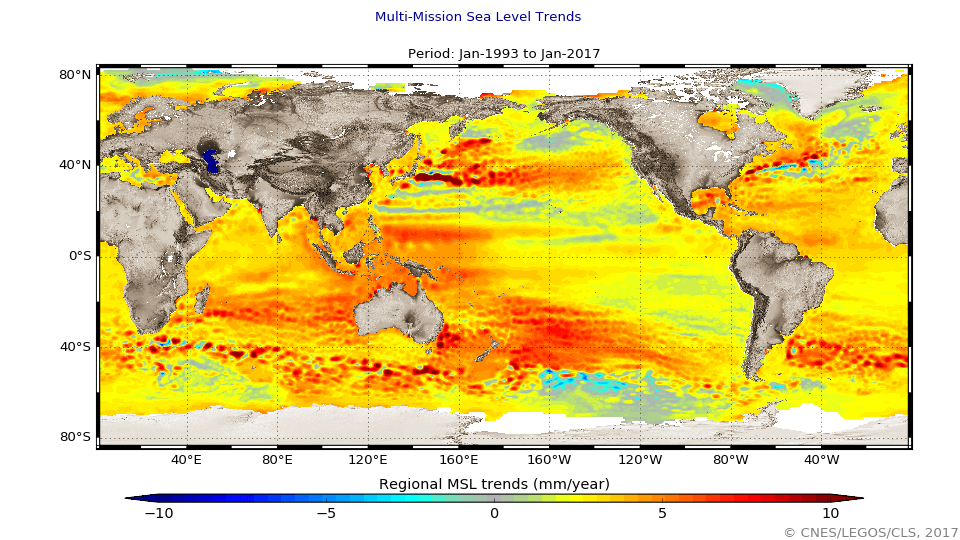
Sea Level Trends mean
© CNES/LEGOS/CLS, 2017 from http://www.altimetry.info/thematic-use-cases/ocean-applications/mean-sea-level/ Info Info

Multi-mission sea level trends (EU Copernicus Marine Service/CNES/LEGOS/CLS, 2018)

Satellite altimeters cover the ocean areas with repeated tracks at repetition rates of some days and permit the estimation of sea surface heights to an accuracy of 1 to 2 cm. The original altimetry data measured by the individual satellite altimetry missions are provided by the responsible space agencies. Some of them also provide pre-processed sea surface heights (so-called Level-3 or Level-4 products). Refined solutions are computed by different agencies, universities and research institutes, who provide their results in grids of few minutes of arc. These products differ with respect to the used data sets, the considered time span, and the processing strategies and methods.

Satellite altimetry enables a nearly global and quasi-continuous monitoring of the sea level with cm-accuracy. The comparison of altimetry solutions referring to different epochs allows the estimation of sea surface and sea level variations, which provide insights in the redistribution of oceanic water masses, thermal expansion and contraction, ocean current variability and eddies, density variations due to water temperature and salinity, atmosphere-ocean coupling, as well as exchange with fresh waters, including melting ice sheets and glaciers.
Selected Data Sources
  • Radar Altimetry Tutorial and Toolbox

    at the European Space Agency (ESA) and Centre National d’Etudes Spatiales (CNES)

  • Ocean Surface Topography

    from Space at the US National Aeronautics and Space Administration (NASA)

  • AVISO+ satellite altimetry data

    at the Centre National d’Etudes Spatiales (CNES) and the Center for Topographic studies of the Ocean and Hydrosphere (CTOH)

  • Altimetric and Ocean Surface Topography Data Information

    at the US National Aeronautics and Space Administration (NASA) and National Oceanic and Atmospheric Administration (NOAA)

  • Copernicus

    European Union’s Earth Observation Programme Copernicus

Share this Product

  • Facebook Facebook Share on Facebook
  • X-twitter X-twitter Share on X
  • Whatsapp Whatsapp Share on WhatsApp
  • Pinterest Pinterest Share on Pinterest
  • Linkedin Linkedin Share on LinkedIn
  • Mail Mail Share by Mail
© GGOS (Prepared by: L. Sánchez, D. Chambers, K. Heki)

PRODUCTS

Reference Frames

  • © TheNounProject (edited by GGOS)
    Height Reference Frame
  • ICRF celestial© TheNounProject (edited by GGOS)
    Celestial Reference Frame
  • © TheNounProject (edited by GGOS)
    Gravity Reference Frame
  • © TheNounProject (edited by GGOS)
    Terrestrial Reference Frame

Earth Orientation

  • EOP Earth orientation parameter© TheNounProject (edited by GGOS)
    Earth Orientation Parameters

Geometry

  • © TheNounProject (edited by GGOS)
    Surface Deformation Models
  • © TheNounProject (edited by GGOS)
    Ocean Topography Models
  • © TheNounProject (edited by GGOS)
    Sea Level Change
  • © TheNounProject (edited by GGOS)
    Digital Elevation Model
  • © TheNounProject (edited by GGOS)
    Ice Sheets & Glaciers – Variations
  • © TheNounProject (edited by GGOS)
    Station Positions & Variations
  • © TheNounProject (edited by GGOS)
    Tide Gauge Records
  • © TheNounProject (edited by GGOS)
    Sea Surface Heights

Gravity Field

  • © TheNounProject (edited by GGOS)
    Global Gravity Field – Models
  • © TheNounProject (edited by GGOS)
    Gravity Field – Temporal Variations
  • © TheNounProject (edited by GGOS)
    Terrestrial Gravity Data
  • © TheNounProject (edited by GGOS)
    Regional / Local Geoid Models
  • © TheNounProject (edited by GGOS)
    Ice Sheets & Glaciers – Variations
  • © TheNounProject (edited by GGOS)
    Height Systems

Positioning & Applications

  • ICON Atmosphere© TheNounProject (edited by GGOS)
    Thermosphere
  • ICON Atmosphere© TheNounProject (edited by GGOS)
    Ionosphere
  • ICON Atmosphere© TheNounProject (edited by GGOS)
    Lower Neutral Atmosphere
  • ICON Atmosphere© TheNounProject (edited by GGOS)
    Atmospheric Products
  • GNSS Orbits satellites GPS GLONASS Galileo BeiDou QZSS IRNSS© TheNounProject (edited by GGOS)
    GNSS Satellite Orbits and Clocks

IAG as part of the IUGG

  
The International Association of Geodesy (IAG)  is a constituent association of the International Union of Geodesy and Geophysics (IUGG).

IAG Related Organisations

IAG collaborates closely with numerous organizations within geodesy and beyond. See the list for details.

Sitemap

  • Home | geodesy.science
  • ⠀└─ 📰News
  • ⠀└─ 📅 Events
  • ⠀└─ 💼 Jobs
  • ⠀└─ 👥 Membership
  • ⭐ About Geodesy
  • 🏛️ IAG | Int. Association of Geodesy
  • ⠀└─ ➡️ Commissions:
  • ⠀⠀◻️ 1 – Reference Frames
  • ⠀⠀◻️ 2 – Gravity Field
  • ⠀⠀◻️ 3 – Earth Rotation & Geodynamics
  • ⠀⠀◻️ 4 – Positioning and Applications
  • ⠀└─ 🔀 Inter Commission Committees:
  • ⠀⠀◻️ ICCT – Theory
  • ⠀⠀◻️ ICCM – Marine Research
  • ⠀⠀◻️ ICCC – Climate Research
  • ⠀└─ ⏰ Project QuGe
  • ⠀└─ ⚙️ IAG Services
  •  🌎 GGOS | Observing System
  • ⠀└─ About GGOS
  • ⠀└─ Structure
  • ⠀└─ Observations
  • ⠀└─ Products
  • ⠀└─ Services

References

Geodesy Glossary

Media Library

IAG Cloud | Public Documents

Terms of Use / Privacy Policy

IAG Statutes

IAG By-laws

Contact Us

Contact

Follow Us

LinkedIn

BlueSky

X (Twitter)

Facebook

Instagram

YouTube

Telegram

RSS Feed

Mailing List

This website is provided by the IAG Secretariat and the GGOS Coordinating Office, which are hosted by the BEV – Federal Office of Metrology and Surveying (Bundesamt für Eich- und Vermessungswesen) in Vienna, Austria.

Website Language Translation

The primary language of this website is English – however, the integrated GTranslate tool enables automatic translation into several languages:

Please note that translations into other languages may not be accurate. For reliable information, refer to the English version of the website.

2026 © Copyright | IAG - International Association of Geodesy
  • Link to LinkedIn
  • Link to Youtube
  • Link to Facebook
  • Link to Instagram
  • Link to X
  • Link to Telegram
  • Link to Behance
  • Link to Rss this site
  • Link to Mail
Scroll to top Scroll to top Scroll to top
Accessibility Adjustments

Powered by OneTap

How long do you want to hide the toolbar?
Hide Toolbar Duration
Select your accessibility profile
Vision Impaired Mode
Enhances website's visuals
Seizure Safe Profile
Clear flashes & reduces color
ADHD Friendly Mode
Focused browsing, distraction-free
Blindness Mode
Reduces distractions, improves focus
Epilepsy Safe Mode
Dims colors and stops blinking
Content Modules
Font Size

Default

Line Height

Default

Color Modules
Orientation Modules