
• Link to LinkedIn
  • Link to Youtube
  • Link to Facebook
  • Link to Instagram
  • Link to X
  • Link to Telegram
  • Link to Behance
  • Link to Rss this site
  • Link to Mail
  • NEWS
  • EVENTS
  • JOBS
  • MEMBER
  • Sitemap
    • Home
      • NEWS
      • EVENTS
      • JOBS
      • MEMBERSHIP
    • ⭐ About Geodesy
    • 🏛️ IAG | International Association of Geodesy
      • About IAG
      • Structure
      • 🎓 ECS – Early Career Scientists
      • 🌈 IDEA – Inclusion, Diversity, Equity, Accessibility
    •   └─ Comissions
      • 1️⃣ Reference Frames
      • 2️⃣ Gravity Field
      • 3️⃣ Earth Rotation & Geodynamics
      • 4️⃣ Positioning & Applications
    •   └─ Inter Commission Committees
      • 📚 ICCT – Theory
      • 🌊 ICCM – Marine Research
      • 🌥️ ICCC – Climate Research
    •   └─ Project QuGe
    •   └─ Services
    • 🌍 GGOS | Global Geodetic Observing System
      • About GGOS
      • Structure
      • 🛰️ Observations
      • 📦 Products
      • ⚙️ Services
  • Shopping Cart Shopping Cart
    0Shopping Cart
geodesy.science - IAG website
  • GGOS
    • Home
      • NEWS
      • EVENTS
      • JOBS
      • MEMBERSHIP
    • ⭐ About Geodesy
    • 🏛️ IAG | International Association of Geodesy
      • About IAG
      • Structure
      • 🎓 ECS – Early Career Scientists
      • 🌈 IDEA – Inclusion, Diversity, Equity, Accessibility
    •   └─ Comissions
      • 1️⃣ Reference Frames
      • 2️⃣ Gravity Field
      • 3️⃣ Earth Rotation & Geodynamics
      • 4️⃣ Positioning & Applications
    •   └─ Inter Commission Committees
      • 📚 ICCT – Theory
      • 🌊 ICCM – Marine Research
      • 🌥️ ICCC – Climate Research
    •   └─ Project QuGe
    •   └─ Services
    • 🌍 GGOS | Global Geodetic Observing System
      • About GGOS
      • Structure
      • 🛰️ Observations
      • 📦 Products
      • ⚙️ Services
  • About
    • About GGOS
      • What is GGOS?
      • Why GGOS?
      • Dual Roles of GGOS
      • Vision and Mission
      • GGOS History
  • Structure
    • Governance & Leadership
      • Governing Board GB
      • Executive Committee EC
    • Coordinating Office CO
    • Science Panel
    • Bureaus
      • BNO – Networks and Observations
      • BPS – Products and Standards
    • Focus Areas
      • Geohazards Monitoring
      • Geodetic Space Weather Research
      • Artificial Intelligence for Geodesy (AI4G)
    • GGOS Affiliates
      • GGOS Japan
      • GGOS D-A-CH
      • GGOS IberAtlantic
    • GGOS Committees & Working Groups
  • Observations
  • Services
  • Products
  • Resources
    • Resources Overview
    • Outreach Materials
    • Logos & Organisation Chart
    • Reports and Articles
    • Presentations and Videos
    • GGOS Meeting Reports
    • Terms of Reference and Strategy
  • Click to open the search input field Click to open the search input field Search
Follow a manual added link
ICON Atmosphere

Lower Neutral

Atmosphere

Official IAG-GGOS Product icon
How can geodesy contribute to weather prediction?

The troposphere and the stratosphere are referred to as the lower neutral atmosphere. It extends from the ground to altitudes at around 50 km, above which charged particles dominate. In general, the refractivity of the neutral atmosphere depends on the density and other characteristics of atmospheric constituents and on the wavelength of the electromagnetic signals. The latter can be neglected for microwaves. The refractive effects on radio signals are typically separated into hydrostatic and non-hydrostatic parts.
Japan
© Arief, S. and K. Heki, 2020 (doi:10.3389/feart.2020.00182) Info Info

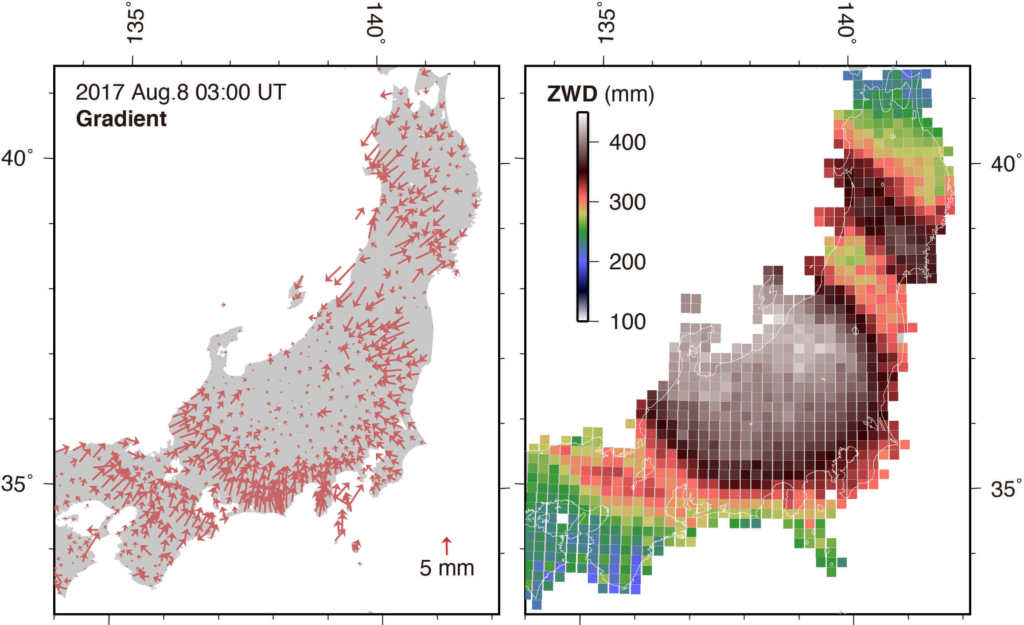
Distribution of atmospheric delay gradients (left) and wet delays (right) when the 2017 typhoon Noru made landfall in central Japan [for more information see Arief and Heki, 2020]

The hydrostatic part can be relatively precisely modelled and corrected on the observation level knowing the atmospheric pressure and temperature at the observer’s position. Zenith hydrostatic delays (ZHD) are mapped into the slant direction of the observed signal through mapping functions. In contrast to the hydrostatic part, the non-hydrostatic atmospheric constituents, mostly water vapor, cannot be simply modelled and corrected. To account for the non-hydrostatic part, the zenith wet delays (ZWD) and the horizontal gradients are inserted into the observation equation system as unknown parameters and are estimated together with other parameters, such as Earth Orientation Parameters and station coordinates. At optical wavelengths (e.g., SLR), the non-hydrostatic contribution is about 70 times smaller and thus typically negligible, whereas the hydrostatic part is about 6% larger than at radio wavelengths (e.g., GNSS, VLBI, DORIS). As an extreme example for atmospheric effects on radio wave propagation, the figure above shows the impact of the typhoon Noru on the distribution of atmospheric delay gradients and zenith wet delays in central Japan. The method for the calculation of the ZWD is described in Arief and Heki (2020).

Read More ...

Comparative studies have shown that ZWD, derived from space geodetic techniques, radiosondes and water vapor radiometers largely agree apart from some remaining technique-specific effects. The current research is on the establishment of atmospheric ties (IAG JWG 1.1.1 “Intra- and Inter-Technique Atmospheric Ties of Commission 1 joint with IAG Sub-commission 4.3 and GGOS”) in order to allow the combination of tropospheric parameters, derived from the individual space geodetic observations. These atmospheric ties could then serve as additional constraints to strengthen the integration of the different space techniques within the ITRF computation.

The ZWDs, slant delays and gradients provide important atmospheric information for weather models. Several international weather centers assimilate ZWD or slant delays. The potential operational usage of gradients is in focus of current research. ZWD has a linear proportionality to the vertically integrated water vapor, which is a key quantity for atmospheric sciences and climate modelling and prediction.

Data Sources

Several of the primary space geodetic technique IAG Services provide troposphere products. The respective webpages for the troposphere products are:

  • IGS - Troposphere

    International GNSS Service (IGS):

  • IVS - Troposphere

    International VLBI Service for Geodesy and Astrometry (IVS):

The website of the Global Geodetic Fluids Center (GGFC) provides a link to the mapping function service of Vienna University of Technology (Austria):

  • GGFC

    Global Geophysical Fluids Center (GGFC)

More products are available on the regional level, such as EUREF, the Regional Reference Frame for Europe, and SIRGAS, the Geocentric Reference Frame for the Americas:

  • EUREF

    Regional Reference Frame for Europe (EUREF)

  • SIRGAS

    Geocentric Reference Frame for the Americas (SIRGAS)

Troposphere products from global and regional networks are available for scientific investigations on special request from E-GVAP (The EUMETNET EIG GNSS water vapour programme):

  • E-GVAP

    The EUMETNET EIG GNSS water vapour programme (E-GVAP)

Further Information

  • Arief, S. and K. Heki: GNSS meteorology for disastrous rainfalls in 2017-2019 summer in SW Japan: A new approach utilizing atmospheric delay gradients, Front. Earth Sci.,8, 182, doi:10.3389/feart.2020.00182, 2020. https://www.frontiersin.org/articles/10.3389/feart.2020.00182/full

© GGOS (Prepared by: M. Schmidt, R. Heinkelmann, D. Angermann, J. Wickert, P. Wielgosz, E. Forootan)
 

Share this Product

  • Facebook Facebook Share on Facebook
  • X-twitter X-twitter Share on X
  • Whatsapp Whatsapp Share on WhatsApp
  • Pinterest Pinterest Share on Pinterest
  • Linkedin Linkedin Share on LinkedIn
  • Mail Mail Share by Mail

PRODUCTS

Reference Frames

  • © TheNounProject (edited by GGOS)
    Height Reference Frame
  • ICRF celestial© TheNounProject (edited by GGOS)
    Celestial Reference Frame
  • © TheNounProject (edited by GGOS)
    Gravity Reference Frame
  • © TheNounProject (edited by GGOS)
    Terrestrial Reference Frame

Earth Orientation

  • EOP Earth orientation parameter© TheNounProject (edited by GGOS)
    Earth Orientation Parameters

Geometry

  • © TheNounProject (edited by GGOS)
    Surface Deformation Models
  • © TheNounProject (edited by GGOS)
    Ocean Topography Models
  • © TheNounProject (edited by GGOS)
    Sea Level Change
  • © TheNounProject (edited by GGOS)
    Digital Elevation Model
  • © TheNounProject (edited by GGOS)
    Ice Sheets & Glaciers – Variations
  • © TheNounProject (edited by GGOS)
    Station Positions & Variations
  • © TheNounProject (edited by GGOS)
    Tide Gauge Records
  • © TheNounProject (edited by GGOS)
    Sea Surface Heights

Gravity Field

  • © TheNounProject (edited by GGOS)
    Global Gravity Field – Models
  • © TheNounProject (edited by GGOS)
    Gravity Field – Temporal Variations
  • © TheNounProject (edited by GGOS)
    Terrestrial Gravity Data
  • © TheNounProject (edited by GGOS)
    Regional / Local Geoid Models
  • © TheNounProject (edited by GGOS)
    Ice Sheets & Glaciers – Variations
  • © TheNounProject (edited by GGOS)
    Height Systems

Positioning & Applications

  • ICON Atmosphere© TheNounProject (edited by GGOS)
    Thermosphere
  • ICON Atmosphere© TheNounProject (edited by GGOS)
    Ionosphere
  • ICON Atmosphere© TheNounProject (edited by GGOS)
    Lower Neutral Atmosphere
  • ICON Atmosphere© TheNounProject (edited by GGOS)
    Atmospheric Products
  • GNSS Orbits satellites GPS GLONASS Galileo BeiDou QZSS IRNSS© TheNounProject (edited by GGOS)
    GNSS Satellite Orbits and Clocks

IAG as part of the IUGG

  
The International Association of Geodesy (IAG)  is a constituent association of the International Union of Geodesy and Geophysics (IUGG).

IAG Related Organisations

IAG collaborates closely with numerous organizations within geodesy and beyond. See the list for details.

Sitemap

  • Home | geodesy.science
  • ⠀└─ 📰News
  • ⠀└─ 📅 Events
  • ⠀└─ 💼 Jobs
  • ⠀└─ 👥 Membership
  • ⭐ About Geodesy
  • 🏛️ IAG | Int. Association of Geodesy
  • ⠀└─ ➡️ Commissions:
  • ⠀⠀◻️ 1 – Reference Frames
  • ⠀⠀◻️ 2 – Gravity Field
  • ⠀⠀◻️ 3 – Earth Rotation & Geodynamics
  • ⠀⠀◻️ 4 – Positioning and Applications
  • ⠀└─ 🔀 Inter Commission Committees:
  • ⠀⠀◻️ ICCT – Theory
  • ⠀⠀◻️ ICCM – Marine Research
  • ⠀⠀◻️ ICCC – Climate Research
  • ⠀└─ ⏰ Project QuGe
  • ⠀└─ ⚙️ IAG Services
  •  🌎 GGOS | Observing System
  • ⠀└─ About GGOS
  • ⠀└─ Structure
  • ⠀└─ Observations
  • ⠀└─ Products
  • ⠀└─ Services

References

Geodesy Glossary

Media Library

IAG Cloud | Public Documents

Terms of Use / Privacy Policy

IAG Statutes

IAG By-laws

Contact Us

Contact

Follow Us

LinkedIn

BlueSky

X (Twitter)

Facebook

Instagram

YouTube

Telegram

RSS Feed

Mailing List

This website is provided by the IAG Secretariat and the GGOS Coordinating Office, which are hosted by the BEV – Federal Office of Metrology and Surveying (Bundesamt für Eich- und Vermessungswesen) in Vienna, Austria.

Website Language Translation

The primary language of this website is English – however, the integrated GTranslate tool enables automatic translation into several languages:

Please note that translations into other languages may not be accurate. For reliable information, refer to the English version of the website.

2026 © Copyright | IAG - International Association of Geodesy
  • Link to LinkedIn
  • Link to Youtube
  • Link to Facebook
  • Link to Instagram
  • Link to X
  • Link to Telegram
  • Link to Behance
  • Link to Rss this site
  • Link to Mail
Scroll to top Scroll to top Scroll to top
Accessibility Adjustments

Powered by OneTap

How long do you want to hide the toolbar?
Hide Toolbar Duration
Select your accessibility profile
Vision Impaired Mode
Enhances website's visuals
Seizure Safe Profile
Clear flashes & reduces color
ADHD Friendly Mode
Focused browsing, distraction-free
Blindness Mode
Reduces distractions, improves focus
Epilepsy Safe Mode
Dims colors and stops blinking
Content Modules
Font Size

Default

Line Height

Default

Color Modules
Orientation Modules